 Netwrck
Science Fiction.
The House with a Fever
Every door in the Museum of Bravery opened somewhere else.
One showed a woman stepping onto a frozen lake with a rope tied to her waist. Another revealed a city lit beneath the sea, where children ran barefoot through streets of blue glass. Nera had tended the museum for eleven years, cleaning brass hinges and replacing the little brass labels when visitors argued over what counted as courage.
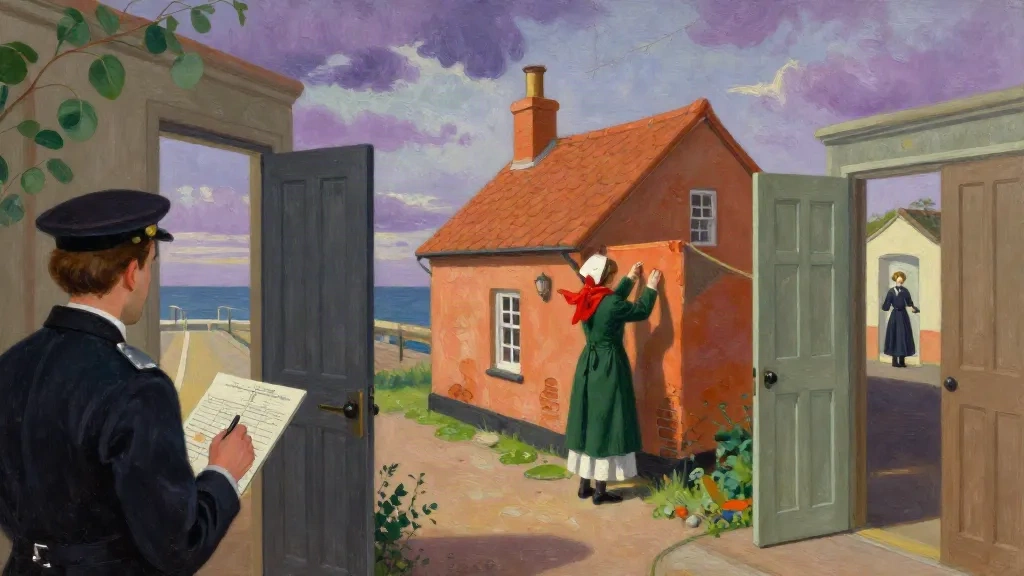
On the afternoon the red scarf appeared, a house at the end of Gallery Seven began to cough.
It was a narrow terracotta house, its eucalyptus shutters tapping against the walls. A red scarf hung from its chimney, bright as a warning in the bruise-purple sky. When Nera entered, the floorboards breathed dust.
“Homesickness,” she said.
Inside, the rooms had been packed for departure. Blue cups stood upside down in the sink. A child’s shoes pointed toward the front door. On the table lay a train ticket, its paper softened by many hands.
The house shuddered.
“Who is leaving?” Nera asked.
A kettle replied from the kitchen, thin and furious. “Everyone. That is how houses become empty.”
Nera found its patient in the attic: a young man named Ilyan, seated beside a trunk with his hand over his mouth. He was staring through a round window at a platform far below.
“My sister sold the orchard,” he said. “She took the red scarf. She has gone to the coast.”
The house made a terrible, settling sound.
Nera touched its wall. Its pulse raced beneath the plaster. She could smell eucalyptus, hot iron, and the green cold of rain that had not yet fallen.
The Stationmaster’s Error
At the museum gate stood a small stationmaster in a lacquered black coat. His name was Orren, and he had the permanent expression of a man correcting arithmetic.
“There is a mistake,” he told Nera. “The departure at 4:17 has been recorded incorrectly.”
“There is no departure at 4:17.”
“Then the station is mistaken.” He tapped his timetable. “Endings require a cause. A door shuts because someone closes it. A person leaves because they were expected to leave.”
Nera showed him the ticket.
Orren’s face softened. “One-way?”
“The return has been torn off.”
“Then the relationship has a scheduled duration.”
He offered her a silver punch. Nera refused it and went to find the missing half of the ticket.
She found it beneath Ilyan’s bed, folded around a small square of paper. On it, his sister had written: I cannot forgive you for staying.
Ilyan folded the paper until it disappeared. “She thinks I traded her future for this house.”
“Did you?”
“I stayed when our father died. She wanted me to leave with her.”
The house groaned. A shutter flew open. Through it came a glimpse of the coast: white cliffs, a red scarf caught in thorn bushes, and a girl walking away beneath a sky the color of bruised fruit.
Repair Before Morning
Orren began rearranging the museum’s door labels. He declared that the red door led to courage, the blue door to endurance, and the narrow terracotta door to “an administrative error.”
Nera climbed onto the roof and cut the scarf free.
The house immediately exhaled. Dust lifted from every room. Nera wrapped the scarf around the chimney, tying it in a knot that had resisted weather for forty years.
Below, the front door began opening by itself.
On the platform beyond, the girl appeared.
She was younger than Ilyan remembered. Her coat was covered in orchard dust, and the red scarf’s absence left her shoulders bare to the cold.
“I thought you would follow me,” she said.
Ilyan stood behind Nera, unable to cross the threshold.
“I thought you would wait,” he answered.
Orren consulted his timetable. “The reconciliation is not punctual.”
“Neither is grief,” Nera said.
She placed the torn return ticket in the girl’s hand.
The house drew breath. Its walls warmed. Somewhere below, the blue cups began to sing.
The girl looked at her brother. “I did not sell the orchard.”
“I know,” he said. “You divided it.”
“Half for you.”
“Half for us.”
He crossed the threshold. She met him halfway.
What the Doors Remember
At 4:17, the stationmaster found Nera in Gallery Seven.
The terracotta house had settled into a new shape. Its front door was open, not onto a journey, but onto a kitchen where two people were arguing over tea.
“There,” Nera said. “Courage.”
Orren frowned. “That is not in the catalogue.”
“No.”
He watched the brother and sister carry the red scarf between them.
“Then perhaps the catalogue requires revision,” he said.
For the first time in his life, he crossed out a departure.
The house stopped coughing. Its walls kept the scent of eucalyptus, terracotta, and rain. Through the doorway came the small clink of a spoon against a cup, the ordinary sound of a home making room for someone to return.
Nera closed the museum door gently.
Not every ending was a scheduling error.
Some were only a story waiting for its second speaker.





