 Netwrck
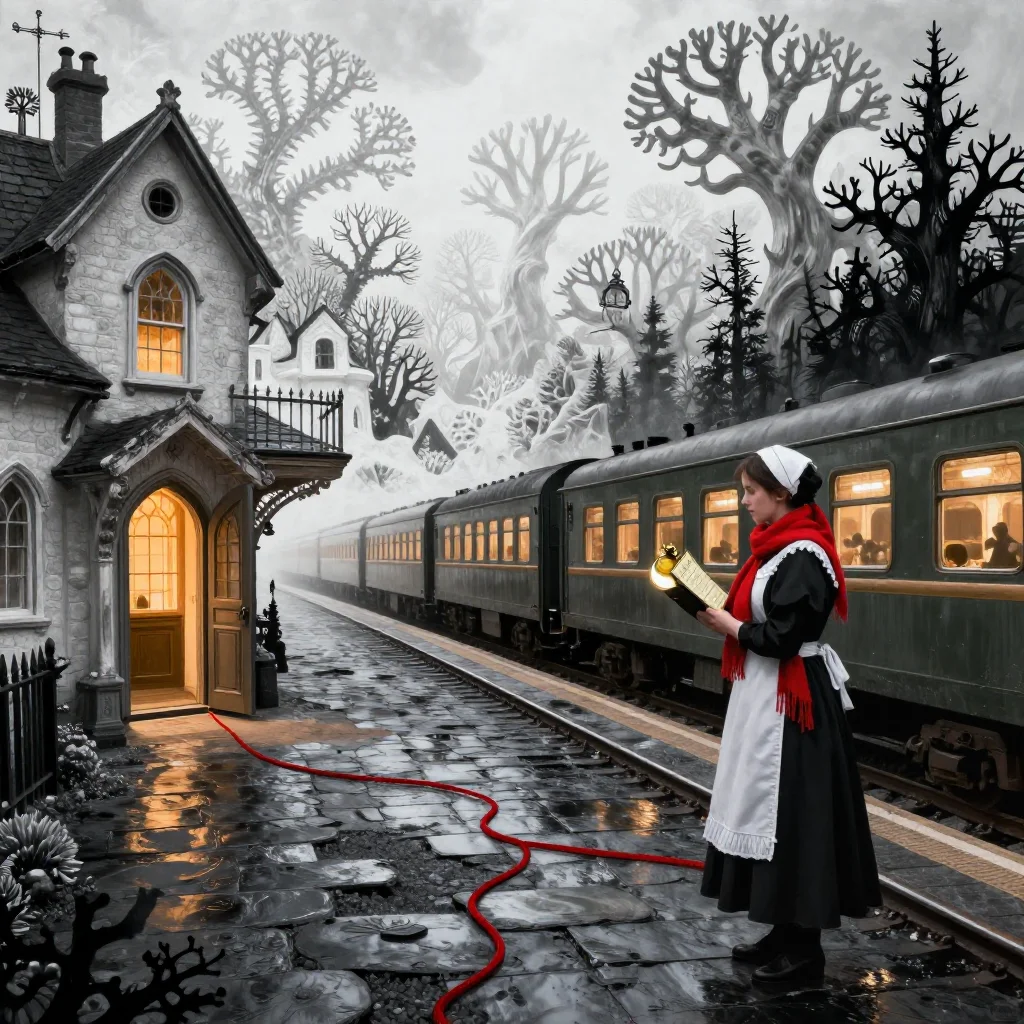
Gothic Fantasy.
The House with a Departure Board
On the rainy morning Mara Venn entered the Museum of Doors, the red scarf around her neck was already fraying. She had tied it herself that morning from a skein left in the chapel basket, though the wool had no name and the thread inside it glowed like a vein under winter skin. She did not know whose skein it was. She never did. That was the price of the work: a thread that carried what people could not say would not keep the names of the people who dropped it.
The museum occupied a narrow station beneath the hill, and its galleries were filled with thresholds. A blue arch opened onto a battlefield where no soldier had yet spoken. A narrow green door led to a field of stubborn poppies. A polished staircase descended into the courage to say no. Every threshold bore a brass plate, and every plate, visitors whispered as they passed, held a destination that had forgotten its name.
Mara had not come for the doors. She had come for the house at the end of the east corridor.
It was a modest dwelling with white coral walls, a slate roof, and a kitchen window fogged from the inside, as though someone had breathed against it a moment ago and stepped away. The house had come to her the winter before, crying down its chimney in a voice like a child swallowing seawater. Homesick, Mara had diagnosed, and she had been glad of it, because homesickness she knew. Homesick houses she warmed at the foundations. She mended their loosened bricks. She persuaded them, patiently and in plain language, that the people who had left were not evidence they had been abandoned.
Her brother said the work made her hard. He said it the winter their mother died, and Mara had not forgiven him for it, and she had not been able to explain the difference, because the difference was this: a house can be mended because someone brings the mending. Her mother had not been brought.
This house wanted no such comfort.
On its kitchen table lay a departure board, brass-edged and ticking, the way a clock ticks when it is working hard. The words changed while she watched.
PLATFORM FOUR. THE 9:17. ONE PASSENGER WILL ARRIVE TOO LATE.
She knew the voice at the stove before she turned around.
“You cannot keep me here by mending the windows,” said Elian, setting down the poker. He was the stationmaster of the museum and the only man in the building who believed its doors should be operated like trains. He carried a timetable in his coat pocket and corrected the hands of clocks wherever he passed. In winter he walked with his hat brim low, listening for the tick of things that could still be adjusted.
Every Ending Is a Mistake
Elian held that endings were scheduling errors. Death, departure, even the final closing of a door, he said, was the consequence of somebody failing to publish a revised notice. He had arranged the museum’s departures for thirty years. When a visitor came out of the battlefield arch unwilling to have fought, he gave the arch ten extra minutes. When the poppies opened, he held the next train. When the green door shut behind a woman who had at last found the courage to walk out of her village, he entered it as an administrative delay and gave her three days to reconsider.
She had used the three days to walk back.
Her name was Wenna, and her sleeve was scorched to the elbow now, and she stood in the doorway of the east corridor with rain in her hair, and she said, without greeting, “I heard there is a departure tonight.”
Elian did not turn around. “There is always a departure tonight.”
“It will not be for me.” Wenna came further in. The scorched sleeve smelled of a house fire. “I waited three days, the first time. Do you know what I did with them? I went home to a house that had been waiting to be forgiven, and it burned while I slept, because houses are not forgiving, they are only patient, and patience has a limit, and you spent mine.”
Mara felt the house behind her flinch. Every house in the museum felt a thing like that; she had watched them lean toward a raised voice and away from a closing one.
Elian took out his timetable and smoothed it on the table edge, over the brass. “I delayed her three days. Three days is a kindness measured in hours. What I withheld was a year. I have read the schedule again since. A year is not a delay, it is a suburb.”
“It was her year,” Wenna said, and left.
And that was the whole of Elian’s defence, offered to an empty room: he had read the schedule again. Mara had tended thirty-one houses in nine years. She had never once known a building to say that it did not mind being mended. It was the only sentence she wanted to hear, and no house had ever offered it.
She turned her attention to the woman at the table.
She and her father had quarrelled through the last summer and most of the winter after it. He was Ilyan, who had driven four hundred miles that autumn to sit with her at the table again and had knocked twice and gone away when she did not answer. Her mother Ovelle had died four years earlier, and the quarrel was about blame, and neither of them had ever been wrong, which was the difficulty. Nessa believed her father had hidden behind his grief. Her father believed his daughter had. Both of these were partly true, and neither of them was the whole of it, and so they had used up every sentence available to them on the question of who had been owed an apology, and never once on the question of what they actually wanted.
She stood beneath the departure board now with a length of red thread knotted at her wrist. On the table between them lay a train ticket, its destination scratched out with something sharp.
“I am leaving before he learns to say it,” Nessa said, watching the board change. “That is the difference between us. He will get there eventually. He is slow, but he will get there, and by then I will have made it so there is nothing to say it to.”
The house shuddered. A brass plate slid from the wall and fell into the fire.
At that moment the east door opened onto a railway platform under a white coral sky. A train waited without smoke or engine. Its carriages were made of salt, translucent and faintly wet, and the windows reflected rooms that did not yet exist yet — a nursery, a kitchen, an argument in progress from four summers ago, all of them lit from the inside by a lamp someone had carried out and never set down.
Elian stepped forward. “There,” he said. “I have located the error.”
The Wrench in the Timetable
Mara went to the table and set two fingers on the board. It was warm the way fever is warm, and under her fingers the letters shifted, and the board showed its next line with the slow honesty of a thing that cannot be argued with.
PLATFORM FOUR. THE 9:17. PLATFORM SEVEN. ONE PASSENGER WILL ARRIVE TOO LATE.
“The door is not the error,” she said. “The door is the timetable working. It is the house doing what houses do when the people in them have nothing left to say to each other. It is packing.”
“Then hold the departure.”
“You cannot. This is the last scheduled door in the museum. After tonight nothing leaves this platform at all. Everything the museum still owes travels out of here on this train or it stays where it is.”
Elian considered this with visible pain, because it was exactly the kind of fact he could not accept, and because being right about it was not the same as being able to use it. He set his watch against the ticket on the table. The hour advanced. The salt carriages rang their bell once, thin and enormous.
In the walls, plaster loosened and folded itself into narrow strips, each printed with a sentence.
Mara read one. I forgive you. I never blamed you. I have been waiting four years for a question I did not know how to ask. She read the next. Do not come. Do not come. Do not come. The next. Tell them about the money. Tell them about the money. Tell them about the money.
None of them were the sentence this house needed. They were ten years of everything swallowed, pressed flat and hung up like linen, and a house could not sort them, so it packed them all.
“You see,” Elian said. “It is a delay. Things are in transit. They have not arrived.”
“They are not in transit. They are in storage.” Mara put her palm flat against the wall, and it was warm, and it was not leaving. “It is not abandoning them. It is folding itself small enough to be carried off by one person.”
She went along the corridor to the room where a father and daughter had once argued, and found that the house had done the one thing she had not counselled against, which was to prepare. The carpets were rolled. There was a lamp packed in cloth. The mantel had been cleared to nothing.
Under three layers of warped floorboards, in the space houses keep for what they are not allowed to say on the walls, she found it.
What the House Said Aloud
Not the apology Nessa wanted. Not the defence her father needed. Something smaller and worse: the truth of the wait. Both of them had been waiting for the other to make leaving feel like a choice instead of a punishment. Each had offered the other an exit instead of a reason, and each had read the exit as a door being shut in their face, and each had been right, and neither had been wrong, and they had both gone on being right for four years because being right was the last warm place in the house.
Elian had followed her and stood in the doorway with his hands behind his back, unusually quiet.
“You could publish a revised notice,” he said at last. “A notice. I have the forms. A revised notice is not a lie, it is a correction. It is what the board is for. I can have this train at nine forty-one and everything in the corridor will be addressed.”
“You can move the train,” Mara said. “You cannot move what is unsaid into a train.”
“Everything is a train, if you are the one holding the key.”
“Then you have been holding the keys to other people's houses for thirty years, and they are all still shut.”
He did not answer. Down the corridor the packed walls creaked, and the strips of plaster swung a little on their nails like flags in a wind that had not arrived yet, and somewhere far off a bell rang nine times and then, unaccountably, seven more.
Mara looked at the strips again and thought about her own. There was one she had carried for eleven years, folded in the lining of her coat, in her handwriting, in a moment of bad confidence: I forgive you, and it is not enough, and I am saying it anyway. She had written it in her mother's kitchen the night after the funeral and had put it in her coat because there had been no envelope in the house, and she had never given it to anyone, and it had been in her coat for every mending since, through thirty-one houses, and no one had ever been asked to read it, and no one had ever been late for anything.
She did not show it to Elian. She wanted to. That was the whole of her knowledge of herself that night, and it was more than she had brought to the room.
The Last Scheduled Door
She called them both into the room, and they came because a house that has stopped holding still has the authority of a summons.
Nessa held out the ticket. Her father took it and looked at it as though it were a map, which is what it was: not a place but a distance, drawn in a clerk's hand, with the destination removed by a person who could not bear to be a liar on paper.
“If you go,” Mara said, “go because you chose the road. Not because the hurt set the timetable.” She took the red thread from her own scarf — the last long length of it, the glowing length, the unspooled year of it — and put it in Ilyan's hand and closed his fingers on it. “She has had four years of the choice taken away by you. Do not take it away tonight by making it for her.”
He looked at the thread, and then at his daughter, and Mara watched him arrive, four years late, at a sentence that was not the apology. “I have been waiting for you to forgive me so I could say I did not care,” he said. “I have been waiting so long that I no longer remember what I wanted before the waiting.”
Nessa's face did something Mara had only seen houses do. It folded, and then it held.
“I do not forgive you,” she said. “I am going anyway.”
And that was the arrangement. No apology, no absolution, no reconciled evening. The house, which had been holding its breath for a decade, let it out through every wall at once, and the coral brightened, and the packed strips of plaster released and fell to the floor like the last of a light snowfall indoors.
What the Door Kept
At midnight the train waited. The platform number stood at four. Elian stood beside its open door with his timetable hanging from his wrist, and for a long moment it looked as though he would do what he had always done, and add the three days, and the three years, and the whole remainder of a life spent in the useful business of delay.
Then he stepped aside. “It is not my board,” he said. “I have only ever been its reader.”
Nessa kissed her father's forehead, and he pressed the blue scarf into her hands, and she tied the red thread around the handle of her case, and the salt carriages took the light from the platform the way water takes a stone.
Nessa boarded. The train moved without a sound, and the platform number changed from four to seven.
“A substantial delay,” Elian said, in the voice of a man keeping a record.
Wenna stepped out of the dark at the edge of the platform. Her scorched sleeve, Mara thought, had been put out in a fire that took a house. She had come back for the departure she had once been refused, and the board, which had warned of a passenger arriving too late, had been keeping its own appointment long before any of them arrived.
Wenna boarded without looking at anyone. The doors closed. The platform went out from the far end, like a corridor light, one room at a time.
Elian watched until there was nothing to watch, then took out his pen and wrote in the last column of his timetable, in the small upright hand of a man who has spent thirty years being right about the length of things: Departed. Destination not recovered. Platform: four. Cause: I was late.
Then Mara looked back, and the museum was not the way they had left it. In the gallery of thresholds, the blue arch had closed to a seam. The poppies had stopped. The staircase up to the courage to say no had been folded away and stacked against the wall like boards. What was left was a row of shut doors and bare brass, and the plates were blank, and one by one, as the wind moved along the hill, the brass began to go dull.
The house at the end of the east corridor stood white and solid and quiet, with its kitchen window clear for the first time in four years. It would not be homesick again. Mara understood, walking out, that she had been mending a roof over a silence, and the silence had been the load-bearing wall, and now the whole thing stood up on nothing at all — on two people who did not forgive each other and a daughter who was going to a place whose name had been scratched out. It was not a solution. It was the first arrangement that did not require anyone to lie.
Only the red thread remained, stretching from Mara's fraying scarf through the corridor, across the salt platform, and into the window of the departing train. It held longer than the train itself, longer than the station, and where it crossed the doorway it hummed faintly, the way a wire hums when something is travelling along it. Mara felt it pull once — a single, specific tug, like a hand at the sleeve, and she understood that there would be a letter, or there would not be one for a year and then a ticket stub with a date and no destination, and that either would be the truth, and that she had no standing to want a particular one.
When the thread broke, she did not follow it.
Some doors, she had come to believe after thirty-one houses, are not made for leaving. They are made to show you where love went, and how much of it came back, and in what condition.





