 Netwrck
Weird Fiction.
Hinges for the Unbuilt
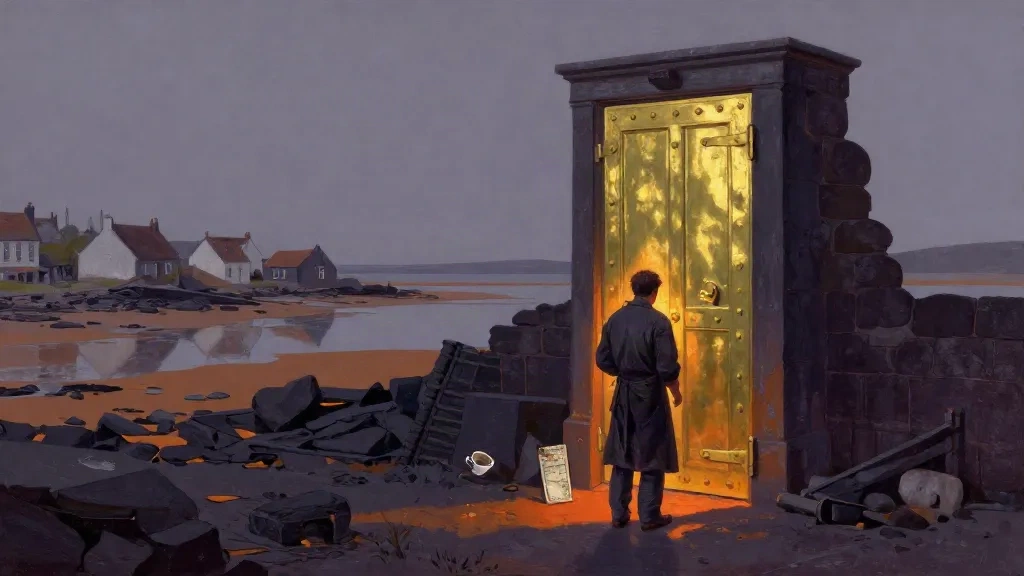
By the time Mara reached the slipway, the saffron tide had withdrawn far enough to expose the old foundations of Bellweather: black stones, barnacled pillars, the ribs of a ship no living resident remembered launching. Smoke-grey air pressed against the roofs, carrying the smell of salt and hot iron. She set down her hammer before it could strike the rust-streaked door leaning between two seawalls.
The door was twelve feet tall. It had no frame, no hinges, and no house behind it.
On its brass face someone had painted a white arrow pointing inland.
Mara did not touch it. Across the mud, Mayor Pell watched from the pier with his tax ledger closed beneath his arm. He had a way of holding a book like a shield.
She had come to Bellweather because of a door like this one, and she had not admitted the reason aloud in four days. Four days earlier her father had stood in her workshop doorway with his right hand shaking, and asked her to go north without her. He had repaired locks for houses built on unstable cliffs for thirty-one years, and he had a name for what he did that she had never once respected. Anhalt work. You find the weight a thing was meant to carry, and you let it carry it. The year before, a house at Kell's Rest had begun sliding toward the water, and its owner had asked for a door hung on the seaward side. Abel Anhalt had looked at the walls, and the tilt, and the way the salt had already entered the hinge seats, and he had refused. He had refused in front of the owner, in front of the family, and in front of his daughter. The house went into the sea in March. Nobody drowned. Nobody thanked him either. Since then his hands had not been steady, and he had sent Mara to Bellweather with a list of names and no explanation, and she had stood in four rainstorms rather than ask him why.
Now the tide had offered her a door that asked for nothing but work.
On the door's lower edge rested a train ticket.
The ticket was dry despite the salt. Its departure station had been scraped away. Its arrival platform showed a number instead of a name.
On the pier rail sat an empty teacup.
Neither object belonged there. The tide had returned them separately, and that meant the sea was assembling an argument.
The Price of Knowing
Pell crossed the mud with exaggerated care, choosing each stone as though the mud might invoice him. He had governed Bellweather for nine years and gained the paunch of a man who eats other people's arithmetic. Behind him the two council guards, Teodor Vance and Nell Brack, stayed at the pier head with a sheet of lead canvas folded under Teodor's arm. Newly returned objects were covered before they could acquire a name. Mara had seen the regulation painted on the wall of the Ferryman's Office, in a hand that had never needed to be corrected twice.
The tide is not obliged to explain itself, and neither is the Council.
“You may not repair that door,” Pell said.
“You may not close it.”
“It has no owner.”
“Then it has one now.”
He glanced toward the empty teacup, and for the first time his composure failed him, which she catalogued the way she catalogued a warped wheel: not a flaw, but a defect that would spread.
“Bellweather has prospered because the town remains unfinished,” he said. “Every question answered closes a route. Every returned thing given its meaning becomes ordinary.”
“And every mystery you own becomes a tax.”
“A tax keeps people alive.” He held the ledger tighter, and this time she understood the gesture. Not a shield. A wage. The ledger balanced the water rate against the winter bread against the coal for the widow of Lantern Row, who stored the names of drowned children in a locked room and was eighty-one and would not last the frost. Pell's mystery was not a metaphor. It was a budget line, and he carried it the way her father carried the good awl he never used on a customer's word.
Behind them, the town climbed the hillside in crooked terraces. Smoke-grey curtains moved between the chimneys. In the market square, shutters opened and closed as merchants displayed copper buttons, sealed jars, and souvenirs cut from unnamed stones. Bellweather looked prosperous because it sold the right to wonder.
Mara lifted the ticket. A date emerged under the salt: tomorrow.
“What happens at platform seven?”
“Nothing.”
“That is not an answer.”
“It is the only profitable one.”
The empty teacup chimed. No one had touched it. The note it gave was thin and true, the note her father had taught her to hear for a hinge that would hold weight and a hinge that would only hold shape.
Mara looked into its bottom and saw a reflection of the door, though the door faced the sea. In that reflection the door stood inside a house with windows full of stars. A woman sat beyond the glass, pouring tea into the cup Mara now held. The woman raised the cup toward her own mouth, but no steam rose.
“Is that the future?” Pell asked. He had stepped closer, and his voice had gone thin as wire.
Mara understood then why he feared the door, and it was not for the reason the council minutes would give. The town's power did not come from keeping the past mysterious. It came from keeping the future unearned. If the door opened, every resident might choose a tomorrow, and Bellweather would lose the right to decide for them. Which meant: no more arrivals at platform nothing, no more sold bells, no more names held in trust for people who cannot pay. Twelve families in the lower terraces earned their winter in wonder. Sim Unner mended umbrellas nobody needed, in a stall that sold only the story of a storm that never touched Bellweather, and he had told her on her second day that his eldest daughter was seventeen and that the wonder trade fed her.
She had repaired Bess Oren's door in her third year of work, a door that opened only when the town rang its bells at midnight. The council had sold the bells in her fourth year, for roof money, and Oren's door had not opened since, and Oren had stopped speaking to Mara, which was unfair, and true.
Mara set the ticket down and placed it beneath the empty teacup, lining the two things up the way she lined up a hinge and its plate.
“I came here to ask you for passage,” she told the door. “I stayed to repair what your hinges have forgotten.”
What the Tide Insisted
Pell raised a brass whistle and did not blow it. He held it up, and the gesture was worse than sound: it told the square that the Council was still the hand. Teodor and Nell came down the pier, the lead canvas swinging between them like a flattened sail, and the smell of it reached Mara first, that particular grey nothing that smelled of a room where nothing had ever been permitted to be a room.
Mara lifted her hammer.
The tide began to rise.
It came without a sound at first, a saffron wall leaning against the horizon. Then it struck the seawall and filled the slipway with reflected windows, and every window showed a room Mara had not been in. The black foundations disappeared first, then the ribs of the ship. The teacup took dark water and did not overflow. The ticket clung to the door and beat like a wing against the timber.
“Do not open it,” Pell shouted. “You will lose the ending you were promised.”
Mara drove the first hinge pin into the timber. The metal screamed, and the sound was the most honest thing she had heard in Bellweather.
She thought about her father, and not kindly. She thought about the seaward door at Kell's Rest, and how she had watched him refuse, and how she had spent a year being proud of the refusal in the way you are proud of a stone in your boot. The old rule was simple and it was the only sermon he had ever owned: do not force a door. Find the weight it was meant to carry. Bellweather had spent generations teaching her the opposite, that doors were excuses, endings were authority, and uncertainty could be sold by the ounce, and had made a woman of ninety who watched the sea come in and said nothing, which was the loudest kind of sale there is.
The second pin sank. The door took the weight without complaint, the way a good door does, and Mara felt the exact moment it stopped being an object and became an obligation.
The guards reached her. Nell tore the ticket from the door, and the paper split along the scrape where the departure station had been, and out of the split came a smell of hot rails and summer orchards, so vivid that Mara's mouth filled with the taste of a platform she had never stood on. Teodor knocked the teacup into the tide. It broke cleanly, once, and the fragments floated around her boots like a necklace of dark moons and did not sink.
She put the ticket back together with two fingers, which was possible, because the tear had run the way good paper wants to be folded.
“You can't choose for me,” Pell said. He had stopped shouting. Quiet had always been the expensive part of him.
“No.” Mara drove the final hinge pin home, and the door took it, and the tide rang the whole assembly like one struck bell. “But neither can you choose for me.”
The door opened inward.
Beyond it was not darkness and not another street. A platform stretched across the black water beneath a saffron sky, its lamps lit in a long line toward a train with every window burning. On the nearest carriage door a chalked numeral had replaced the station name. The platform was not empty. She counted nine people standing along it, spaced the way people space themselves when they are unwilling to be neighbours, and not one of them turned to look at her, which told her this was a service and not a miracle.
Bellweather was nowhere in the reflection.
Platform Seven
The train sounded its bell. Mara looked back, and Pell and the guards stood rigid on the pier with their outlines going soft at the edges, smoke-grey air moving through them the way it moves through a shuttered room. Behind them the town appeared, but only as a diagram: neat roofs, closed gates, every window facing inward.
At her feet lay the empty teacup, intact again, still half full, the dark water in it perfectly level although the train and the tide and the door were all moving. She understood the arithmetic of it now. The sea had given her three objects and the town had given her one argument, and a hinge could only be fitted where there was something to swing against. Board the train and the mystery stays with the town, and the town will close it. Stay and the door shuts, and the tide returns the cup and the ticket tomorrow, as it returns everything, and the whole enterprise becomes a merchant's argument about wonder, priced by the ounce.
She put the ticket in her pocket and left the cup on the platform.
Then she stepped aboard without sitting down.
Behind her the door slammed. The hinges held.
As the train pulled away she saw Pell running along the shore, his ledger under his arm, and the wind tore the pages loose from it. The pages came up over the saffron water as pale birds, circling, and one struck the teacup on the platform, spun it once, and vanished into the cup as though it had been written there.
Mara remained standing.
The Line That Ran Past Bellweather
The conductor was a wide woman with salt in the seams of her coat and a punch the size of a fist. She came down the aisle without hurry, and each passenger she passed received the same two taps, and each passenger flinched at the second, as though the sound were the fare and not the receipt.
At the window seat she stopped.
“Name the house,” she said.
Mara had the ticket out before she understood the question. The paper was warm now, and the arrival platform had changed from a number to a blank, the way a name is rubbed out when a place decides to be inconvenient.
“Kell's Rest,” she said, and then heard herself, and understood what the ticket had wanted. Not a house that existed. A house she had refused to hang a door for, in front of an owner who had gone on standing in the surf all afternoon, waiting.
“That one has an owner,” the conductor said. “The fare is for houses that don't.”
Then the train began to move, and Bellweather came to her sideways.
It came at window speed and wrong. First the slipway, grey and emptying. Then the market square, and Mara counted the shutters, and counted them again, and could not tell whether they were shut or merely unremarkable, which was the difference between a bad harvest and a town with nothing to sell. A man in a copper-button stall was stacking his buttons into a bin and not selling them, and she saw him put his hands in his pockets to keep from arranging them, and she thought of what he had told her about his eldest daughter and felt the floor of the carriage go further away than the floor.
Sim Unner had stood in that square for forty years selling a storm that had never come. His wonder was not a metaphor either. Twelve families in the lower terraces had winter in it.
The train showed her the water rate, too, in a way: the slate roofs going dark in patches where the moss had been let grow over a season nobody would need to mend it. It showed her the pier, empty, the brass whistle on its nail. It showed her Pell standing in six inches of rising water with the ledger gone to birds, holding a door that had already shut, and doing what she would have done if her father's hands had failed on a job: standing very still, waiting to see what the weight was.
Then the town slid away, and what she had done came up to meet her without ceremony.
She had been the hinge. That was the whole of it. A door out of place was still a door, but only so long as somebody stood in front of it who would refuse to let it be explained. She had wanted passage, and the tide had wanted a witness, and both of those were honest, and neither of them had been about the people on the lower terraces. Her father had refused a commission and called it principle. She had climbed aboard a train and called it a repair.
In her pocket, the ticket was blank, and warm, and waiting.
The Woman With No Steam
At the fourth stop the carriage emptied down to three and a man with a surveyor’s chain across his knees. Mara sat down for the first time since Bellweather, and the seat took her weight the way the door had, without complaint, which she noted, because she was her father’s daughter and could not stop noticing what held.
The cup was on the table between them.
It had come aboard. She had not seen it come aboard. It sat on the varnished wood with its handle turned toward her, full of a dark tea that gave off nothing, and in its surface the window showed a house with stars in its glass and a woman pouring.
Mara put her thumb on the rim. It was warm, and it was the same weight as the one she had left standing on platform seven, and she understood, with a coldness that had nothing to do with the carriage heating, that leaving the cup had been the fare, and that the fare had been taken anyway.
“You are going to ask her,” said the woman across the table. She had appeared without the carriage door moving, which Bellweather would have confiscated. Her fingers were stained to the second knuckle, the way a tinner’s are, or a woman’s who has spent a long time with a lamp.
Mara looked at her hands and did not lie. “I am going to repair the hinges.”
“You are going to find out what they carry.”
The woman turned the cup. “Ask, then. Everyone asks. I have been asked eleven thousand times and I have never once been told the truth, and you are no better than the rest, though yours is a better hammer.”
Mara had learned, in a workshop at the top of a stair above a chandler’s, that a question asked in a hurry is a hinge being forced. She set the hammer on the table. She had carried it four days up the coast and had not once put it down.
“What did your door belong to?”
“A house,” the woman said, “with a woman in it who chose.”
“Was it worth it?”
The woman poured, though the cup was already full, and the level did not rise.
“No one has come back to tell me.”
Outside, the saffron water ran flat and featureless under a sky that had begun, very slightly, to lighten at the edges, the way a sky does at the hour when a person who has not slept decides that morning is an opinion they are willing to hold. The conductor’s punch sounded once somewhere behind Mara, at a ticket, and the second tap did not come.
Mara thought about her father’s hands. She thought about Sim Unner’s hands, going into his pockets, to keep from arranging a display that no longer meant anything. She thought about Bess Oren, eighty-one years old, in a room of locked names, who would keep them anyway, out of what would now be habit rather than instruction, and who had every right to. She thought about the man on the shore holding a door that had already shut, and she decided, without comfort and without any argument to make on her side, that the town would eat. It would eat badly and slowly, and the poor would go first and the mystics last, and none of it would be anybody’s fault in a form a court could use.
Then she stood, and picked up her hammer, and crossed to the carriage door where the chalked numeral had replaced the station name, and set her palm flat against the cold glass over it.
She did not ask where the line went. She had come four days to find out what a door was meant to carry, and she had found it under a railway platform in a cup that would not empty, and the answer was not the house, and it had never been the house.
Mara remained standing.
Behind her, the hinges held.





