 Netwrck
Magical Realism.
The Rumour of Earth
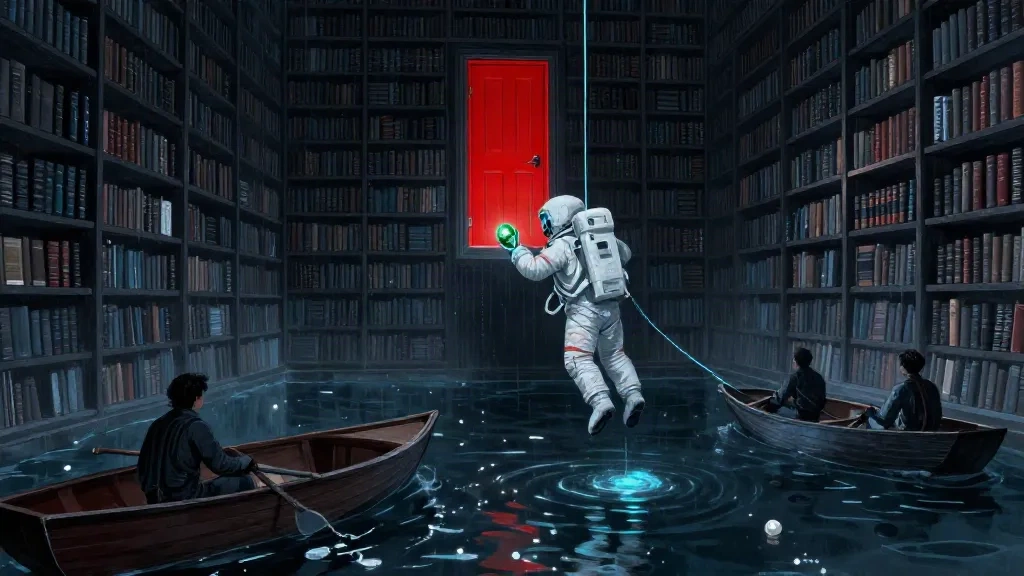
By the time the oceans entered the National Archive, Librarian Ilya Venn had not touched ground in nineteen years. She kept herself inside an old pressure suit moored above the third reference floor. Below its narrow window, librarians rowed between shelves black as submerged cliffs. Their oars whispered through water clouded with pulp and printer’s ink.
Earth was no longer a blue sphere on the archive screens. It was a rumour passed between observatories: green under a white smear, perhaps; inhabited, allegedly; wet, if rain still existed. Ilya refused to leave orbit. The last time she had seen the planet without a visor between herself and it, it had been too bright to look at honestly.
In her left palm she held a green stone from the first launch road. A blue thread ran from its puncture hole to the buckle of her suit. The thread led nowhere. Every morning she drew it tight, and every morning it lengthened again.
Her voice had been archived on her sixteenth birthday. Not her declaration or her famous flight, but her mother laughing behind the telephone while Ilya read the weather from orbit: Light rain here. Heavy silence in the kitchen. The catalogue called it incidental speech. The archivists had preserved it, but in a hundred retrieval queues, beneath announcements, footsteps, and the pulse of machinery. History used her mother as background noise.
Doors in the Weather
On the morning Ilya finally requested the recording, the archive storm arrived.
Rain struck the roof in silver sheets. Shelves groaned. One by one, the doors between departments tore loose from their frames and moved through the water like sleeping animals. A brass door appeared inside the genealogy cabinet. The card-catalogue room entered the map room, followed by a narrow green door that swung, dripping, above nothing.
Librarians lashed their boats together. A weather-reader called up through the ventilation shaft.
Every doorway is now attached to the wrong room. Anyone crossing one may arrive inside a different century.
Ilya descended on the thread. It tightened around her wrist and lowered her through three floors of dark water. The librarians met beside the red door, the only red in the pearl-and-midnight flood. It had once been Exit 6. Now it hung between the shelves, opening onto a narrow corridor lit like afternoon.
“Your voice is in there,” said the archivist at the oars. “So are voices erased by floods, fires, and polite revisions.”
“Then why are the doors moving?”
“Because you have brought an index.”
She understood. The green stone was the origin. The blue thread the query. And she, still insisting she was above the world, was the catalogue.
The Room Inside the Weather
Ilya entered the red door holding the stone above the water. The corridor changed at once. Water became carpet, the archive became a kitchen, and steam clouded the window over a sink. No one was there.
The telephone waited beneath the coats.
When she lifted the receiver, static filled her helmet. Within it came a cupboard closing, a kettle beginning to sing, and her mother’s voice.
“Light rain here,” it said.
Ilya pressed the green stone into the mouth of the telephone. The voice strengthened. She heard a spoon strike a mug, the complaint of a loose window, her own younger self reciting temperatures with tedious pride. These small sounds arrived first, then the laugh she had crossed the drowned archive to recover.
The storm struck. The kitchen buckled. A map room opened behind the refrigerator, and a sea-room appeared beneath the floor. Through its porthole Ilya saw the red door, tiny and blazing, slam shut.
She tied the blue thread to the telephone cord and cast the stone through the porthole. The stone struck the far door; the thread drew tight between worlds. For one violent instant every sound in the archive came down the line: oars, rain, drawers, footsteps, a planet’s remembered engines.
Then the line cleared.
Her mother said, “Ilya, come down for supper.”
Not history. Not evidence. An invitation.
An Honest Landing
Ilya did not answer. Not yet.
She held the receiver until the kitchen filled with morning. Then she spoke her own name into it, one small act of authorship, and heard her mother answer from nineteen years ago.
“I’m here,” Ilya said.
They remained connected while the storm rearranged its impossible rooms. The blue thread burned cold around her wrist. The green stone returned through the porthole, damp and ordinary.
When the kitchen disappeared, Ilya stood again in the flooded archive. Behind her, the red door had vanished. In its place was a small index card, dry despite the flood.
It read: Primary voice located. Classification corrected.
The librarians watched her climb into the boat. None asked whether Earth was real. The question had changed. Ilya looked not toward the distant orbital lights but down through the pearl water, where every row of shelves cast long midnight-blue shadows.
“Take me ashore,” she said.
And as the oars dipped, the blue thread at her wrist pointed gently home.





