 Netwrck
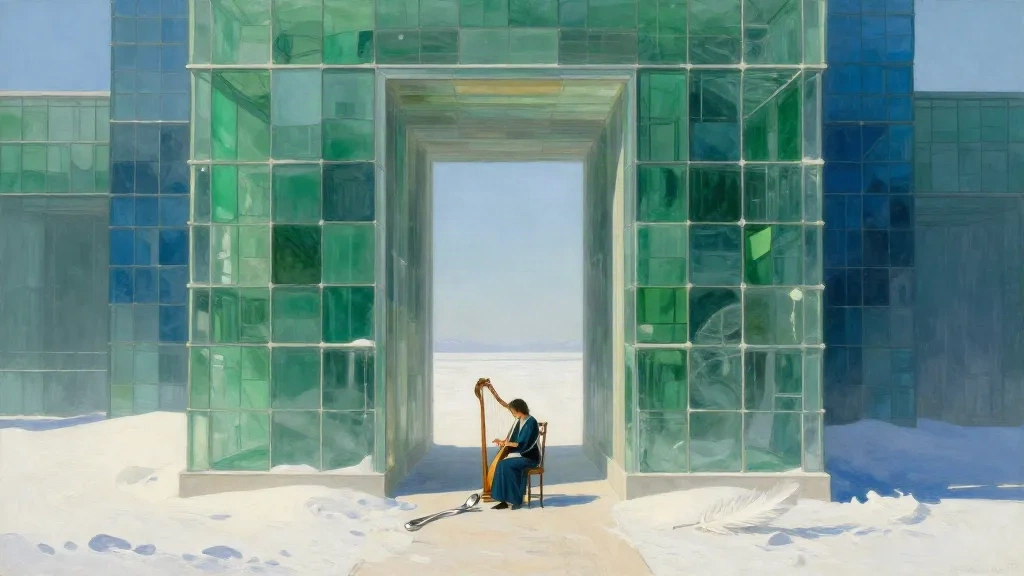
Mythic Fiction.
The Note Under the Salt
On the first day of the long winter, I heard a note beneath the museum's eastern staircase.
It was low and blue, almost lost beneath the sea-glass green of the walls. The visitor who had spoken stood beneath a door marked PATIENCE. He had told the truth about his brother, and the note had risen from the stone like a bubble from deep water.
My name is Nera. I played the small brown zither in the museum's public gallery, and every honest word gave me music.
Each note had a different color. Courage sounded brass-bright. Shame gave a thin silver shiver. Love made the strings tremble gold beneath my fingers. Most people lied carefully, so my music was usually modest, a few cautious notes scattered across the afternoon.
That winter, however, everyone was hiding something.
The Door of the First Frost
The frost began in the Hall of Departures, where doors opened onto lost roads. It seeped beneath the thresholds and froze the sand outside the museum. Then it climbed the walls.
Children remembered the taste of oranges. Mothers remembered laughter. Even the white feather left on the entrance bench each morning grew rigid as glass.
The curators opened the door marked ENDURANCE. A blizzard poured through it, rattling the silver spoons in the dining exhibit and covering the floor in cobalt shadow.
“That door opens onto the courage to endure,” the curator said. “It is the largest courage we have.”
But the winter did not break. It remained for one generation, passing from old hands to young hands, making every year an argument with the same white sky.
I wanted to build something that could survive the storyteller. Not a song, which ended when the singer forgot the words, but a structure no single voice could command. I imagined a hall made from every true note I had ever heard.
The Spoon That Remembered
On the hundredth night, I found the curator in the nursery beneath the museum. She held a silver spoon and tried to feed warm milk to a child who had forgotten how to cry.
“The snow is not outside,” she said. “It is inside us. It spreads whenever we say one thing and mean another.”
I touched the spoon. A memory climbed through its handle: my mother teaching me to mend a torn sail with a curved needle. The memory had a note, and the note had a door.
Behind the door stood my own workshop, burning beneath the sea-glass green sky.
“If you make a thing from truth,” the curator said, “someone will eventually lie about it.”
“Then the lie will become part of its memory.”
She placed the spoon in my hand. The white feather drifted down from nowhere and settled beside it.
A House Without the First Voice
I gathered the museum's oldest objects: the feather, the spoon, a chipped shell, a key that opened no lock. I built my construction in the Gallery of Unfinished Things.
It had no front door. People entered from whichever courage they carried. Those who had stayed awake through fear entered through the door of Watchfulness. Those who had surrendered forgiveness entered through the door of Release. Those who loved an enemy entered through a low passage beneath the sand.
At the center stood a listening chamber built from the zither strings. I did not make the final wall. I left it open, and the winter entered.
It froze the silver spoon. It darkened the white feather with cobalt shadow. For three days the museum held its breath.
On the fourth day, a child crossed the unfinished floor and said, “I am afraid.”
Her note was the clearest thing I had ever heard.
One after another, the others came. Each voice confessed what the winter had hidden. Fear of being forgotten. Anger at the vanished sun. Love for someone who had died before the snow. The construction answered with a new chord, and the chord held when the voice stopped.
At dawn, the doors of the museum opened inward. Beyond them: green grass, wet sand, a sky divided by clean sunlight.
I kept the gallery unfinished. The white feather remained by the threshold, and the silver spoon still shone like a small moon. In the center, the listening chamber had become a house with many entrances and no owner.
That is how I learned the difference between permanence and survival. A thing does not survive by refusing change. It survives by making room for the next honest voice.
Build no monument to the first truth. Build a place where truth can arrive again.
I still play the zither in the entrance hall. Sometimes a visitor tells the truth, and a new note appears among the others. I do not name it. I only widen the room.





