 Netwrck
Mystery.
The Book of Unlikely Returns
In the museum of doors, the librarian kept a book behind the circulation desk. It had no title, no author, and no page numbers. Every morning it appeared at her elbow, warm as bread, smelling faintly of rain.
Her name was Mara, and her task was simple: lend the book to a visitor, watch what their courage opened, and record the result before the door closed.
The first visitor wanted to speak to her brother again. The book opened onto a corridor lined with unanswered apologies. The second wanted to forgive a woman who had left without explanation. Her door opened onto a kitchen at dawn, where forgiveness waited in the steam.
By the third day, Mara had stopped expecting the visitors to bring impossible wishes. They brought ordinary ones: courage to leave, courage to stay, courage to admit they were tired.
What Mara wanted was different. She wanted a home that accepted impossible residents: a mother who had forgotten her own name, a man with a shadow that lived in another country, a child whose shadow had refused to follow him.
She had never told the museum. The building had been designed for doors, not for people. Its rooms were full of thresholds, locks, hinges, and narrow halls leading to kinds of courage no landlord could classify.
The Child at the Cracked Bell
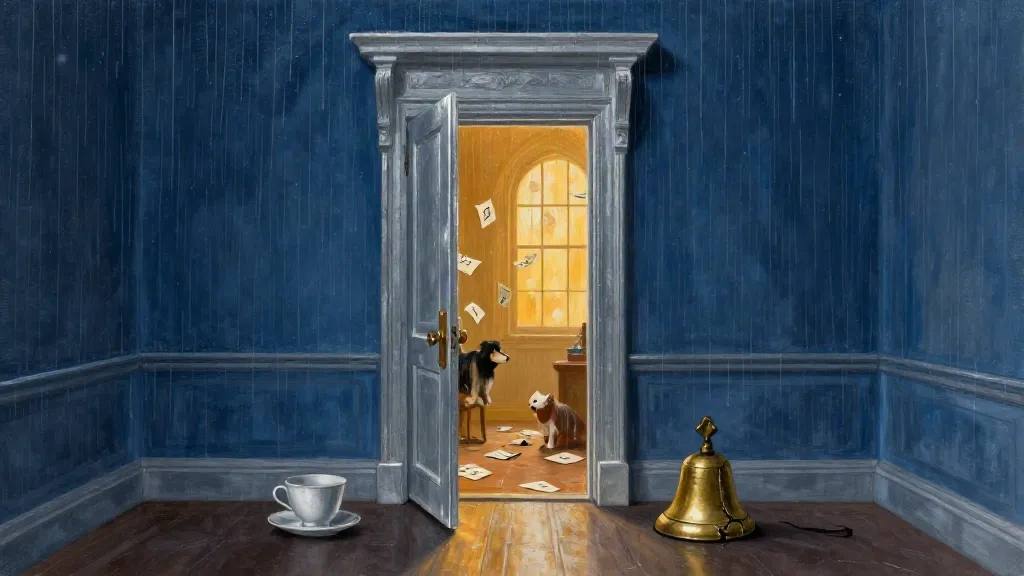
On the seventh day, a girl arrived with an empty teacup.
She was perhaps nine, her shoes wet through, her hair braided with a strip of blue thread. She placed the cup on the desk and said, “The bell in the west gallery is cracked.”
“I know,” Mara said.
“Everyone agrees it rings beautifully.”
Mara looked at the cup. No mark of tea, no stain at the rim. “What does it sound like to you?”
The girl tilted her head. “Like someone trying to call from underwater.”
There were no cracks in the west gallery bell. Mara had walked beneath it every morning for twelve years. It hung perfectly still above the Door of Small Returns, polished brass catching the blue light from the courtyard.
The child placed one hand over Mara’s book.
“You should lend this to the bell,” she said.
“The bell is not a person.”
“It is carrying everyone’s missing voice.”
Mara opened the book. The pages were blank except for a single line appearing beneath her hand: Borrow the sound you refuse to hear.
When she read it aloud, the west gallery bell cracked.
Not visibly. The metal remained whole, the clapper remained still, but beneath the painted blue wall a second sound began. It was faint, silver, and unmistakably human. Someone was knocking from the other side.
The child’s empty teacup filled with rain.
What the Doors Conceal
Mara followed the knocking through six galleries. The doors she passed opened onto familiar fears: a stage before a silent audience, a battlefield after the flag lowered, a bedroom where a frightened child had hidden beneath the sheets.
At the end of the sixth hall, she found a door that did not belong to the museum. It was painted rain-silver, with one warm amber window glowing at its center.
The child stood before it.
“My mother lives there,” she said.
Mara knew the claim was impossible. The museum had no residents, only visitors and the courage they temporarily borrowed.
She lent the girl the book.
The silver door opened.
Beyond it stood a narrow house with rooms that changed size depending on who entered. In the kitchen, a woman sorted letters from languages that had not been invented. Under the stairs, a glass jar held a thunderstorm asleep inside. On the landing, three impossible residents carried furniture toward a room marked ALMOST ENOUGH.
“This is a home,” Mara said.
The child looked back at the cracked bell hanging behind her. Its missing voice now rose through the house, joining the letters, the rain, and the soft work of making space.
“Then why is it locked?” she asked.
Mara looked down. The book had opened in her hands. On every page, someone had written the same address, followed by a different warning: Not for those who are afraid of being changed.
She understood then. The house had not been hidden because it was dangerous. It had been hidden because courage of that size was contagious.
A Door Is Not a Promise
Mara stepped inside.
The threshold accepted her without hesitation. The child did too. The impossible residents looked up, their faces changing in the amber light, and made room on the narrow sofa.
“You have to leave the book,” the woman sorting letters said.
“It is the museum’s.”
“Everything you lend is meant to be returned,” the girl said. “Even homes.”
Mara closed her fingers around the cover. Behind her, through the open door, the museum appeared impossibly far away. Every gallery had filled with people standing before doors they feared to open.
The book grew heavy. Inside it, pages rustled like a storm moving through rooms.
She could return it and keep the museum’s work intact. Or she could leave it here, where a home would learn to lend courage to the world.
The cracked bell sounded.
Not underwater now. Close, clear, and warm.
Mara opened the door of the house and placed the book on the kitchen table.
The impossible residents gathered around it. Somewhere beyond the walls, the first new door opened.
The child picked up the empty teacup. Rain silver filled it to the brim, and in its surface Mara saw herself standing in the warm amber window—not as a librarian, but as a resident.
“What happens now?” she asked.
“Now,” the child said, “we make more room.”
Then the bell rang, and the door stayed open.





