 Netwrck
Mystery.
The Last Carriage
By noon, the station had become a theorem in sand: one platform, one track, and a line of heat shimmering above the rails. Mara Venn stood beneath the timetable with her hands buried in her sleeves. The board said the Meridian train arrived at 12:07. It was already three hours late, which meant it was coming from a year with better arithmetic.
She had not meant to come. No one had meant to come. Yet every morning, the old newspapers printed the same small paragraph beneath the weather: an astronaut seen above the southern cities, refusing all requests to return.
The paragraph was false. Mara knew because the photograph was hers.
In the photograph, her visor held a reflection of the Earth, round and impossibly whole. The caption claimed she had never landed. The other newspapers claimed she had never left. The oldest one, preserved in a climate vault beneath the station, contained only a blank space where her name should have been.
That was the voice she wanted. Not the speeches, not the launch transcript, not the clean explanations given to children. She wanted the breath before ignition, when the capsule shook and she said, I am here, I am here, I am here, and history treated the words as background noise.
The train arrived without a sound.
Rooms in the Rain
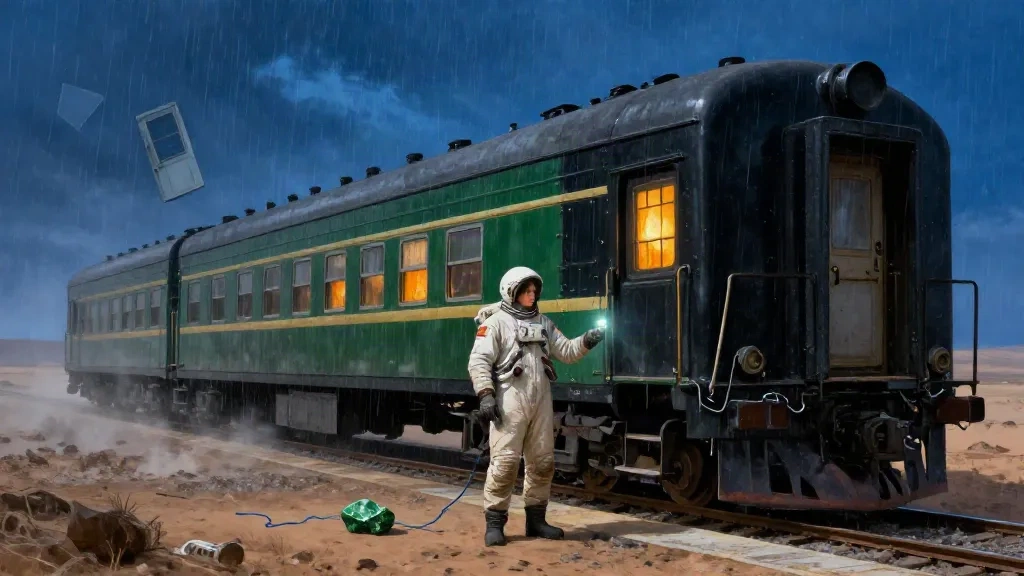
It was black and green, with brass fittings gone soft as candlewax. The conductor wore a coat from a century that had not yet learned buttons. He looked at Mara as if he had been expecting her complaint.
“Last carriage,” he said. “Do not stand behind a closed door.”
“Why?”
“Because the storm has borrowed the hinges.”
Rain arrived before she could ask more. It struck the platform sideways, silver needles thick as piano wire. The station doors began to move.
A green door walked three steps across the waiting room. A narrow blue door folded through itself and appeared inside the ticket office. Somewhere behind Mara, a child slammed a door that opened onto the roof.
She caught the green door as it passed. On its other side was the Moon, close enough to touch. Beneath the lunar dust stood a microphone, its cable disappearing into the ground.
“Venn,” said a voice through the speaker. “Can you hear the noise?”
“Who is this?”
“We need the noise. The room is full of people, but the room keeps forgetting which voices matter.”
A blue thread stretched from the door handle into the dark. It trembled with the rhythm of a pulse.
Mara pulled. The thread tightened, and the station announced her name in a voice she had once known by heart.
The Green Stone
The conductor found her in the luggage room, where a green stone had appeared beneath a bench. It was warm, wet, and shaped like a piece of the Earth that had never existed.
“Your launch,” he said, “was recorded twice.”
“That is impossible.”
“So is this platform.” He placed one finger against the stone. A woman's breathing filled the room, each inhale thin with static.
Mara recognised the gap before the first word. In the original recording, the launch team had cut three seconds of hesitation. The hidden version preserved it. In that missing interval, a young technician whispered her mother's name, then laughed at himself.
“History calls it noise,” Mara said.
“History is efficient,” the conductor replied. “It keeps only the parts that make a useful shape.”
The blue thread was now wrapped around the stone. Every pulse tightened the walls. Behind them, doors opened and closed in different centuries. Through one, Mara saw her first launch at sunrise. Through another, she saw the Earth from orbit, but the planet was empty and white.
“If I cut the thread,” she said, “the voices disappear?”
“The doors do.”
She raised the stone and struck the nearest door. Rain burst through the frame. The station buckled, platforms folding into one another.
The Amber Window
Mara ran.
She crossed the black train, its windows flashing with years she had not lived. The conductor held the conductor's lantern low, and the child with the impossible door followed, carrying the blue thread around both wrists.
At the far end of the platform, a single window burned amber.
Behind it, the station clock showed 12:07.
“That is the room,” Mara said.
“Every room is a room,” the conductor said. “Choose carefully.”
She pushed open the amber window. It was not a window but a recording booth, suspended above the desert. Inside, the technician sat beneath a bare bulb, older than the photograph, younger than the station. Beside him lay a ledger of erased transmissions. Every page was crossed out except one.
Mara took the ledger.
“I came back,” the technician said, “but they sent my voice away.”
“Then say it again.”
He leaned toward the microphone.
Outside, the storm tore every door from its frame. The train began to depart. Mara held the green stone against the console and pulled the blue thread until it shone like a nerve.
The technician spoke her mother's name, laughed, and then said, “Mara, if you are hearing this, remember that leaving is not the same as abandoning.”
The signal went silver across the desert.
At dawn, the station stood unchanged, except for one open window in the waiting room. Inside it, the timetable had been replaced by a single line:
All voices are records. All records have witnesses.





