 Netwrck
Romance.
The Season Cabinet
Edren made clocks for seasons rather than hours. In his narrow workshop beneath the garden’s east wall, spring lived in a silver case with beeswax seals, winter in a jar of blue mercury, and autumn in a movement that released one dry leaf each morning. The summer clock had no hands. It advanced only when someone remembered happiness.
Every clock was built to be returned. That was the condition of Edren’s trade: no mechanism belonged to its maker forever. He repaired them for gardeners, ferrymen, children born under snow, and once for a woman who said her heart had forgotten which season it preferred.
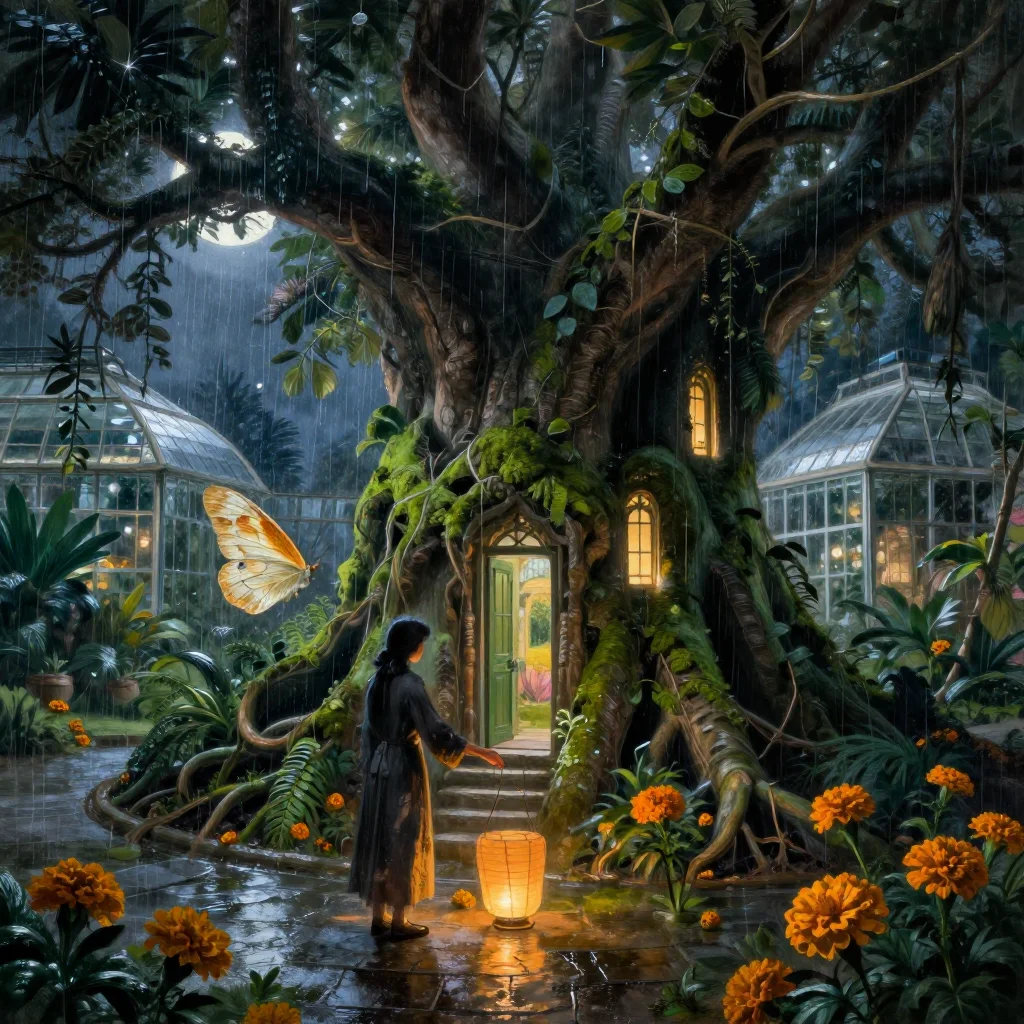
Her name was Liora. She carried a paper lantern everywhere, its panels clouded with rain and its bottom stitched closed with gold thread. She worked among the orchids, naming the flowers for the rooms they resembled. The central tree stood beyond the glass roof, enormous and green, its bark marked by narrow seams that looked less like cracks than doorframes.
One morning Liora left the lantern on Edren’s bench. Inside its candle chamber, instead of flame, lay a single moth wing, pale as a petal and veined with gold.
He knew whose it was. Liora had found the moth beneath the tree the night they first met. She had pressed the wing into a book and said, “Nothing beautiful is lost if someone remembers its shape.”
That evening she walked into the garden’s deepest door.
The Choir Under the Bark
The tree had opened without wind. Its seams widened like shutters, and Liora stepped through carrying no shadow. The paper lantern remained in Edren’s hands. The wing inside it beat once, though it had no body.
“Wait,” he called. “Liora.”
The door closed.
Afterward, voices began issuing from the bark. They sounded like Liora, but each carried a different weather.
“She went north,” said one voice, crisp with winter.
“She went under the lake,” said another, soft with summer.
“She is still standing beside you,” whispered a third.
They were memories stored in the tree, Edren understood. The garden preserved every season that had ever touched it, and the choir had preserved Liora in pieces. The winter voice wanted the spring clock opened. The summer voice wanted her lantern kept burning. The third insisted she had never left.
Edren brought the lantern to the trunk. Its paper walls strained toward the seams, and the moth wing fluttered without moving.
“Give her back,” he said.
“Give her back to which woman?” the choir demanded.
He placed his hand against the nearest seam. Warm air breathed through the wood, smelling of wet stone and marigolds.
A Door Made of Hours
At dawn, Edren opened the spring clock. Its beeswax seals cracked, releasing a scent of sap and blossom. The clock had been made for Liora before she vanished, though he had never told her. He had wanted to return it while she was still alive: one season that would last until she chose to leave it.
The tree answered by producing a door low in its roots. It was the smallest door, barely high enough for a person to crawl through. Marigold light leaked from the gap.
The choir contradicted itself. One voice said the door led to a meadow. Another said it led to a drowned city. The third sang Liora’s laugh in imperfect notes, making Edren’s chest ache.
He set the spring clock before the opening and unfolded the lantern. The moth wing lifted itself from the paper, hovered over the mechanism, and pointed inward.
Edren entered.
Beyond the door was a room made of branches, roots, and old glass. Liora sat at a workbench, stitching a paper lantern. Her hands were young, her hair unbound. She looked up when he entered, and her face held no recognition.
“You made this,” he said, offering the lantern.
She frowned at the moth wing resting inside it. “I made the wing,” she said. “The clock is yours.”
For a moment he misunderstood. Then he saw the truth: Liora had made the wing from a memory of herself, preserving the promise they had not yet made. Edren had carried it away from her, and the tree had carried the promise away from them both.
“I made the wing to remind you,” Liora continued, stitching. “And you kept it.”
“I was afraid you would leave.”
“I did leave.”
Her honesty hurt less than the memory of her absence. He placed the spring clock beside the lantern.
The Hour Returned
Edren opened the clock’s case. Instead of hands, a small brass key appeared, warm as a hand.
“This was inside all along,” he said.
Liora looked at the key but did not take it. “Then return it to the one who made it.”
He had assumed the maker was Liora. The answer was simpler and crueler: he had made the key himself, with the first hour he ever spent beside her. It opened no door. It was shaped like the memory of a promise.
The voices outside grew louder. Winter demanded cold. Summer demanded heat. The laughing voice demanded that he remain.
Edren placed the key in Liora’s palm. “You made the wing,” he said. “I made the hour. Neither of us should have to carry both alone.”
She closed her fingers around it.
The glass room filled with green shadows. Outside, the tree’s seams began opening one after another, revealing spring gardens, winter fields, autumn orchards, and summers bright as struck metal. The choir did not agree. It argued, harmonized, and finally fell silent when Liora stood beneath the paper lantern.
She stitched the gold thread through its final seam. The moth wing lifted, carrying the spring clock’s warmth with it.
“You are late,” she said, though this time she knew him.
“I returned the hour.”
“No.” She looked toward the doors, where every season waited to be chosen. “You returned it. Now help me choose where to go.”
Edren took her hand. Behind them, the choir resumed—one voice singing low, one voice bright, and one giving directions they could finally understand.
They stepped through the smallest door together. The paper lantern burned moss green, the wet stones reflected their joined shadows, and somewhere above them a flash of marigold opened like a door returning to life.





