 Netwrck
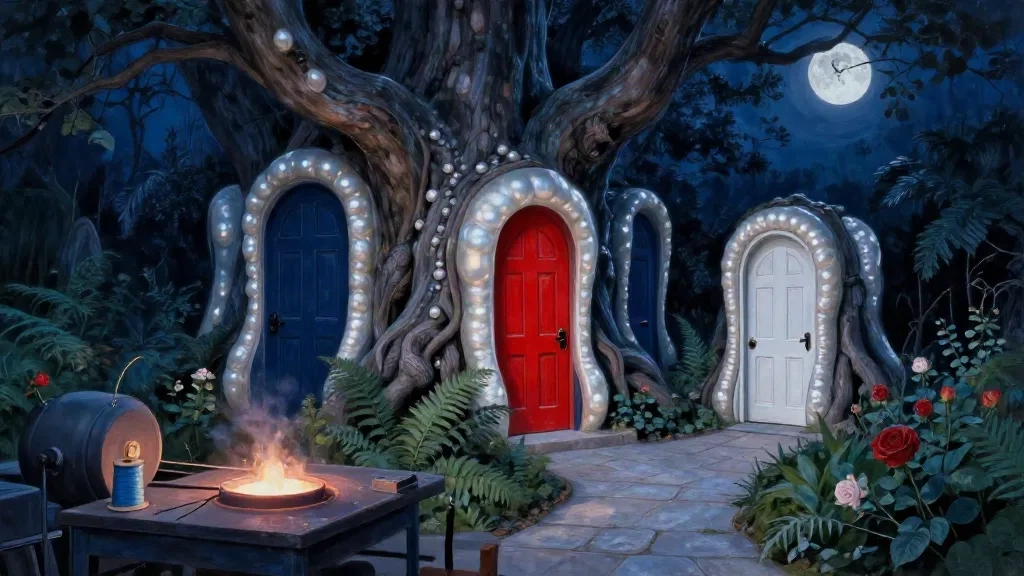
Magical Realism.
The Glassblower’s Window
Mara kept her furnace beneath the western wall of the botanical garden, where the tree leaned low over the ferns and dropped doors instead of fruit. They arrived in clusters at dusk: narrow red ones, blue ones polished to the color of deep water, and little pearl doors no larger than a child’s hand. By dawn, the tree had made enough rooms for a small city.
Mara shaped their windows. She gathered silica from the garden’s black soil, warmed it until it glowed like a captured moon, and blew with the steady breath she had learned from her mother. A pane for a room in another world must be perfectly clear. A bubble, a wavering edge, and the occupant might spend years looking through a landscape that slipped sideways whenever the weather changed.
That morning, she had promised herself an ordinary one.
She would sleep until six. She would drink tea from the chipped blue cup. She would eat pears from the lower terrace and leave the blue thread wound around her wrist for no reason at all. The tree had opened an unmarked door near the toolshed, its paint the dull cream of old ivory. Mara had noticed it yesterday while carrying a bucket of molten glass.
Today the unmarked door had moved closer.
The Safer Trail
It stood between the rose beds and the pond, where no path had existed. A line of pale stones crossed the grass, leading through the roots and out toward the glassblower’s cottage.
Mara followed it.
At the first stone, a gardener named Pell was kneeling beside a broken rose trellis. He had been telling everyone that the storm had ruined it.
“The storm did not do this,” Mara said.
“I saw the storm,” Pell replied.
The pale stone beneath her foot turned solid and warm. The rose trellis stood straight again, every nail driven home.
Farther along, a boy confessed that he had eaten the last white peach. The pond became shallow enough to cross. A pair of lovers admitted they had mistaken one another for someone else, and a bridge appeared beneath their feet, plain and strong.
At each confession, the path improved. At each denial, it narrowed toward a door that should not exist.
The blue thread around Mara’s wrist tightened. She unwound it and held the loose end over the stones. It pulled toward the cottage, then backward, toward the tree.
Behind her, an unmarked door opened.
Through it came the smell of pears and the sound of a kettle beginning to boil.
The Morning Taken Away
Inside was her cottage exactly as she had left it. Mara crossed the threshold before she could think. The chipped blue cup waited on the table. The pears sat in a bowl beside the door. Sunlight rested on the floorboards in one long, ordinary stripe.
But no sound came from outside.
She returned to the garden. The pale trail had reached her cottage and was still collecting lies. Pell was no longer tending roses. The boy had vanished. Even the tree seemed to be holding its breath.
Mara picked up a red-hot rod and shaped a small lens. When she raised it, she saw the trail’s true shape: a chain of doors, each fastened to a memory that someone was surrendering. At its far end stood the tree, and on its lowest branch hung an unmarked door painted pearl-white.
She understood then. The trail did not merely grow safer when lies were spoken. It consumed the truths that kept them harmless. By dawn, it would have taken every morning it touched—including the one she had wanted to keep.
Mara placed the lens over the nearest stone. Through it, the truth appeared: Pell had loosened the trellis himself, frightened of dismissal. The boy had eaten the peach because his sister was ill. The lovers had spoken falsely to preserve a promise neither of them wanted to keep.
She began naming what she knew.
“I am afraid,” she said. “I am angry that every room I make is temporary.”
The stones trembled.
“I do not know whether my mother would recognize me.”
The chain of doors cracked.
At the final truth, Mara looked toward the cottage.
“I want one morning that belongs to no one else.”
The Red Door
The unmarked door fell from the branch.
It struck the ground without breaking, and the pale trail became a single red door. Mara understood the price: the door could return the morning, but it would keep only what she had refused to say—the complaint, the fear, the unloving thought. To reopen it, she would have to let the whole garden hear her worst truth.
She opened the red door.
Morning rushed back across the garden. The pond filled. The roses lifted. Pell began rebuilding the trellis, this time honestly, while the boy carried water for his sister. In the cottage, the kettle whistled. The blue cup shone beside a plate of sliced pears.
Mara sat and ate breakfast without speaking.
It was ordinary. It was hers.
Then she tied the blue thread around the red door’s handle and left it standing in the garden, where anyone could see the way home. The tree made many doors, but it made only one that asked no explanation.
She never learned which world lay beyond it. For once, that did not matter.





