 Netwrck
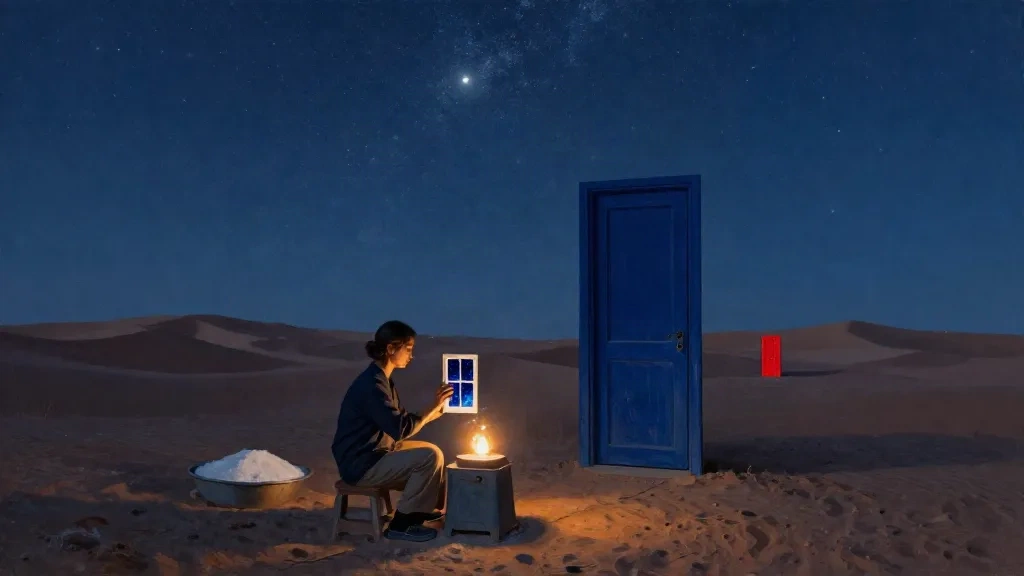
The blue thread
At dawn, before the desert had decided to become white, Mara tied a blue thread to the antenna of the old observatory and watched it pull east.
The observatory stood on a low hill above the basin: a dome repaired so many times that no two panels matched — cheap window glass, a lens, a mirror, a sheet of hammered tin. Beske had been its only astronomer for nineteen years. He read the sky by the sound it made when the air was steady and wrote what he heard in ledgers no one else opened. In the last month his eyes had gone the color of river silt. He did not mention it. He said he was saving his sight for something specific.
Below the hill, Harrat Sahl lay in its bowl of salt and iron-colored stone: four hundred roofs and one long argument. At that hour the town smelled of bread, of alkali, and of the faint metal tang that rose off the well. Nobody said the word for that tang. They said the water is fine, and the saying wore smooth with use, like a coin in a pocket.
Through the mismatched panels, Beske tracked stars that arrived carrying messages folded inside their light. Most were numbers. Some were weather reports from places that had stopped existing between one delivery and the next. Once, the sky had sent the name of a woman who had forgotten where she was buried. Beske had read it aloud at the evening meal and the town had gone quiet, because everyone in Harrat Sahl had a person in that condition.
Mara did not read the messages. She made windows.
The shop was at the bottom of the hill, a room of thick walls and one small furnace that her mother had built, and that Mara had inherited along with the tongs, the granite slab, and the habit of sleeping near the door. The first fire in a glass shop is a captive sun. She turned molten quartz until it became a narrow ribbon and folded the ribbon around an invisible corner, cooling it with breath and patience. Every window she had ever sold was meant to keep something safe: a sleeping city, a field after drought, a room in a house where a child had never come back.
For eleven months she had been making a window for one ordinary morning.
The morning she would not name
Not a wedding morning. Not a battle morning. A market opening. Steam coming off bread. A blue cup set back on a table, chipped, handled by someone who would not throw it out. The sort of morning that asks nothing of anyone and therefore has no defenders.
She knew which morning it was. She had not said so to a living soul, and she did not intend to, and the not-saying had a shape, the way a held breath does.
It was the last morning of her mother's life. Amina had come out of the shop at dawn to argue about the price of sand, wearing the blue coat with the burned cuff, and had come back eleven hours later as a quantity of ash the wind had opinions about. That morning there had been three green apples on the sill. A dog had drunk from a cracked saucer on the step. Nura, nine years old and unkillable, had been sent to fetch salt and had run all the way, arriving with the salt and a dog hair in her mouth.
Mara had made the window in the shape of that morning. The pane was pearl-colored with a midnight-blue rim, and it had one flaw at its center, which she had spent four months trying to grind out. The flaw was the shape of a red door.
What the stars said
The message came three days early.
Beske found it as a white seam lying across the eastern stars, and he read it aloud on the steps with his hand on Mara's shoulder because he could no longer find the inkwell by looking. The message said: Keep the blue thread. Do not follow the unmarked door.
Then he said, without moving his hand: It does not say do not open it. That is the worst shape a message can have.
Below them, the town had already begun to lie, which was to say: the town had already begun to live.
Saleha, the girl who watched the goats on the north slope, was the first to see the door, and she told her father, and her father told the well committee. The red door stood at the edge of the salt where nothing grew, a rectangle the red of a wound seen through cloth, and it was there in the morning and gone by the time you had finished being afraid of it, and it was there again. After Saleha, everyone saw it. After a week, no one said so. Saying it put a shape in the air that the air then used.
So the town learned its seams. At the well they said the water was sweet, though it tasted of nails. At the school they said the children had slept well, though no child had slept since the door appeared. At the market they sold salt and called it sugar, and the sugar was fine, and everyone went home slightly sweet-mouthed and slightly afraid and slept the whole night through like a stone in a river.
Mara watched the cost arrive in the sky.
Each truth loosened something invisible. The constellations bent away from the town first, as if the air over Harrat Sahl had thickened. Then the horizon lost its distance: the far ridge, eleven days' walk, came to look like an hour. The animals understood. The jackals stopped taking the goats, the snakes came up under the door of the bathhouse, and the birds went up into the heat and did not come down. Every lie was a brick. Every lie made the night less dangerous and the world a little smaller, and the town slept like a baby in a box, and outside the box the desert turned its enormous unhurried face toward a thing that was not the desert.
Beske put it plainly, one night, in the workshop, while she annealed a pane.
Truth is load-bearing. A wall you did not build. Lie is mortar. Lie is cheap, and it holds, and it holds you in.
Then he turned his silt-colored eyes toward her and said: You have been laying a great deal of mortar, Mara.
The glassmaker's lie
Nura came up the hill at dusk the next day, thirty-one years old, schoolteacher, the woman who stood in front of the town's children every morning and said the sentence about sleeping well.
She had her mother's hands and none of her mother's mercy. She put the pearl pane down on the bench, held it up to the furnace light, and looked at the red flaw a long time.
You made this in April.
Yes.
April is when the door came. You told the school the glass cracked itself. I was standing there. I heard you.
I know what you heard.
You lied to nine hundred children and forty parents and one sister, and the lie has a rim and a shape, and I have been building my curriculum on top of it.
Then her voice went down, and the anger went with it, and what was left was worse.
Why?
Mara could have said the furnace, the debt, the buyer in Tarim. She said: Because you were nine. And you had been crying for two days, and you asked me if it was real, and I said I promise it is not real. I said it eleven times. I said it until you stopped asking and started believing, and then the town stopped looking outward, and the stars could not get their messages in, and Beske has been deaf to the sky for nine years because of me.
Nura sat down on the slab, in the dust, in the heat off the furnace.
So we are small.
We are sealed. There is a difference, and it is the difference between a house and a box, and I built the lid.
Do not make it a metaphor. It is a box. I have been teaching in a box. Halid brings water from the well now and drinks it and says nothing, and I teach boys that they slept well, and we are all so restored. She pushed the pane toward her with two fingers. What is this one for?
It is not a window.
Mara.
It is the door.
Nura looked at the flaw. She did not touch it. She had spent her childhood being careful with fire and her adulthood being careful with sentences, and both instincts were telling her the same thing: do not put your hand in that shape.
Whose morning?
Mara told her. It took a while. It was the first time she had said it aloud and the words had a smell, green apples and burnt cuff, and Nura's face did something Mara had not been ready for: it went young, and then it went hard again, and Nura said, Of course. Of course it's hers. It would be hers.
Nura—
Do not tell me it is a metaphor now. My mother died in a fire and you were the one who got out. You get to keep the last morning. That is the arrangement. I have had nine mornings since then and I remember all of them badly.
They sat with it. The furnace ticked. Downhill, four hundred people were choosing, each one, the smallest sentence that would hold.
The unmarked door
It stood beyond the observatory wall, where no wall had been built, in ground nobody had ever bothered to clear of stones.
No hinges. No handle. A narrow rectangle the blue-black of deep water, the color the sea makes at four fathoms when the sun is high, and here there was no sea and no sun and there it was.
Beske walked out to it with the thread tied to his wrist and his other hand on the wall, so that when he stopped, the stopping told him where it was.
I cannot see it. That is the first fact. I cannot see it, and I have stood in front of something the size of a door, and I would like you to notice that the sky is honest enough now to hide a thing from a man who has already stopped being able to see.
Beske—
I am not asking you to open it. I am asking you to notice what it costs to look. The moment you look at the door, the door is a room. The moment a room exists, someone has to be inside it. In nine years of sealed nights this town has never once had to choose. That is what your lie bought, girl. Not safety. Postponement.
The blue thread pulled at Mara's wrist. She let it. The pull was not strong. It was patient, the way a rope is patient when it has been tied to something that intends to move.
Inside, she saw the morning.
It was exactly as she remembered and not at all as she had been telling it to herself. The market under a low sun. A woman arranging three green apples, unhurried, weighing them in her palm. Steam coming off the loaves in sheets. The dog on the step, drinking from a cracked saucer, its ears going up and down at nothing, at flies, at happiness. A blue cup on a table with a chip in its handle and a thumbprint worn white beside the chip. Her mother at the corner of the shop in the blue coat with the burned cuff, alive, calling out a price for the sand, unhurried, alive, and behind her a nine-year-old girl running the length of the street with salt in a fist and dog hair on her lip, grinning so hard it looked like it hurt.
Through the glass, Mara could hear the first bell of noon.
Behind her, Beske said: Do not look too long.
And she understood, standing there with the pane's edge cutting her thumb, that the door was not a place. It was a decision being made in real time, in her body, with the thread.
If she said the truth out loud — the door came, I saw it in April, I promised my sister it was not real, I sealed this town and I did it with my own mouth — then the walls would go back to where walls belong. The horizon would take up its eleven days again. The sky would open the way a lid comes off a jar, and whatever had been leaning on that small sealed room for nine years would find out what the room had been made of.
And if she lied, the morning would stay. Whole. Every detail. It would stay in the glass and in her head and in nobody else, ever. Nura would grow old without seeing it again. Beske would never hear noon again. Four hundred people would keep sleeping, safely, in a box, while the box walls thinned one lie at a time until there was no box, only a room, only a morning, only the two of them in it forever with the price of sand still under discussion.
She pressed the thread flat against the blue-black surface. It tightened. It cut.
Then Mara said: I made this window for a room. A room where a morning can stay.
And the door opened.
The last pane
She put the window into the door.
The pane accepted the frame without a sound, the way a bone accepts the socket it was made for. The pearl surface brightened from within. The midnight-blue rim softened and went translucent, and the red flaw at its center widened, unhurried, into a doorway with a step and a sill and a smell of bread coming out of it.
The ordinary morning spilled out across the salt.
For a moment the whole town saw everything at once: the lies, all of them, laid out like tools on a workbench. The water that was not sweet. The children who had not slept. The sugar that was salt. The door that had come in April and been agreed out of existence by four hundred separate sentences. They saw the sky above it, which was not empty, and not friendly, and enormous.
Then the glass warmed, and the morning became ordinary again.
That is what a morning does. It does not stay remarkable. It arrives, it is bread and light and a dog drinking, and then it is over, and then it is a thing you had. The glass took the shape and let the wonder go, and what it let go of was not the morning but the argument: the thing in the air that had been keeping every door shut, quietly, politely, using their own words as hinges.
Mara did not feel saved. She felt the specific, unromantic weight of having said a true thing in public.
The blue thread snapped.
She caught the loose end before the wind took it. Around her wrist the thread had left a cool blue mark, delicate as a river on a map, and she understood — because it was glass work, because she knew the chemistry of what had happened to her — that the mark would not fade. It would be there in the desert heat and in the well water and in the winter. She touched it whenever the desert tried to make her forget what had been chosen, which was often, which was the entire point.
After
The red door did not vanish. It moved.
That is the part nobody tells you about an honest sky: it does not take the threat away, it takes the padding off. The red door was gone from the horizon by evening, and the horizon was a horizon again, a real distance, cold at the edges. The sky stayed where it was, immense and unhurried, and the things in it went on being in it.
But the door was not gone. Twice that year, in the last blue hour, Harrat Sahl saw it again, standing far out on the salt, a mile, then four, then a day's walk and a little more. It did not approach. It did not need to. It had all the time there was, and the town had memory, and everything that had happened for nine years had not un-happened; it had merely stopped being hidden.
The town paid for the box in the ordinary way.
The well tasted of nails, plainly, in daylight, in front of witnesses, and the first thing they did was argue about it for a week. Then Halid, who was sixteen now and had stopped pretending not to know what the water tasted like, went up the hill and asked Mara whether glass could take a taste out of anything. She said: not out. It could take a taste into a thing, so that you knew what you were drinking, and then you would want the water fixed instead of the taste hidden. Halid said that was a stupid answer. Mara said it was the honest one. He carried three bottles down the hill and the well committee fixed the well in October, badly, expensively, and it was better afterward for a year.
Nura changed the school. She did not abolish the sentence about sleeping well. She replaced it with a new discipline: every morning, each child had to name one thing in the town that was worse than it had been the day before, and could not be fixed, and would be said out loud. It was hated. It is still hated. The name of it in Nura's schoolroom is the honest hour, and the children can recite it in their sleep, and two of them have gone on to write in the observatory ledgers.
Beske could see. That is what the extra piece bought him, and he never once pretended it was a gift.
He was blind for eleven days after the door opened — he said it was as if someone had changed the channel — and when the sight came back it came back wrong and wonderful. The stars were not the small bright pins he had spent nineteen years transcribing. They were large, and structured, and several of them were, as far as he could now see, occupied. He sat at the bench by the salt for a week and wrote without stopping, in a hand that shook with the pressure of what he was putting down, and the ledgers ran for a year. Then he sent the first message anyone had sent in nine years, and the answer to it took three days and arrived early.
He read it on the steps, with his hand not on anyone's shoulder, because he could hold the paper himself now.
It said: Room received. Thank you for the weather.
Mara had been building glass for the observatory, most of it, that year. Panes for the ledgers, panes for the lenses Beske was having ground in the valley by a man who owed him money. Panes for Nura's classroom, which had no windows at all and had been losing children to the heat every June. Panes for Halid's house, one for each corner, because he had asked, and because a house with four corners and one window is a house that is holding its breath.
And every pane she blew from that year forward, she blew in two colors.
Midnight blue, which is not a lie and not a promise. It is the color of the whole outside at once, the color that does not promise to be anything. And at the rim, a thread of red, worked in hot and laid on last, cool enough not to burn, hard enough not to bend. It was not a safe color. It was not a warning either. It was the color of a door that exists, which is the only color worth having in a house.
She kept one clear space in every window she made. Uncolored. The width of a hand, low down, at the height of a person sitting at a table.
You can look through that space, or you can put bread on it, or a cup with a chip in the handle, and see the cup. It will not hold. That is the whole design. She had learned it at the most expensive possible price, in a sealed town, in a box, with a thread around her wrist, and it was not a metaphor, and it was not a summary.
It was a window. It was, if you held it right, a door, and it was, if you let it, a morning.
And on the hill above Harrat Sahl, the astronomer, whose eyes were open, said the numbers out loud, and the numbers were not a message this time, and the sky listened anyway.





