 Netwrck
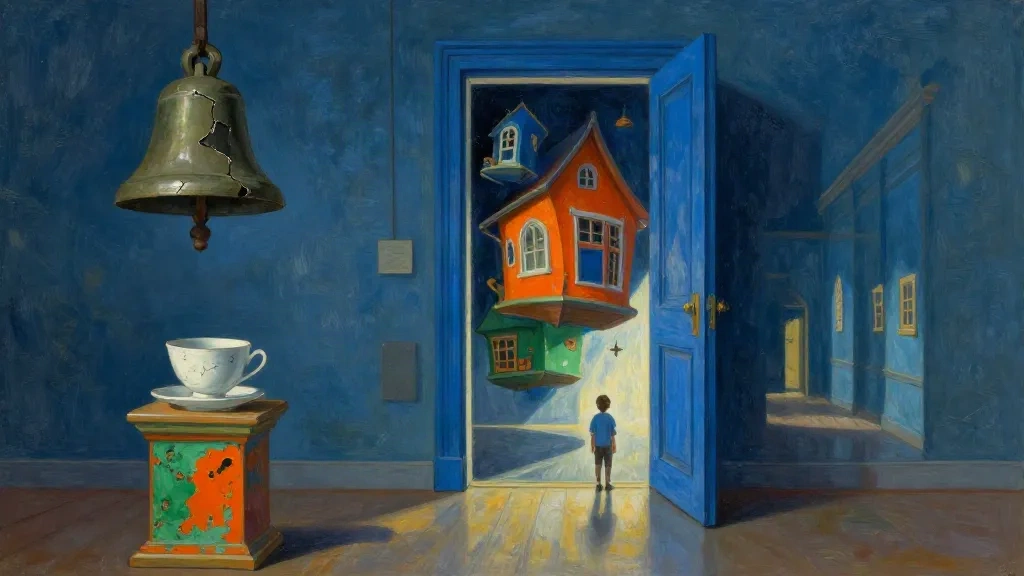
Surrealism.
The Book of Unfinished Rooms
The librarian's name was Mara Venn, and her wish was small enough to hide in a drawer: a house with a door that would not lock against her.
She had spent years in the Museum of Doors, cataloguing their hinges, thresholds, and the kinds of courage beyond them. One opened onto the courage to forgive a living enemy. Another onto the courage to become the person your family had mistaken. A third was painted lichen green and led to a field where every abandoned courage grew back as a sharp blue flower.
On the desk lay an empty teacup, white as a moon erased from the sky. Visitors sometimes asked for tea, then saw the cup and remembered they had come to borrow courage instead. Mara poured water into it anyway. The water never disappeared. It gathered itself into a small trembling lens, reflecting the doorway no one had chosen.
Every visitor received the same book.
It had no title, no author, and no pages at the end. Its cover was warm brown leather repaired with a single strip of burnt-orange cloth. Mara called it the Book of Possible Residences. Whoever opened it found a different house described in handwriting that seemed to have been formed by rain.
The Child at the Door
One afternoon a child arrived with a cracked bell in his hands. He was perhaps seven, though the museum made age difficult to judge. He wore a coat the color of storm-light and stood before the blue door, the one everyone else insisted opened onto nothing.
“There is a room behind it,” he said.
“There is usually a room,” Mara replied. “The exhibit is the seeing.”
He rang the bell. A dry note crossed the hall, and the blue light on the floor folded inward. Behind the door was not a room but a house with all its rooms visible at once. A kitchen floated above a bedroom. A staircase descended into the walls. Under the floorboards, something enormous breathed in patient, sleeping intervals.
The child pointed to a narrow crack beneath the doorstep. “That is where the people are hiding.”
Mara looked. For years she had seen dust there, a loose nail, the harmless darkness beneath a door. Now she saw the house itself crouched inside the crack, holding its impossible residents close: a woman made of weather, a boy with six shadows, an old architect whose body was a corridor, a map that had learned to walk.
“Why can you see it?” she asked.
“Because I am not looking at the wall,” he said. “I am looking at what the wall is pretending not to be.”
A Home With No Conditions
That night Mara opened the impossible book. A house appeared on its blank final page: a crooked place with windows shaped like open hands. The cracked bell leaned beside its chimney, and on the kitchen table sat an empty teacup.
“It accepts everyone,” Mara whispered.
But the book showed one condition. The house could take only those willing to remain visible to one another. It could not contain shame, concealment, or the agreed blindness by which crowds make monsters of strangers.
The child rang the bell again. In the blue storm-light, every door in the museum began to tremble. From them came sounds no visitor had been able to describe: a whale learning to live in a teacup, a city apologizing to its shadows, a thousand people saying the first honest sentence of their lives.
Mara understood then that the doors were not souvenirs of courage. They were invitations. The museum had been collecting the courage of departure because no one had built a courage of arrival.
She carried the book into the blue doorway. The child followed, bell in hand. The house in the crack opened without sound. Inside, the weather-woman, the many-shadowed boy, and the walking map made room beside the empty teacup.
What the Walls Remember
By morning the museum had changed. The blue door no longer opened onto nothing. It opened onto a hallway lit by storm-light, and beneath it lay a stone inscribed with a single sentence: NO ONE IS TO BE LEFT UNSEEN.
Mara did not get a key. She did not need one. The house knew the sound of her breathing, the child's cracked bell, and the soft clink of an empty teacup being filled for someone newly arrived.
Every evening, people came to the door carrying excuses. Mara lent each of them the impossible book. Some read for a moment and left. Some laughed. Some wept. A few entered.
At closing time, the child set the bell on the desk. Its crack held a thin line of blue light.
“What if someone cannot change?” he asked.
Mara looked through the doorway, where the impossible residents shared bread beneath a ceiling of warm boards.
“Then we will make the house wider,” she said.
Outside, the night burned orange at the edges, and lichen crept over the walls. Inside, the cracked bell rang once—not to summon someone away, but to tell them they had been expected.





