 Netwrck
Mystery.
The Observatory Below
Captain Ilya Venn had been above the monastery for eleven years, though the monastery was not below her in any way that mattered. It was the country beneath her that had become doubtful. Governments changed their names. Rivers were reported in new locations. A child in the valley asked which nation had made the moon.
Ilya stayed in orbit because leaving felt like accepting the rumor. Every orbit carried her over the same ink-blue cloud fields, rain-silver mountains, and one warm amber window in the old monastery. The window was visible only when the storms lowered.
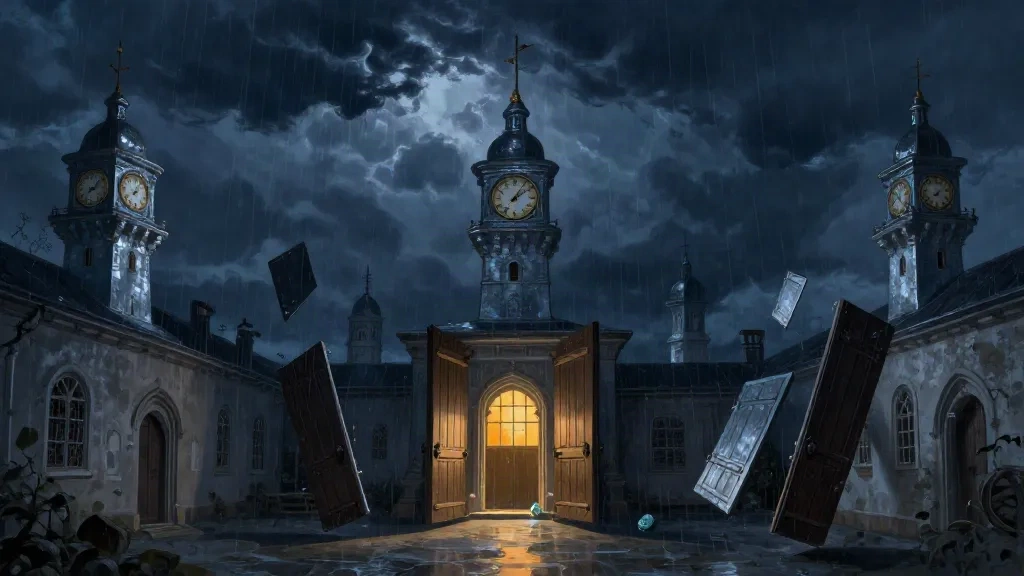
Below it, the clockmakers kept time for a country that no longer trusted it. They did not wind their clocks. They repaired them, coaxing broken wheels into agreement. Their monastery had four courtyards, seventeen workshops, and a rule that no door could be marked with paint.
Ilya carried two objects in a sealed suitbag: a green stone the size of a thumbnail, and a blue thread knotted around her wrist. The stone had been found in her spacecraft’s heat shield after the return that never happened. The thread had been torn from the recording cable carrying the last public message of the expedition. The message had been buried beneath emergency coordinates. History had used it as background noise.
When the Doors Changed Places
On the night the weather turned silver, Sister Anja came above the monastery by the old bell tower and asked Ilya to descend. Her voice crackled through the radio.
“The storm has moved the doors,” she said. “Your room is beside the confessional now.”
Ilya had never been inside the monastery, but she knew its plan from old orbital photographs. She tied the green stone beneath her collar and entered through the courtyard before the rain began.
The storm moved walls without breaking them. One moment the laundry passage ended at a locked door. The next, the door opened onto the bellmaker’s attic. Wet coats hung from ceiling hooks. Blue thread crossed the floor, tied from doorknob to doorknob.
Ilya followed it.
It led her to a narrow room with no clock. A woman sat facing the wall, her hands folded around a small black cylinder. The woman wore an expedition flight suit, though it was decades out of fashion.
“You kept the message,” Ilya said.
The woman turned. Her face was Ilya’s own, younger and bruised by cold.
“No,” she said. “I hid it.”
The Voice Under the Floor
Ilya took the cylinder. Inside was a recording: six seconds of breathing, then her own voice speaking the emergency coordinates from the final descent. Behind it lay another voice, faint and crowded by static.
“Orbital historian, station Kestrel,” the voice said. “The Earth report is not a report. It is a story repeated by people who have stopped looking down.”
The storm struck. The ceiling opened into a seam of rain silver. The black cylinder rolled from Ilya’s hand.
Doors began slamming through the monastery. Somewhere a heavy door struck stone, then another opened beneath it. The younger Ilya stood and hurried toward the sound.
They crossed a workshop where clock faces spun without hands. A green stone sat on every workbench, each one polished by a different hand. In the center of the room, a ladder descended through a hatch that had not existed when they entered.
“The doors are not hiding rooms,” the younger woman said. “They are returning what was removed.”
They climbed down.
At the bottom waited a narrow archive with shelves reaching into darkness. Thousands of voices murmured behind the books. The recorded voices of witnesses whose testimony had been softened, summarized, and finally called background noise.
Ilya placed the cylinder into a listening machine. The archive answered.
A History That Breathed
Her own voice emerged first, then the historian’s, then hundreds of others: dockworkers, teachers, children, archivists, a woman naming the vanished villages beneath the reservoir. The sound was not a message for one person. It was a country refusing to be reduced to a footnote.
The younger Ilya cut the blue thread from a ledger and bound the green stone to its end.
“What are you doing?”
“Giving the voice a direction.”
Above them, the storm moved the monastery again. The archive filled with the sound of hinges opening across the world.
Ilya climbed toward the amber window. At dawn, she placed the cylinder in the clockmakers’ great brass transmitter and turned the wheel until the dead machine began to tremble.
Her voice crossed the country. Then the others did. Each remembered fact struck the air, refusing to become rumor.
In orbit, her abandoned ship received the transmission. Its receiver lit by itself, a small green star against the blue.
Ilya remained where the voices were strongest. The Earth was still below, still uncertain, still enormous. But for the first time, its silence had a shape—and she knew where to send an answer.





