 Netwrck
Folk Horror.
The Book of Unlived Rooms
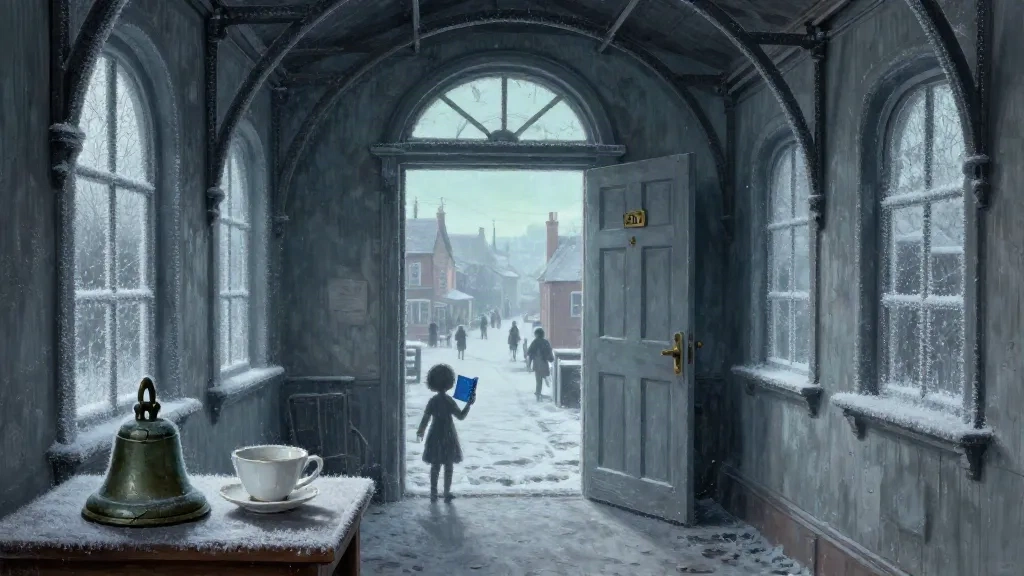
Mara kept the museum of doors behind the railway arches, where the brick walls sweated iron in winter and the lamps shone the soft cyan of a dawn that could not decide to arrive. There were three hundred doors, each set in its own crooked wall. Brass labels named them: courage of the First Step, Courage of the Empty Hand, Courage Required at Three in the Morning.
Door 267 had no name. Its paint was the grey of frost settling over a field, and its brass plate had been polished so often the numerals were thinning.
Mara was the librarian. To residents, the locals said, she was merely the woman who worked too late among doors no one could use.
Her own rented room above the station accepted no impossibilities. It had a brass key, a pasteboard bed, and a landlady who complained about damp. Every winter Mara asked whether the town might need a librarian who had not yet decided what she was. The landlady said the town needed fewer books and more damp-proofing.
So Mara kept a book beneath the museum counter.
It was bound in blue leather, though no blue had survived in the spine. Whenever a nervous visitor opened it, the pages showed a different room: their own, but altered. One window had become a door. One ancestor stood behind the glass. One wall had been removed, exposing weather that smelled of scorched rosemary.
Visitors read their possible lives, borrowed the courage they required, and returned the book by dawn. They always thanked Mara as though she had merely lent them a flashlight.
The Empty Teacup and Cracked Bell
On the desk where visitors signed the ledger sat an empty teacup. Its saucer was chipped, though the cup was perfect. A cracked bell lay beside it, mute since the museum opened. Mara rang the bell whenever a door changed its destination. No one could remember hearing it.
A child came on the first Thursday of frost.
Her name was Nell. She had arrived without a coat, carrying a red mitten filled with black seeds. Mara meant to give her tea, but the cup remained empty when she poured.
Nell pointed to the book. “That is the house where the forgotten people drink.”
“There are no forgotten people,” Mara said.
“There is one behind your refrigerator.”
Mara explained that refrigerators were not among the museum’s exhibits.
Nell opened the book. In its pages, Mara saw a kitchen with no doors. A narrow shape crouched beside the boiler, long arms folded over its knees.
“She is waiting for everyone to agree she cannot come to supper,” Nell said.
Mara looked from the page to the child. “You can see it.”
Nell nodded. “Because I have not made up my mind about her yet.”
That was why the adults found Nell uncanny. She spoke to the dog that had vanished years ago. She greeted the drowned man crossing the market on rainy evenings. Once she waved to the pale woman who lived in the church organ and refused to sing.
The townspeople had agreed the pale woman did not exist. They shut the organ, dismissed their children from the square, and altered their memories whenever one returned. Nell had spoiled it by calling her Miss Alder.
Two Hundred and Sixty-Seven
Door 267 began knocking that night.
Not loudly. A spoon against porcelain. A fist inside a hollow wall. Three patient taps, then a fourth swallowed by the floor.
Mara lifted the cracked bell. Its clapper had been removed. Still, it trembled in her hand.
Nell pulled the door open.
Beyond it stood a village under a cyan dawn, every house occupied, every lane crowded with people who had been forgotten in one particular way. Across the square, a man argued with the rain. Beside the well, a woman poured endless water from an empty teacup. She looked toward Nell and raised one grey hand.
“You must take the book,” she said. “Or all these doors will lead here.”
Behind Mara, the museum doors began swinging. In the dark glass of each, the same impossible village appeared. People stumbled through carrying the same book, all of them shouting the name of someone no longer visible.
Nell held out the red mitten.
The forgotten people had filled it with seeds: rue for courage, thorn for anger, bellflower for forgiveness, and the black seed of an unasked question. They wanted to plant them in ground that had agreed to grow only useful things.
Mara understood.
The villagers were not trapped because the town rejected them. They were trapped because rejection had become a place.
She gave them the bell. Nell struck it with the red mitten.
The crack became a voice. Then a road.
A Place on the Floor Plans
At dawn, the landlord found frost across every window in the railway arches. Door 267 stood open. Beyond it, impossible residents crossed the museum carrying beds, cradles, ladders, jars of cloudy weather, and portraits of themselves.
Mara had not found a home. She had made one.
She placed the empty teacup in the doorway. The pale woman from the organ filled it with warm water, then added tea that smelled of every lost key.
On the last page of the blue book, Mara wrote:
Address: here. Occupants: as found.
That night, Nell returned the cracked bell to the desk. It was not healed. She said some families needed a summons to remind them the door was theirs.
Years later, travellers reported seeing lamps in the railway arches and a librarian standing aside, making room.
They also reported a small boy listening beneath the floorboards, saying hello to whatever had been agreed not to hear him.
Some nights, the bell rings once.
No one turns away.





