 Netwrck
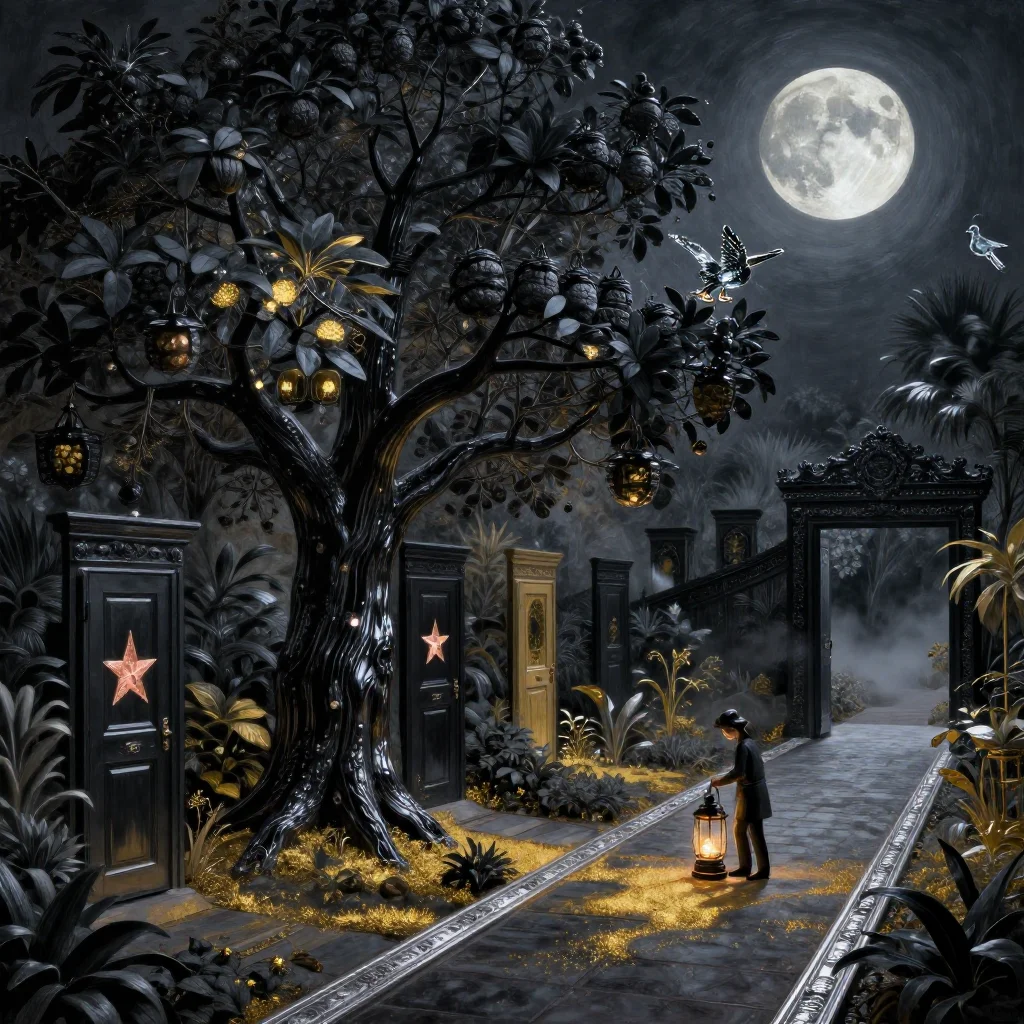
Fairy-Tale Fiction.
The Lantern of Avoided Paths
Mara made lanterns for the paths people avoided. She sold them at the ditch beyond the eastern wall, where the ferryman twice had turned back a customer and once had walked his own horse into the water. She sold them to children who would not pass the black orchard. She sold them to messengers who had begun taking longer routes because the straight ones remembered too much.
Her lanterns were small, palm-heavy, turned from beaten copper with a seam of black wax down one side. The wick was flax, braided by her own hands, and the oil was rendered from the grey geese that grazed the upper field. The flame in such a lantern never leaned. Set one beneath an ivy arch and the ivy would shine green-gold for as long as the oil lasted. Hang one from a neglected gate and the gate would remember, for an hour or so, that it had once been a door.
That was the whole of the trade. Illumination that was not fire. Illumination that asked nothing of the ground it lit.
At the center of the garden stood an old walnut tree whose trunk had grown doors. Narrow ones at knee height for children, broad low ones grooved by cart wheels, black-lacquered ones with no handles at all, and high in the crown three doors that opened only when the moon was cold enough to silver the hinges. Mara crossed the garden every evening winding her wick and polishing the paths with her light. She kept to the southern arc. She never once took the northern face, where the roots came up pale and braided like ribs.
Beyond the northern face lay the border. She had seen it once from the ridge, a silver line laid between two countries that appeared on no map in her satchel. On her side: black trees, empty fields, a wind that smelled of turned earth. On the other side: lights moving in patient procession, a procession that never arrived anywhere, because it was not a procession of people but of evenings.
Her mother had been a mender of coats, and had left her two things. A copper star, small as a thumbnail, that fitted inside a lantern exactly. And a glass bird with no wings, its body shaped as though it had remembered flying and been told to forget it. The star had come out of the coat pocket where Ilva kept her needle. The bird had stood on the kitchen sill above the blue cups for eleven years, and had never once been dusted, which Mara had thought impossible until she understood that the bird did not collect dust. Dust collected near it.
Those were the last words, and Mara had carried them for two years without once opening them for inspection:
Do not let them choose what you are.
She had built a small private arithmetic on top of them. She called it keeping. Keeping the star in the lantern. Keeping the bird on the sill. Keeping the boy at the orchard from going in. Keeping the kitchen exactly as it had been, the third cup still chipped, the blue ones never used. If she kept all of it, then nothing in it could leave, and nothing in it could die twice.
The border guard would admit anyone who surrendered what they carried. A name. A keepsake. A reason for leaving. Mara had prepared speeches for each and had rehearsed them to the wooden posts of the fence until the words had gone soft as coins.
She would say she carried nothing worth keeping. That was false, and the border knew falsehood better than she did.
She would say the copper star was only metal and the bird only glass. That was closer, but truth offered in pieces was still a surrender, and she had decided — she remembered deciding, on a Tuesday, with her hands in the dishwater — that if the border was going to take something, it would have to come to the garden and pull it out of her living hand.
The Bell Under the Roots
On the seventh evening of autumn the bell rang.
It hung beneath the walnut tree in a hollow where the roots crossed, a small bronze thing the size of a fist, green at the lip. It made no sound when Mara approached with her wick. It made no sound when the guard raised his lantern along the far side of the line. It stayed mute for a fox, and for a heron, and for the wind itself.
Then Mara closed her hand around the copper star inside her lantern.
The bell answered with one clear note, and the note went on longer than any bell she had ever heard, long enough that the leaves above her turned their pale undersides out, all at once, like a hundred small hands opening.
“Decision,” said the guard.
He said it from thirty paces off, without raising his voice, the way a man says a word he has said many times at the end of a long shift.
“I did not decide anything.”
“You decided to keep them.”
She withdrew her hand. The note stopped so abruptly that her ears kept ringing, which she found insulting. She was fifty-one years old and the ringing made her feel like a struck cup.
“You decided,” the guard said, “while standing at that sink. You will have felt it settle. It is not a big decision. The big ones are easier. Nobody rings for those.”
She put the star back into the lantern and latched the door of it, and the bell stayed silent, and that silence was the loudest thing in the garden.
It began ringing again the same night, without her touching anything. Once when she looked north toward the silver line. Once when her hand found the star through the copper. Once, more faintly, thinner, like a wire heard through a wall, when she thought of the last words and heard underneath them the sentence she had never once said: I do not know what they meant.
That was a decision too. She had carried it farther than the border.
Senn came at dusk the next morning, the orchard boy, nine years old and no longer nine, carrying his lantern by its hook so it swung against his knee like a censer.
“It doesn't lean,” he said. “I stood in the wet grass an hour and it didn't lean. I want to be the kind of person it doesn't lean for.”
“Sit down. I'll trim it.”
“I heard the bell.”
Her hands did not stop. “You were at the ridge.”
“I was at the ridge. Not because I was brave.” He said it without any weight at all, which was how she knew he had learned it from her. “Because you were down here. I'd rather be watched by you than not watched at all.”
She gave him the trimmed wick and the small jar of goose oil and taught him the seam, and when he left the southern gate he turned once, deliberately, to look at the northern face, and she let him, because a thing you are not allowed to look at is a thing you look at for the rest of your life.
The Ledger of the Guard
The guard came over the line at the hour before dark, when the border was only a thinning of the air, and set a lantern of his own on the grass between them. It was a lantern of government, plain, unpolished, its wick burning with a dry little yellow flame that gave light the way a word gives light when you are being questioned.
“Oren,” he said. “Not my whole name. The border has the rest of it. It keeps what I gave it.”
“You crossed.”
“I crossed once. Fifty-two years ago. I gave them a name — my sister's — and they let me through, and then they posted me at the line, and here I have stood every night since with the very lantern I carried in.” He turned the plain lantern a quarter turn. “Do you understand what I am? I am the toll. Every traveler I admit, I do not. I stand here so that the ground under me is the only ground I have any business being on.”
“Then you know what I am carrying.”
“I know what you are not putting down.” He nodded at the tree, at the pale braided roots. “It has been ringing for you for a week. It rang for me too, the whole time I was waiting for a name to stop ringing for.”
“What did it say about you?”
“It said you decided your sister should be the one who goes,” Oren said, “and then it said you decided to call that generosity, and then it said you decided to stop deciding, and called that service, and were given a lantern for it.” He said it without bitterness, in the flat tone of a man reading an inventory. “It is very precise. It never once accuses. I would give a great deal for a thing that accused.”
“And if someone gives you a name tonight?”
“Then I will be the one who is admitted, and I will have not the faintest idea where to go, because I have been a border for longer than I have been a man.” He picked up his lantern. “You think the line is a punishment. It is a habit. That is worse and it does not end.”
He went back over the silver line, and where his boots went the grass took a moment to remember being grass.
The Doors She Had Refused
On the second night the walnut's doors began opening without her.
The first showed a kitchen with blue cups. Ilva was at the table with the star in her palm, turning it, not sewing, not standing over anyone. The room was warm and wrong and Mara knew within a breath that the room did not have a window, because the kitchen had never had a window. She looked at it the way you look at a portrait of yourself painted from a description.
“She's not ill,” said the room. “You'd like that clarified first. She's not ill. She's seventy-four and she's tired and she's waiting for you to admit that you have been making her wait for four years so that you could keep the last of it.”
Mara closed the door.
The bell rang once, and the ringing was not a punishment. It was a receipt.
The second door was a hospital corridor with a green cloth bed and her own hands folded on it, the knuckles of the left hand gone white, and a man she had not been able to look at in that corridor leaning on the wall in a coat with the wrong color. The room said nothing. The corridor simply went on being a corridor, which is the cruellest thing a refused place can do to you.
She closed that door too. The bell rang.
The third was a railway platform in summer, and Ysabet was on it, forty years old and furious, holding a child's hand, and the child was not old enough to be hers and the sun was the specific gold of an August that Mara had spent inside a locked room of her own making.
“You decided I should be told after,” Ysabet said. “That was a decision. You decided a kindness could be a schedule.”
“I decided it would be gentler.”
“Yes,” her sister said, and this was the part that put the knife in, not the anger but the agreement. “It was gentler. That's what decided it.”
p>Mara closed the third door, and the bell rang, and the sound climbed into the tree and loosened the leaves so that gold dust sifted down and settled on the black-lacquered doors, which had until that moment been shut, and which now stood open, all eleven of them, in a fan.She counted them. Counting was what she did instead of the other thing.
Behind the eleventh was the black orchard, and Senn was walking into it with his lantern held high and his shoulders unhunched, and past him the trees were making a sound like a held breath, and he did not turn around, because he had decided not to, and there was nobody left in the orchard to call him back.
“That one is not a place you refused,” Oren said from the line. “That one is a price. Refused rooms only show you what you did. That one shows you what you did with a boy.”
She shut it. The bell rang, and the gold dust went into her hair, and she stood in the middle of her own garden in the dark with eleven doors in the tree and one of them she could not afford, and the arithmetic she had kept so carefully came apart in her hands like a wet ledger.
The Border That Would Not Move
At the ridge, in the gray of the fourth dawn, she found a footprint crossing the silver line.
One print, heel deep, toe shallow, pressed into the line itself as though the line were mud. No body attached to it. It began at the border and ended beneath the walnut tree, and it had been made by a bare foot, and the print was the size of her mother's.
She followed it. The silver line moved with her. When she stepped toward the other country the black trees on her side bent away from her, not breaking, bending, the way a crowd bends. When she stepped back, the lights across the line went out, one after another, patiently, as though they had been counted off.
It was not a wall. It was a question asked so many times by so many people standing exactly where she was standing that the asking had hardened into geography, and geography did not care who you were, only that you had asked.
She put her palm flat on the line. It was warm, the way a hand is warm, and under her palm she felt it adjust — a fractional hesitation, a held breath — and she understood that the border was not a place she was being kept from but a place she was being politely held in.
“Offer the bird,” Oren said. He had come up the ridge without sound and stood with his ledger under his arm, or the thing he carried instead of a ledger. “It is the lightest thing you carry. Lightest is not the same as least, and that is precisely why it will cost you.”
She held the bird up. Its tiny beak took the coming daylight and gave back a piece of nothing at all — a colorless, weightless sky, the color of a thing that had been described to you secondhand your whole life.
“No,” she said.
“I know,” said Oren. “I am required to make the offer. It is the only part of the night that is mine.”
And at once every door in the walnut slammed, all eleven, the full length of the tree, a noise like a held breath let go. Night became a sealed room. The paths vanished under black leaves. Somewhere beyond the branches a child said her name — not Senn's voice, a younger one, her own, the way she had said it at the door of her mother's room in the last winter — and then did not say it again.
Mara struck the trunk with the copper star.
A narrow door opened in the bark at knee height, and inside it was her childhood room, exactly as she had left it, including the mark on the floorboards where she had dropped the iron as a girl. Her mother sat by the window sewing a coat that was already finished, because that is what the room wanted, not a memory but a chance.
“You came back,” the woman said.
“I never left.”
“No. You decided not to return. Those are different animals and only one of them can be tied up.” The needle went in and out, in and out, without a seam. “The bell is not under the tree, Mara. It is under the floor. It is under every floor you ever stood on and would not move.”
Mara sat down in the doorway, because her legs had made the decision for her.
“Tell me what I have to say,” she said.
“No,” said her mother. “That is the entire point of you, and it is the last thing I am going to teach you.”
The Name of the Crossing
She stood up and took the unfinished coat off its hook. It was heavier than a finished one. She held it for a moment against the small of her back the way you hold a child that has been asleep a long time, and felt the weight of it, which was not a weight.
“I left because I was afraid,” she said. “I told myself for two years that I was carrying her last words. I was carrying the right to be her last word. I made Ysabet wait to be told so I could go on being the one who was wrong first, and being wrong first is a throne, and I sat on it for four years and called it keeping.”
The bell rang once under the floorboards.
The room shook. Cold moonlight came through the window and lay across the floorboards in a silver sheet, and where it touched the coat the stitching let go, thread by thread, without a sound, the way a knot gives up when you finally stop pulling.
“Will you cross now?” her mother asked, and stood, and was not there, and the window was still open.
“Will you come?”
“No. Crossing is not returning. It is only the other direction.”
Mara kissed the empty coat and laid it across the bed, and out in the garden the sky had gone the color of a knife that has been sharpened too far.
She went back to the walnut with the copper star and the glass bird and put them both down in the lantern together, side by side, the way her mother had kept them, in two different places, for two different reasons.
“I surrender the claim,” she said, “that keeping them keeps me unchanged.”
“Say what that spends.” Oren was there. She had not heard him come and did not care; there was no longer room in her for the care that took.
“Everything I had that I did not have to earn again.”
The bell rang — under the roots, under the floor, under the whole of the garden — and the two objects changed.
The star dimmed. The glass bird shattered into a thousand clear pieces, and the shards did not fall, they went upward into the branches and stayed there, hanging in the crown among the high doors, each one catching light and giving back a small, colorless sky. The loss went through her hands sharp and clean, exactly as a held note goes through a room, and the flame in the lantern did not go out.
It illuminated the path.
She crossed without offering the objects, because they were no longer hers to offer, and behind her the walnut's doors folded into the bark one after another with a soft, closing sound, like a house being shut up for winter. Ahead, the foreign lights had stopped their procession and were standing still, spaced out along the line, and when she passed between them they did not cheer and they did not follow.
“Now what,” she said.
“Now you find out what you are without a throne in it,” Oren said. “It is not comfortable. Most people go back across within a season and pretend the line moved.”
The Path Afterward
On the far side there was no city, no field, no promised procession. There was another garden, darker than her own, with doors growing out of its trees and its paths avoided by people who had never learned their names. The grass there had been walked flat in a narrow line, the same narrow line, back and forth, for a great many years.
At the edge of it stood a lantern-maker's bench. Beside the bench lay a hammer, a jar of gold dust, and a blank sheet of black glass. The bench had been made for a right hand. Mara set her own palm flat on it and felt how the wood had worn down on the left, the way a thing wears when the same person stands there a thousand times, leaning.
She understood, then, and it took her a while to get all the way around it, that the border had never wanted her objects. It had wanted the lie underneath them: that possession was a kind of keeping, and keeping was a kind of love, and love so arranged required no answer from anyone, ever, and could therefore never be refused.
She set the wingless bird's frame on the bench. It was miraculously whole, the frame of it, thin as a hair, and she bent the wires back with her fingers until the little ribs of the wings were true again. Around that frame she built a new lantern: body black lacquer, seams dusted with gold, wick of flax, oil of grey goose. She filled it with moonlight, which is not a liquid and is not a fuel, and works anyway in a lantern built by a person who has stopped keeping.
When she hung it over the first neglected path, the hidden door appeared in the hedge — an old gate, unpainted, sagging, that had plainly been a door once and had been talked out of it.
From somewhere beyond it came a bell.
p>Not beneath the roots this time. Inside her lantern. And the note it struck was the note the walnut's bell had given the copper star on the seventh evening of autumn, and it rang for the closed doors, and for the chipped third cup, and for the blue ones never used, and for a railway platform in August, and for a corridor with a green cloth bed, and for a man in the wrong-colored coat whose face she had not been able to look at, and it did not stop, and it did not punish her, and she understood at last that the bell had never been an accusation.It had been waiting to tell her the exact moment she had chosen the life she wanted.
Behind her, the border had closed to a seam of silver and stayed there, a question asked only once now. The dark garden went on being dark, and all its doors went on waiting, and the flat walked line in the grass went on being walked, and none of it was finished for her, and none of it had ever been going to be.
She opened the gate in the hedge and stepped through, carrying light enough to return by, and nothing she had mistaken for a promise.
Behind her in the hedge, a gate that had not been a gate for nineteen years came loose from its hinges and fell outward, and stayed open, and would not be closed again by anyone she had ever known.





