 Netwrck
Magical Realism.
The Book of Unfinished Rooms
Mara kept the museum in the basement of an old customs house, beneath a ceiling painted midnight blue. Thirty-seven doors stood in rows along the walls, each one breathing a different weather when opened. Copper smelled of rain. Glass carried the hush of a winter road. A narrow red door, its paint still wet, opened onto a field where every lost person was waiting with a lantern.
Each door represented a kind of courage: the courage to forgive, to begin, to stay, to ask for help. Visitors touched the brass plates and received a challenge. They returned later, changed.
Mara was the librarian. She did not lock the doors or explain their meanings. She only lent books.
Her favorite was impossible. It had no title. On its cover appeared a house with every window illuminated, and whenever a borrower opened it, the pages described a different way to enter that house. A widower read about a kitchen hidden beneath a bridge. A courier found instructions for crossing a river without leaving footprints. A young woman discovered that home was not a building but a person willing to remember her name.
No borrower ever returned the same book. Mara did not mind. The library’s shelves were never short of volumes, and the impossible book always appeared on her desk by morning.
Her desire was small, precise, and impossible: she wanted a home that would accept impossible residents.
She had lived alone above the museum for eleven years, in one narrow room with a window facing a brick wall. Every evening she placed an empty teacup beside the lamp, waited for the sound of footsteps, and poured tea for someone who never came.
The Child and the Invisible Door
On rainy afternoons, a boy named Elian visited the museum. He was nine, severe in the way of children who have learned not to expect much. He never chose a door. Instead, he stared at the wall behind the red one.
“There’s a crack,” he said.
“Every wall has cracks.”
“Not like that.” He pressed his palm to the plaster. “Someone is knocking from the other side.”
Mara heard nothing. The other visitors heard nothing. They agreed, without discussing it, that the wall was solid.
Elian frowned. “You all decided he wasn’t there.”
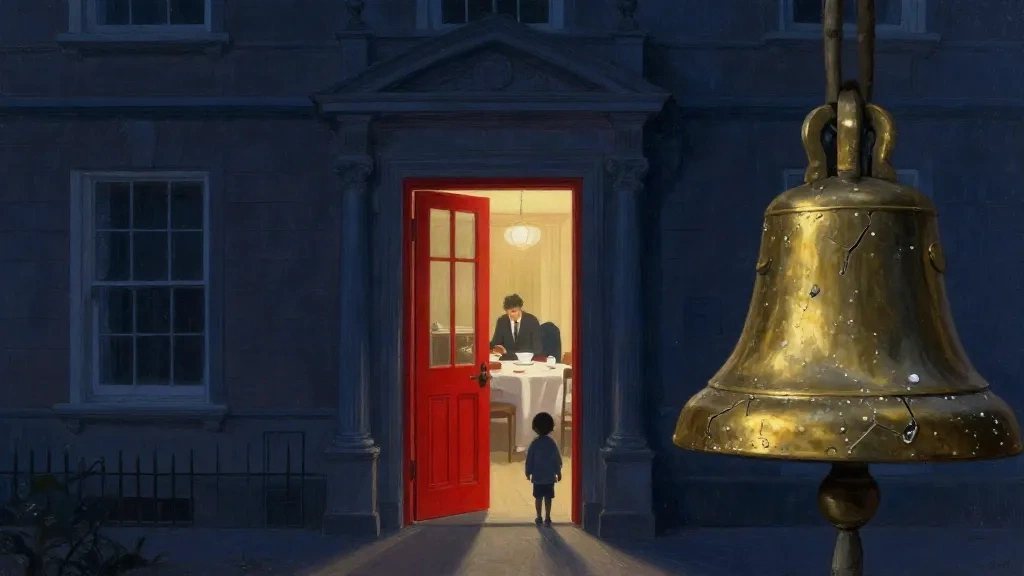
That evening, the cracked bell in the museum’s central hall began to tremble. It had not been rung since the doors were installed. Its fracture ran through the metal like a river on a map, and its sound arrived as a series of tiny, familiar coughs.
Elian pointed toward the red door. “Open it.”
“That door leads somewhere else.”
“I know. It is here.”
Mara turned the brass handle. The red door opened onto a dining room lit by pearl lamps. A long table stretched through the room, set with mismatched plates and one empty teacup at the far end.
Beyond the windows, shadows moved without bodies. Shelves climbed the sky. A staircase descended into warm earth.
On the table lay a stack of application forms.
The House at the Edge
The first form asked for a name. The second asked what the applicant could become if no one watched. The third had a single question: Who will notice when you are gone?
Mara filled them out. She wrote her name in the first box. In the second, she wrote “unobserved.” In the third, she wrote Elian.
He reached for the pen. “If I go in, does the house know I can see things?”
“It will know what you see.”
“That isn’t the same.”
Outside, the museum’s doors began opening and closing by themselves. Visitors walked through walls, returned with wet shoes, laughed too loudly, and forgot where they had been. A woman claimed she had found her courage in a room full of locked doors. An old man said courage was a light that never searched for its match.
Then the house asked Mara to choose who could live there.
She looked at Elian. She looked at the red door. The empty teacup waited on the table, no longer empty: a small green light trembled inside it.
She understood then. The museum had been a test, and the child had been the only one honest enough to see it. The walls were not hiding a door. They were waiting for someone to stop pretending the door was not there.
A Room with the Lights On
By dawn, the impossible book lay open on Mara’s desk. Its pages had changed. There was no longer a house on the cover, but a row of lit windows moving slowly across a midnight-blue horizon.
She picked up the cracked bell. Its missing note was somewhere inside the walls, waiting to be returned.
When Elian arrived, he was carrying the empty teacup. He had crossed the invisible threshold alone and found the room they had built: crooked chairs, a narrow staircase, a cellar full of forgotten names.
“It accepted me,” he said.
Mara took the cup. “Does it have room for one more?”
He pointed to the windows. Pearl light filled them one by one.
“It has room for everyone the world overlooks.”
Then the bell rang. The sound was not loud. It traveled through the museum, through every locked and unlocked door, into the rooms where people had been afraid to knock.
Mara took Elian’s hand and stepped inside.
Behind them, the red door closed. It did not disappear.
That was how she knew they had finally come home.





