 Netwrck
Mystery.
The Keeper of Other Weather
I keep the weather from places that have never existed.
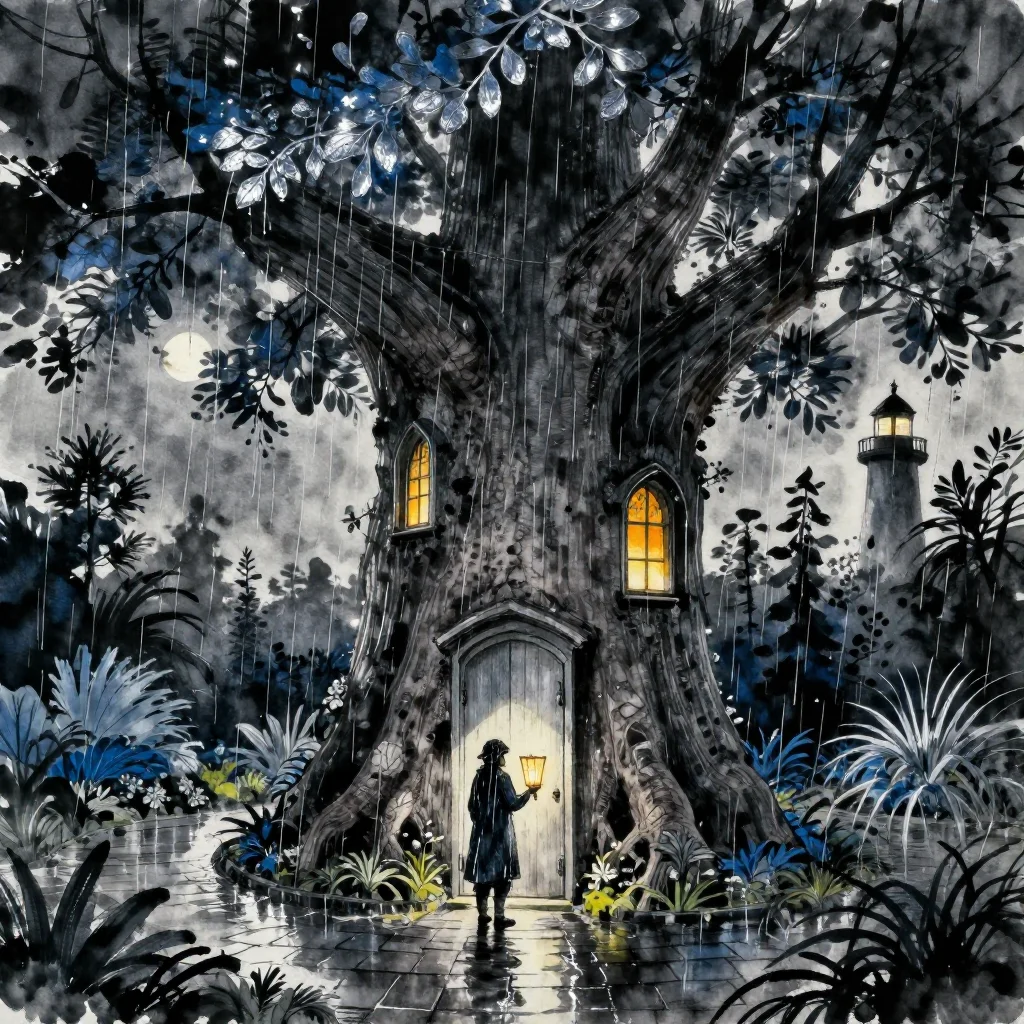
Every dawn, before the gardeners arrive, I climb the lighthouse tower on the eastern wall of the Arboretum and write down the pressure, wind, and rain that pass through its colored glass. I record silver rain falling upward over a red desert. I record the warm blue mist of a country whose cities float beneath a sea. In the margin, I note the hour when a small moon appears, though it is neither waxing nor waning.
The Arboretum stands around a tree older than the city. Its trunk is smooth as wet slate, and its branches bear doors instead of leaves. Some open onto greenhouses, some onto narrow rooms containing nothing but salt, and one opens onto a beach where the tide repeats the sound of my mother’s name.
I do not enter the doors. I only catalogue what comes through them.
That morning, a paper lantern drifted from the tree’s highest branch. It was folded from the same silver paper as the rain, though one window of it glowed amber. It landed at my feet, and inside was a damp visitor’s ticket.
The name on the ticket was Ilyra Venn.
I knew her. She had come to the garden every Tuesday to feed the night-blooming jasmine. On the previous night, she had asked me to record a storm she remembered from no world I knew. Then she went home.
She did not arrive at the gate.
Articles of the Impossible
At the municipal office, Registrar Eno tapped the ticket against a brass scanner. The machine produced no number.
“A lantern from a tree-door,” he said. “A person who cannot be located. Both are forbidden.”
I showed him the rules, bound in blue covers. Article Nine: no impossible object may be transported within municipal boundaries. Article Twelve: no person may be returned to a place that does not exist. Article Sixteen: any phenomenon lacking a registered cause must be declared unreal.
“The tree grows the doors,” I said.
Eno shrugged. “The tree has a permit.”
“Then Ilyra is a missing person.”
His face softened, but he did not open the file. “She has been reported as collectively forgotten.”
That was the phrase they used when a person vanished from every register at once. No body. No last address. No surviving relative willing to say the name. The city declared the absence administrative, as if grief were a clerical error.
Ilyra’s name flickered on the ticket.
In the corridor, a brass notice clicked on the wall: THE IMPOSSIBLE IS NOT TRUE. IT IS ONLY UNLICENSED.
I pocketed the ticket and went back to the tree.
A Door Made of Weather
The doors opened more often after dusk. They whispered in the leaves, each one offering a different climate. I lifted the lantern beneath the lowest branch.
A door appeared in the trunk, narrow as a person.
Beyond it was Ilyra’s room, exactly as she had left it: a blue coat on the chair, two cups on the table, the jasmine seeds lined up in a row. Ilyra sat on the floor with her back against the door, writing her name on paper.
“They keep taking it away,” she said.
“I know.”
“You don’t.” Her eyes held the same weather I had catalogued: distant lightning, an ocean without a shore. “Every time the city forgets someone, the world forgets how to return them. I can’t cross the threshold.”
I understood then why the rule existed. A door between worlds was a wound. A person caught inside it was a living breach.
But Eno’s prohibition did not say rescue. It said return.
I reached for Ilyra’s hand.
The tree slammed shut.
The garden went dark. Lanterns ignited along every branch, silver and amber, until the rain over the courtyard fell upward and the small moon shone through the cloud like a coin held underwater.
Eno stood beneath the tree with an official seal in his hand.
“You have created an unregistered exit,” he said.
“She created the door.”
“You brought the impossible within the boundary.”
“No.” I held up the ticket. “I found evidence that she was still alive.”
The Name That Stayed
At dawn, I climbed the lighthouse and opened the catalogue.
In the book, I wrote the weather Ilyra had carried: pressure rising from below, rain falling inside a sealed room, the small moon fixed above a window that had burned amber all night. Then I wrote her name in the largest letters I could make.
Eno climbed the stairs to take the book.
“That entry is impossible.”
“It is observed.”
“It violates the register.”
“It is the register.”
Below us, the tree-door opened. Ilyra stepped through carrying her blue coat and the paper lantern. Her wet footprints darkened the stone, each one giving back a small amber window.
Eno looked from her to the catalogue. His seal fell from his hand.
“For the record,” he said, “this never happened.”
“Understood.”
I watched Ilyra cross the courtyard. The small moon remained visible above the lighthouse, no longer making the sky smaller.
That night, I recorded a new climate: one clear window in a city determined to close them. In the margin, beneath the weather, I wrote her name again.
It stayed.
So did she.
The tree opened another door. This time, I kept the lantern lit.





