 Netwrck
Adventure.
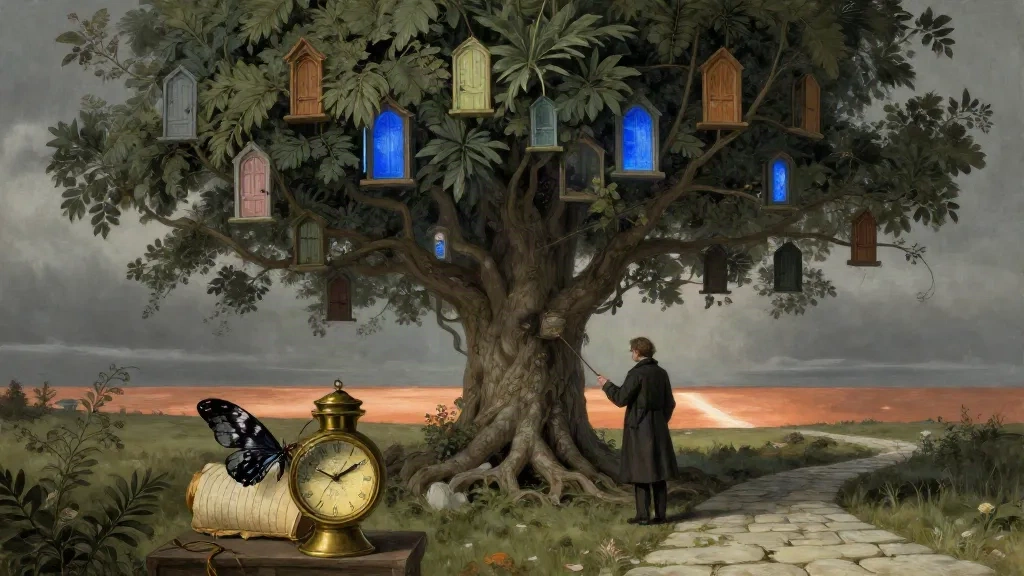
At the edge of the city, beneath a sky the color of hammered copper, the Marrow Botanical Garden grew its doors inside a tree called the Indices. The tree was not planted. It had arrived during a storm so dry that the riverbeds cracked open and three years later began to bloom.
Iona Venn kept the garden's clocks in a narrow pavilion of pale stone. Her clocks did not measure hours. One caught the short blue morning of spring, another held the long, breathless pause before rain. The oldest recorded the season of a particular tree, winding its brass hands whenever its leaves remembered falling.
On the morning the paper lantern stopped moving, Iona found a moth wing beneath her workbench.
It was the color of black cherry, veined with copper, and dry as old paper. She recognized it from a memory she had never lived: a child in a glasshouse, holding a lantern, watching one wing become translucent.
The clock responsible stood open on her bench. Its dial was blank except for a small blue door.
The Choir in the Trunk
When Iona turned the key, voices came through the tree.
One voice insisted the lantern had been lit for guidance. Another said it had been lit to lure something away. A third remembered a hand reaching for the moth, and a fourth insisted the hand had been raised in warning. They overlapped, each memory altering the meaning of the last.
“We are the garden's custodians,” the tree said through the hollow door.
“Then you know who made the lantern.”
The choir went silent.
On the back of the lantern, beneath a peeled strip of paper, Iona found a maker's mark: three linked circles crossed by a line. She knew the mark. It belonged to Elian Roe, the gardener who had planted the first seeds and disappeared before the garden opened to the public.
Iona's task was simple enough to be cruel: return the wing, lantern, and stolen memory to the person who had made them. She packed a brass case, a spool of silver thread, and the clock with the blue door. The wing rested between two sheets of vellum.
She did not tell the choir she was leaving.
The Door That Faced Winter
The nearest door opened onto winter.
Snow climbed the garden walls in blue-white folds. Every tree had lost its leaves, and the Indices stood stripped, its branches crowded with small wooden hinges. Beyond the door, a child in a glasshouse held the lantern.
Iona stepped through.
The child looked up. Its face was young, but its voice belonged to the choir.
“Take it,” the child said, offering the lantern.
Iona's fingers tightened around the case.
The wing had been torn from a moth. Elian had made the lantern. The memory belonged to neither of them, and the garden wanted it returned to someone specific. Every door offered a different claimant.
A second door opened in the tree. Behind it stood Elian, older than Iona had been told, his sleeves stained with soil. He reached for the wing.
“I made the lantern,” he said.
“I did not make what happened next.”
“The moth made it possible.”
“The moth did not ask you to keep its wing.”
The choir began again. Some voices urged her to give him the wing. Others warned that he had left the garden to fail. The child pleaded for the lantern. A voice from the far side of winter whispered that the lantern had been meant for Iona.
She pressed the silver thread across the lantern's frame. The memories brightened, each one showing the same instant from a different angle.
What the Maker Could Not Keep
Elian had not abandoned the garden. He had sealed the final door after finding that the tree was taking memories from visitors and turning them into seasons. The lantern was his warning system. The moth wing was the first thing the garden took.
He had hidden both in the clock so that someone would discover the theft and repair it.
“Why not leave your name?” Iona asked.
“The tree edits names.”
She looked at the blank space beneath the maker's mark. Then she cut the thread free.
The blue door on the clock opened. Inside, instead of a room, there was a shallow hollow lined with pale stone. The lantern stood there, intact. The moth wing lay beside it, and beneath both rested a note in Elian's hand: RETURN WHAT IS NOT MINE.
He had not made the theft. He had made the lantern. The moth had made the wing. The child had made the memory of holding it. Iona held only the hour when the loss was noticed.
The choir split into voices arguing over which truth deserved to survive.
Iona placed the wing back on the lantern's handle and wound the season clock to the instant before the theft. The paper lantern flared, releasing the memory intact: Elian, the child, the moth, and a blue door opening onto a morning that still had room for all of them.
Then she carried the lantern and wing through the tree.
Elian received them without apology. The child received the memory. The moth's wing returned to the moth, which circled the lantern until its flight made the paper glow.
At dawn, Iona repaired the blank dial. The blue door remained, but it opened only onto the garden.
From then on, she made no clock for a season without giving it a way home.
The Hour Before Return
Years later, travelers still enter the Indices by doors that appear after rain. They bring lost things: gloves, letters, names, the final word of apologies. The choir debates their meanings, but the clocks keep the rules.
No one may keep a thing merely because they understand its sorrow.
Every maker must receive what was taken. Every witness must be allowed to tell the story. And every door, even the one that opens onto winter, must eventually face the copper horizon.
Iona's oldest clock still sounds before dawn. Its hands do not point to an hour. They point toward the road, where the paper lantern moves between the pale stone trees, guiding nothing home except what has finally learned the way.





