 Netwrck
Weird Fiction.
The Book with No Cover
Mara worked at the Museum of Doors, where every corridor ended in a different kind of courage. One door opened only for the person who could forgive a murderer. Another waited for someone willing to walk toward a creature known by the sound of its breathing. The museum had no ordinary maps. Its rooms rearranged themselves according to what visitors needed, and its curator said this was not magic but good architecture.
Mara's own room contained a desk, a narrow bed, and a locked cabinet she never opened. Inside the cabinet was the same impossible book she had lent to visitors for twenty-three years. It had green cloth pages when she took it out, a title that changed according to the borrower, and no first page. Every reader returned it altered. Some found their name written in the margins. Others found a map leading to a house they had never seen. One man closed the book and forgot how to lie.
Her desire was simple. Mara wanted a home that accepted impossible residents: doors that remembered footsteps, clocks that occasionally wept, and people whose shadows had been misplaced in childhood. She wanted a place where none of them would have to become ordinary in order to be safe.
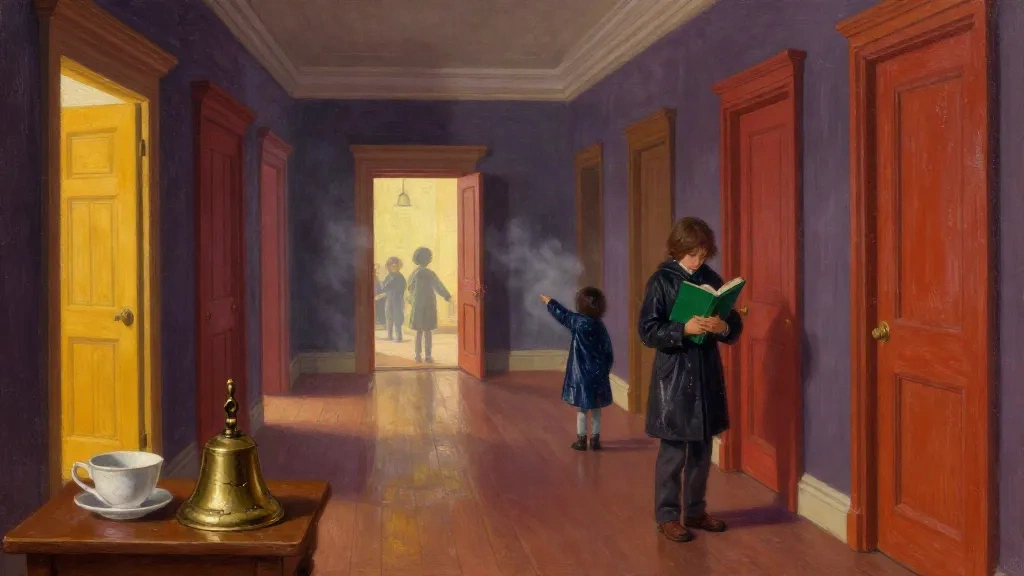
Every evening, she placed an empty teacup beside the book. Beside it sat a cracked bell, mute since the day the museum had opened. Visitors thought the cup was for luck and the bell for silence.
The Child in the Blue Coat
On the first day of winter, a child arrived wearing a blue coat soaked through with rain that fell upward. The child carried no family, no ticket, and no fear. While the other visitors hurried past the locked doors, the child stopped before an unremarkable wall and said, “You have a room behind you.”
Mara looked. The wall stayed still.
“There is nothing there,” she said.
The child pointed at the empty teacup. “There is a house. Everyone agreed not to see it.”
Then the child took Mara's hand. The wall opened inward.
Beyond it was a narrow house with windows in the floor, a staircase leading into fog, and a family of translucent tenants eating breakfast at a table made of old doorframes. A woman with too many shadows waved to Mara. A child with a bird for a heartbeat pointed toward an empty chair.
“We agreed to overlook this place,” the child said, “because the house is afraid.”
Mara opened the book. The title on its cover read Homes for Those Who Have Not Been Believed.
What the Bell Remembers
The tenants had once lived in the museum, but the doors had closed on them. They could be seen only when everyone admitted the agreement that hid them. The child had seen because children had not yet learned the shape of that lie.
Mara read aloud. The words on the green pages became a floor plan. The house assembled itself around the empty teacup: rooms for the woman with stolen shadows, for the boy whose heartbeat nested in a sparrow, for an old man who had forgotten his own name. Each door opened onto a courage someone had abandoned.
At midnight, the cracked bell trembled. A thin sound escaped, and the house began to shake.
“It needs a witness,” the child said.
Mara understood then that the museum had built itself from doors no one dared open. Its courage was not bravery performed in public, but the willingness to make room for what others called impossible.
She struck the bell against the teacup. The crack became a voice. The room filled with the ringing of every rejected thing.
A House with No Disguise
By morning, the impossible residents had not vanished. They stood in the courtyard, wet and plainly visible. The museum doors strained against their hinges. The curator complained that the exhibition had become untidy. Mara gave him the book and told him to lend it to someone who needed it.
He carried it away, pale beneath his beard.
The child stayed. Mara kept the empty teacup on her desk and the cracked bell beside it. The house had no address until she wrote one, but the address was not the important part. The important part was that every tenant had a key, and no key locked anyone out.
When evening came, the bell rang by itself. It was still cracked, but its sound no longer meant that something had been lost. It meant the door was open.





