 Netwrck
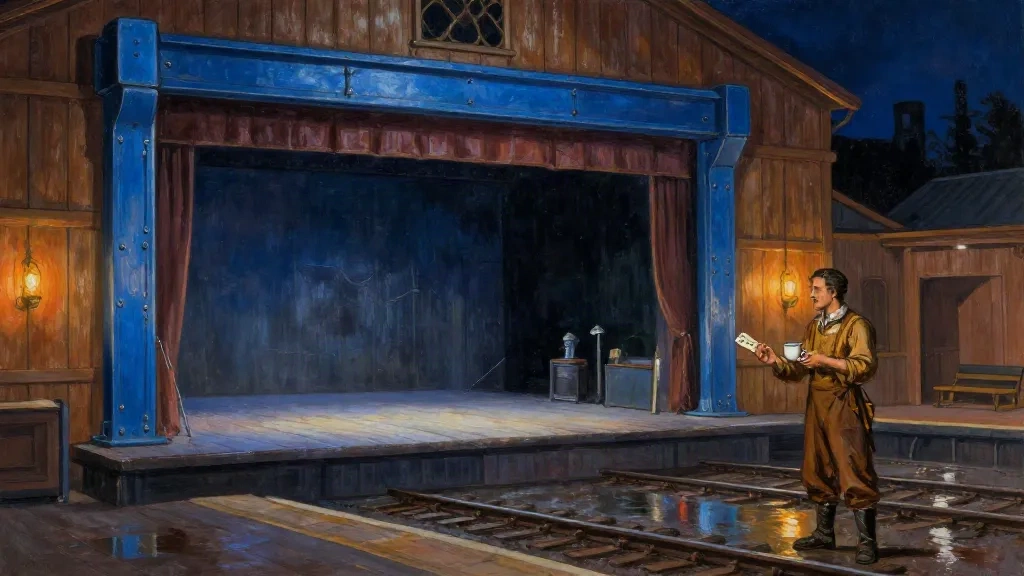
Historical Fantasy.
The Hinges of Tomorrow
On the winter of the copper bells, Mara Venn found a hinge beneath the theatre floor.
It was the size of a cart wheel, forged from blue steel, and shaped like a door that had once stood between two mountains. She carried it out from under the boards the way a surgeon carries out a bullet: level, in both hands, not thinking about her back.
She had repaired tower gates, cathedral valves, and the rusted arms of harbor cranes. Twenty-nine years of hinges. She knew what they were for. A hinge is not iron. A hinge is a promise about weight — a statement of how heavy a door may be and in which direction it will fall when a shoulder leans on it. You can read a door's whole history in the wear on its pin.
She set the hinge on her anvil and read it, and it said nothing. The pin turned without grinding. Each quarter revolution gave a small blue light at the knuckle and, under it, the distant rhythm of wheels on rails, patient as a metronome. There was no cooling scale on the metal. Steel that has never cooled has never been hot. This hinge had been made at its final size, by a hand that had known the finished measurements before the ore left the earth.
Beside it in the crawlspace lay a railway ticket dated tomorrow, and a cup of cold tea with the leaves still standing upright in the dark.
The theatre stood behind her, shuttered, its painted sign faded to the colours of old weather: a masked figure holding a flame above an open black box. Mara had filed that sign eleven years ago, when the town still had a theatre and still hired girls to hold flames in pageants. Her daughter Nell had played the flame. She had worn a tin funnel and a wire cage of candle stubs, and she had smiled all the way down the aisle at a mother who had pretended not to be afraid.
That was the winter of the storm.
Mara had spent it doing what she always did. She had walked the north line's signal box in the wet and re-hung the door, which had thrown off its top pin and killed a man's right hand when it fell. A fortnight after that, Nell walked into the rain with the rest of the pageant girls and did not walk out. Not drowned. Not lost. The river gave back everyone else. Nell simply was not among them, and the town, after the manner of towns, had grown tired of the question by spring.
She was not a woman given to omens. She was a woman given to measurements. But a hinge the size of a cart wheel, forged without a scale, and a ticket stamped with a date that had not yet arrived — those were measurements too. Someone had been exact. Too exact.
The Theatre of Unfinished Endings
The theatre opened only when the last street lantern went dark, and Mara understood within a month that this was not superstition but a term of the arrangement.
The audience arrived without footsteps. Milliners from the row behind the mill. Ferrymen still wet from the crossing. Widows. Children sent to bed an hour ago, in their coats, with their boots on. Once, a young soldier with mud to the ankle, who sat in the front row and wept through all three acts and could not say afterward where he had been.
They watched discarded endings.
A king confessed his treachery in the second act, holding the crown in both hands like a bowl of soup, while his chancellor read the confession aloud and the court repeated every third word. A bride opened the wrong door in a house with only one door. A city sank beneath a bell, and the bell kept ringing underwater, and the water did not sound like water. In the final act of every performance, an actor in workman's boots carried a sealed envelope out to the wings.
Then the curtain fell, and the audience rushed the door.
They did not go home. They went to the stalls, where printed accounts lay in stacks, and they bought them, and they read them standing up, and they argued about the price of admission as if it were a tax they had chosen to pay. The theatre made its profit in the last four minutes of the night.
Mara had not come for the endings. She came because the theatre had given her daughter a role, and because in the pit that winter there had been a girl with a tin candle-cage who had smiled at her, and because two winters ago a folded ticket had appeared under her door with no stamp on it, no fare, and one line written in a nine-year-old hand that had learned its letters from her mother's invoices.
The line read: NORTH PLATFORM.
Afterward the manager, Mr. Pell, locked the doors with a chain wrapped in red accounting paper — the paper twisted round the links and through the hasp, so that to force the door you would have to tear a number. He was a thin, unhurried man with ink to the second knuckle. He sold tomorrow's endings by the sheet and kept their mysteries in a ledger, and he told people, cheerfully, that an ending in the book was an ending that had been paid for.
Mara had never liked being told the price of a thing she was not buying. She stood at his office grate anyway, with the hinge on her shoulder.
What the Ledger Ought to Have Told Her
“We sell what the world discards,” Pell said, looking at the hinge the way a man looks at a coat that has come back from the same season he remembers. “Some doors are valuable because they never open.”
“Who buys them?”
“Everyone who can afford to be afraid.” He turned a page. “The mayor buys endings in which the factories fail. He cannot shut them, but he can hold them up in council and watch a man change his mind. The railway company buys endings in which another line is built east, past the flats, where the ground is cheap because the ground is drowned. The pawnbrokers buy the ones where a family keeps its secrets. We deliver. They never collect.”
“And the storm?”
She had not meant to say it. It came out of her the way a splinter comes out of a palm.
Pell did not pretend not to understand, and that was worse than the pretending. He read for a while, moving one broad finger down a column of dates, and then he stopped at a line and turned the book around so she could see it, which no creditor in the history of the world has ever done.
17th Frost. Storm, following. Minor. Stage, second night. Girl, candle, unlit. Sealed. Paid, in full, by order.
Below the entry, in a different hand — small, upright, the hand of a man who had learned penmanship as a soldier — were three letters: N. L.
“North Line,” Mara said.
“North Line.”
“You sold my daughter to a railway.”
“I sold a page of weather,” Pell said. “I did not read the page. I am not permitted to read the page. If you open a door before its ending has been printed, the ledger does not balance, and the theatre does not open, and everything unwritten in it comes due at once.” He closed the book with the flat of his hand, gently, the way you close a child's eyelids. “That is not a threat. That is accounting.”
She wanted him to be a monster. Instead he was a clerk, and the clerk had a household and a bad knee and no more idea what was on page three hundred and eleven than the man who carried it to the registry office. That was the shape of it: nobody in this town had ever chosen a murder. They had only chosen a signature.
And they had all signed. Mara noticed, walking home through the mud, that the signal-box door she had re-hung was a North Line door, and that the railway had paid her four pounds for the labour, and that she had taken the four pounds.
The Price of an Open Door
She set the hinge between two oak beams in the workshop and drove in the first pin by hand, because her hand wanted to do something before her head could object.
The wall behind her answered.
A doorway showed itself in the brick, and it was not a doorway that had been built there — there was no lintel, no reveal, nothing a mason would have cut for. It simply was, the way a reflection is, all the way through, and it was filled with reflected candlelight and the slow drift of sparks. Beyond it lay a platform under a steel-blue sky, low fog, a train standing with its lamps burning and its doors open. The rails shone as though recently oiled.
Beside the track knelt a little girl in a pageant apron, holding an empty teacup out in front of her with both hands, as though offering a drink or asking for one.
Mara's hammer slipped. It fell an inch and she caught it, the way she caught things.
Pell came through the workshop door with no coat and no hurry, which meant he had been waiting somewhere close.
“You can close it,” he said, “and be paid the price of a completed story. Your daughter is finished and printed and you will never wonder again. Or you can open it, and take a future that has not earned its ending. One of those is a commodity. The other is a child.” He looked at the platform. “I have never been able to tell them apart, and that is the honest limit of my education.”
“You told me to close it.”
“I told you the price of it.” Pell glanced at the hinge. “I have never once in nineteen years told anyone what to do with a door. It is the only act of this business I am not permitted to perform.”
The whistle came up out of the fog, close, the way the north line whistle sounds when it has already decided. The little girl lifted the cup higher. The candle stubs in her cage were all cold. She had been waiting a long time and she had not grown any older, and Mara understood with the clarity of a gauge fitting a hole that this was the one thing in her life she had never once had to measure.
A Future Without a Final Line
Mara drove in the second pin.
The absent door swung wide and did not make a noise any door should make.
She stepped through carrying the railway ticket in one hand and the empty teacup in the other. Behind her the theatre went out of the world by degrees — the shuttered sign, the chain, the red paper, Pell's thin face — and the last thing to go was the smell of candle smoke, which she had smelled every winter of her life and had never once had a name for.
The platform smelled of iron, rain, and hot metal. Candlelight leapt across the carriage windows though no lamps burned on the platform. A porter passed her with a barrow of nothing, and tipped his cap to her, and she understood that this was a railway that ran on other people's arrangements.
The train was not empty. She looked into every window and could not see a single passenger, and the windows showed her own reflection walking the length of the train as if it were a corridor in her own house. Her daughter was not in the train.
The little girl was still kneeling beside it.
“Is it time?” the girl asked.
Mara crouched. The apron was threadbare at the elbows. The candle cage hung from her neck on a wire, and inside it, the stubs were guttered down to a quarter inch. Mara had dressed this child in a shed behind the theatre with a coal fire and a kettle. She remembered the exact sound of the wire cutting the girl's shoulder when she put it over her head. The wire had cut her. She had said nothing. It was eleven years ago and it was this morning.
“Do you know what I'm holding?” Mara said.
The girl looked at the teacup, then at the ticket, then at her own cold stubs, and shook her head slowly, patiently, the way children shake their heads at things grown-ups have made a ceremony of.
“The tea went cold when you stopped drinking it,” the girl said. “You put it down to go and look at the door.”
Mara looked at the ticket. Tomorrow's date had gone soft, a dark wet thumbprint across the day. She had spent eleven years believing that a mother could protect a child by mending the boundaries between one life and the next — that if the hinge was right, the pin was true, the door swung true, then nothing that walked through it need be lost. The hinge was true. It had been true from the beginning. That was the cruelty of it. The hinge had held perfectly. It had simply never promised to bring anyone back, only to say, clearly and in iron, this is where the door goes.
She set the teacup on the platform wall, upright, beside the station clock that had no hands.
“You decide when to board,” Mara said.
It was the cruellest thing she had ever said to a child, and she said it because the alternative was to decide for her, and she had stood in a shed behind a theatre and let a wire cut a small girl's shoulder because deciding for her was faster.
The child considered the train. Then she considered the cup, and the wire, and the eleven years of not being asked anything at all.
“Will you keep it?” the girl said, nodding at the cup.
“Every day.”
“Then I will go when I am taller.”
She smiled and went into the carriage, and the door closed on her the way a door closes when a hinge is properly hung — without complaint, without grinding, exactly as it should. The train pulled away without sound, taking the light with it.
Mara stood beside the wall until the steel-blue morning widened over the tracks. The pin she had driven in second was still there, in her own workshop, in the world with the shopfronts and the smell of the foundry, and behind her the absent door began, unhurriedly, to close.
She lifted the hinge from the threshold before it shut. It weighed what it had always weighed. It would need straightening, resizing, new knuckles, a cart to carry it. But for the first time in eleven years she was not mending something so that it would keep its shape. She was taking it home to make it into something else, and the difference between those two acts was the whole of her life.
What the Town Said Afterwards
The ledger did not balance. Pell was right about that much, and it took nine days.
The first printed account came out wrong: a performance in which the north line never reached the flats, and the actor playing the engineer walked off at his line, and the envelope went out to the wings, and nothing was in it. The stalls emptied by the second night. On the fourth, the paper mill stopped paying for stock, because paper was what the theatre bought, and the theatre had stopped buying.
On the eleventh day the railway posted a notice about a landslip on the eastern embankment and the wages of eleven signalmen went into arrears. On the fourteenth, two of the widows who had been receiving the theatre's quarterly pensions were turned back at the counting house, and the queue behind them was long enough that the clerk sent for the constable. On the nineteenth the counting house window was broken and the constable said nothing, which everyone agreed was the worst of it.
None of that was Mara's doing. All of it was Mara's doing. She ate at tables where the talk turned to her, and the talk never once said murder, and that was because the town had no word for what it had lost: a future in which eleven men had steady pay.
Pell came to the workshop in the last week of the month, when the chain was off the doors because there was nothing left to chain. He stood in the doorway and did not ask her for the hinge.
“The page is still not printed,” he said. “Page three hundred and eleven. Unperformed.” He turned his hat over in his hands. “You will want me to tell you I did not know. It would not be true, and you would know it, and I have never been able to lie to a woman holding a hammer.”
“Did you know?”
“I knew the North Line bought storms. I did not know my house was the one she walked into.” He put his hat back on. “I have thought about the difference between those two sentences every day since the second pin, and I have come to the conclusion that there is no difference, and that a man who tells you there is, wants to sleep.” He nodded once. “The page will be filled in. Everything that is unwritten comes due. You may go and look at the flats when they flood next spring, if you would like to see what your door cost, but I would not advise you to buy a ticket.”
Then the railway came, with an agent who was very courteous and very cold, and who wanted the hinge more than he wanted her.
They offered eleven times the four pounds. They offered Nell's pageant apron, kept eleven years in a store room, folded, with the wire still attached. The agent explained, without embarrassment, that the company did not want a door. It wanted a door's hinges, in order to know in advance which doors it might later be accused of opening.
And Mara, who had not slept, who had a daughter on a platform somewhere and a cup of cold tea standing on her own windowsill where she could see it from the anvil, made a decision she would keep making for the rest of her life.
She took the money. She spent four days at the forge and made a hinge, blue steel, cart-wheel sized, perfect on the surface and hollow at the heart, and she gave the agent that one, and she signed the receipt in her own careful hand without a single false measurement. She was still a smith. The only lie in the piece was the one that could not be found with a caliper, and she has never once been certain that makes it smaller.
The agent weighed the hinge on his own scales. He nodded. “Indistinguishable,” he said, and it was the only compliment of her life, and she took it the way she took every other thing — level, in both hands, without letting her back show.
On the first warm night she hung the real hinge on a door of her own designing, in a workshop of her own building, on a street that still had a foundry on it. She set it on oak. She drove the pins by hand. The door swung without grinding, and the light that came up blue at the knuckles was faint, and it did not go anywhere, and it was not a promise about what was on the other side.
It was only a door that opened the way a door should.
And the station clock in the workshop, the one with no hands, ticked for the first time.





