 Netwrck
Mystery.
The winter terminus
Mara arrived at Vey Station before dawn, when the lamps were still warm and the tracks shone like veins beneath ice. Snow packed the timetable board into a white slab. Every platform held a different weather: one smelled of cut grass, another of hot rain, a third of apples ripening in a cellar. The passengers carried tickets made of bark, salt, or thin sheets of ice.
Mara was a glassblower. Her furnace waited in a shed behind the station, its brick chimney breathing blue smoke. She made windows for rooms in other worlds, panes that could hold weather without letting it enter. The smallest were for kitchens. The largest were for doors that had forgotten what lay beyond them.
Her mother had once told her that an ordinary morning was a luxury: bread warming, a kettle complaining, sunlight crossing the floor one square at a time. Then the winter had come to their house and taken the morning. Not the day after it, not the whole day. Only the first hour, stolen cleanly as a coin from a pocket.
Mara came to Vey Station because the station clock had begun losing the same hour.
The blue thread
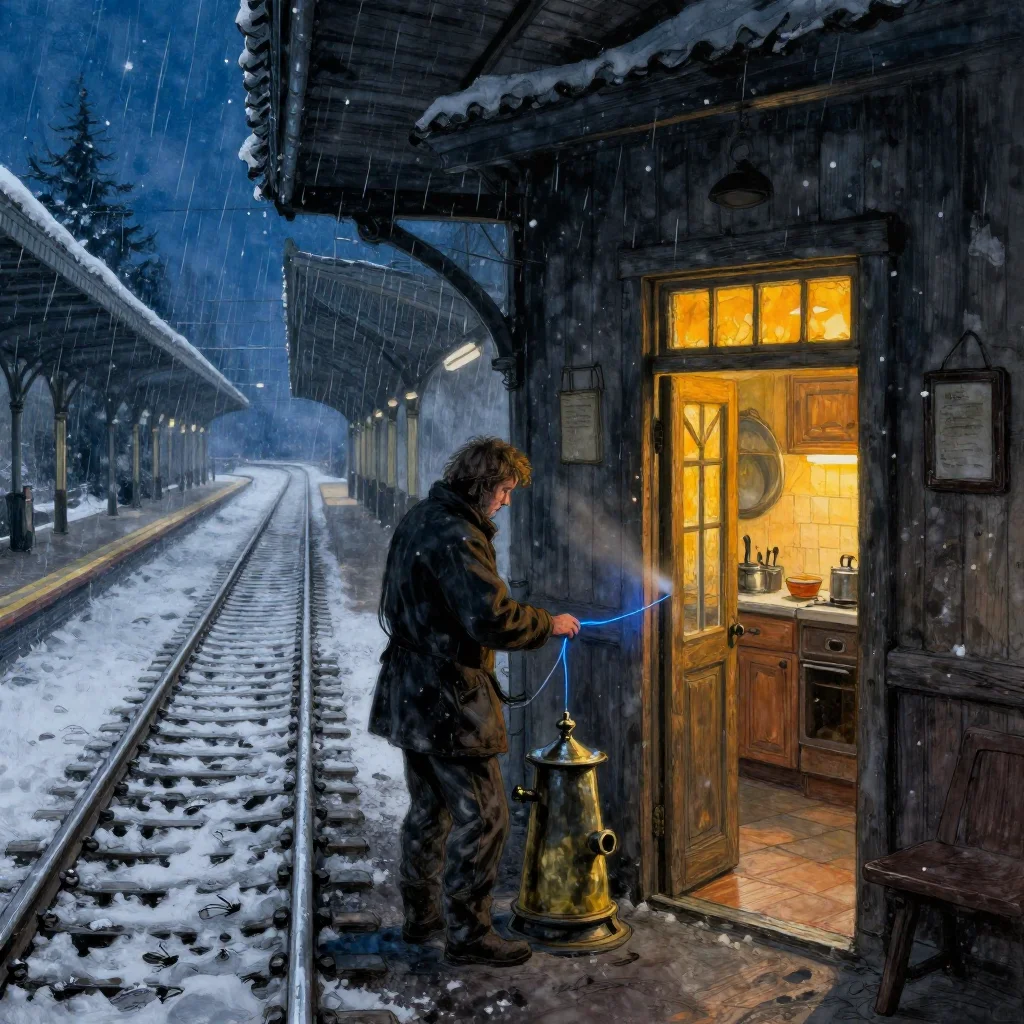
On the platform, an unclaimed blue thread lay between the rails. It was wet, though no rain fell, and it trembled toward an unmarked door standing where no wall should be.
The conductor would not meet her eyes. “Do not follow it,” he said. “The trail is safer when people lie.”
“Safer for whom?”
“For the ones who arrive.”
Mara picked up the thread. It tightened around her finger and pulled toward the door. Behind it was a narrow corridor lined with wooden room numbers. At number seventeen she found her mother's kitchen. The room was exactly as it had been: blue cup, flour on the table, a knife resting beside an unwarmed loaf. Yet the window was empty.
A woman stood with her back to Mara, making tea. “You came late,” she said.
Mara knew the voice. Her mother turned, smiling. The kettle whistled. Sunlight entered through the blank window, but it was the wrong sunlight, pale and borrowed.
“Tell me what happened,” Mara said.
“Nothing happened.”
The corridor shuddered. A crack raced through the kitchen window, though no glass was there.
At the next door, a man was trying to board. He held a ticket stamped with autumn. “I am going home,” he said.
His shadow remained on the platform, stretching toward winter.
Every time one of them spoke the truth, the blue thread slackened. When they lied, it pulled taut, and another room appeared beyond the walls. Mara saw a field under thunder, a child buried in snow, a city burning beneath a purple moon. The trail was not leading her toward her mother. It was feeding on the gaps between what people admitted and what they concealed.
What the station hid
Mara followed the thread through seventeen doors, each one opening onto a version of the same platform. The conductor appeared in the glass, younger, with no station clock behind him. “The first lie is the oldest one,” he said. “This place is built from it.”
“Then give me the lie that took my mother's morning.”
He looked toward the blank kitchen window. “We did not take it.”
The thread snapped and drew her through the unmarked door.
They stood inside the station's clock room. Hundreds of gears floated in the dark, each carrying a small ordinary hour. Mara found hers: a warm square of morning, marked with the smell of bread. The station's first lie was waiting beside it, a black gear stamped with the words: SHE LEFT ON TIME.
Her mother had not left. She had come to the station every winter morning and waited at the platform, carrying the loaf and the blue cup, hoping the lost hour would return. The station had turned her waiting into a single lie, then hidden that lie inside the clock so the theft would remain painless.
Mara seized the black gear.
“If I break it, what happens?”
“The winter sees itself.”
“And if I put it back?”
“The morning stays lost.”
The conductor reached for the blue thread. Around the room, the false rooms began to close. Behind each door, a traveler was becoming less certain of where they belonged.
The warm window
Mara put the black gear against the warm square. She did not break it. She spoke the truth plainly: “My mother stayed because she loved me. The station stole her morning. No one else deserves to lose an hour for our convenience.”
The thread burned cold, then bright. The black gear cracked, and every floating gear turned at once.
In the kitchen, the sun climbed over the table. The kettle boiled. Mara's mother turned from the window and saw her.
“You are late,” her mother said.
Mara laughed. It was the first sound the station had not tried to edit.
At Vey Station, the timetable board cleared. Each traveler boarded into the season printed on their ticket. The conductor watched Mara thread a blue line through the oven door, tying it loosely to the first warm window.
He asked what she had named the room.
“Ordinary,” Mara said.
By morning, the station was quiet. Somewhere beyond the winter tracks, a kettle whistled, bread rose, and an unmarked door stood open to the day.





