 Netwrck
Weird Fiction.
The Market Above the Water
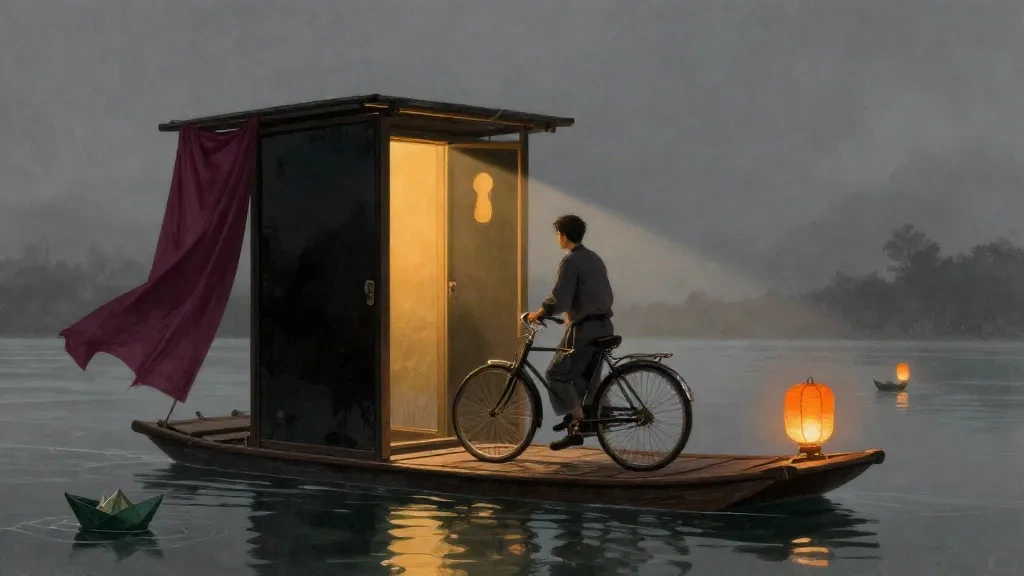
At dusk, when the saffron lanterns came alight, the market rose out of the marsh on rafts of lacquered wood. It had no oars and no poles. It simply arrived, the way a rumor arrives, and the villagers came out to see what it had brought. The sellers called their wares by what they had been: a childhood bedroom, the green flash before lightning, a dog barking at a house that had gone under in the flood year. Nobody bought anything with money. You named a thing, and if you could name it exactly, the market took it and gave you something less definite in return. A courier's rule, and the oldest rule there was: take nothing you cannot name.
Nera earned her bread carrying letters to the stalls. Her bicycle had no bell, only a front wheel shaped like a keyhole, and it went through closed doors the way a needle goes through cloth. At every post she tied it down and waited for the frame to shiver. Then she followed the thin silver shimmer off the frame, through a door that had been sealed since she was a child, and she set her basket where the letters said to set it.
She was good at names. Stall nine sold the sound of a slammed cupboard; stall fourteen sold a bet, unpaid, about the weather. Stall four could not move today because no one living remembered the year it came from, and Nera stood in front of it for a long time, reading, and went home without buying.
She had paid once herself, hard, in the fever winter when her brother Iven was nine and the physician wanted money the family did not have. She sold the memory of his face to a seller of small, useless years. The price was right. The physician came. Iven lived. What Nera kept was the sound of his cough changing on the fourth night, and the fact that he had been afraid of dogs, and the smell of the wet blanket. What she lost was the color of his eyes. She had decided afterward that this was a fair trade, and she had decided it many times, which is how a person keeps a decision alive.
Her assignment waited in a basket lined with plum-colored cloth, and it was not a name or a description. It was a question. Understand why the future has stopped sending letters.
The Treaty of Listening
The old treaty was nailed to the underside of the market's central raft, upside down, the way you nail a thing you want the water to read. Its seal had been pressed in black wax by the Basin Authority, a government that had dissolved itself in the flood year out of shame and left behind nine thousand regulations and one permission. The land of this basin is granted the right to listen whenever it pleases. The land took the permission literally. It listened through roots, through the seams in walls, through the hollow teeth of old wells. It had learned four languages before people arrived and was still learning.
Nera's grandmother Asa had told her the treaty was harmless, the way you tell a child a dog is harmless while the dog is eating. It only listens, she said. Listening is not a crime. Every mother on this basin is a treaty. Then she had laughed, and Nera had been six, and she had thought the laugh was the sound of the whole world being safe.
Asa died in the flood year with the rest of the north orchard. Nera inherited the post, the bicycle, the contract of carriage, and a single sheet of Asa handwriting saying nothing at all, which Nera read as a kindness at the time and no longer does.
The market was less patient than it had once been. Its postmarks now arrived dated two hundred years ahead, and the first of those letters had been almost boring: repair instructions for a sluice gate, a weather report, a list of the names of children not yet born, sent with the flat administrative confidence of a clerk who assumed the future would be there to receive them. Then the envelopes stopped, one spring, mid-week.
“It is not a war,” said Mara, who sold unclaimed silences from a stall with no roof and no floor. She set a paper boat in Nera's palm, folded from a report about tomorrow's shoreline. “Wars announce themselves. This is a withdrawal.”
“You are not a courier. You have no contract.”
“I have a stone.” Mara touched the green thing at her ear, a dull oval the size of a plum. It was a hearing-stone; the market gave them to sellers who had to hold still for long hours. “My daughter is not dead, courier. She is elsewhere. She went somewhere the future goes when the future is generous. I do not say this to be pitied. I say it so you will weigh what you are about to carry.”
Through the raft's floor, the smoke-grey water showed drowned fields, fences and orchard walls shining faintly at ten feet down, the way a drowned orchard shines: nothing up there, all of it down here, waiting to be addressed. Nera had delivered letters to that water for nine years. She had never once asked who read them.
Registrar Ollick and the Dawn Deadline
The government's replacement arrived by launch at midmorning, which is impossible, so Nera assumed he made his own hours. Registrar Ollick of the office of Civic Acoustics was a small dry man with a leather case and a smell of hot paper. He asked to see the treaty, asked who administered it, asked what the market was worth, and wrote the answers down in a hand that made them sound already decided.
“The basin carries a debt,” he said. “Water is not free and listening is not free. We intend to survey the acoustic holdings of the central raft and bring the arrangement under article nine.”
“Article nine does not exist,” Nera said.
“It exists as of this morning.” He smiled at her, kindly, the way you are kind to a courier. “I will want a witness to the silence of the site. A courier is acceptable. Dawn, the day after the market rises.”
That gave her one night. A courier's night. It was enough time to carry letters and not enough time to be wrong twice.
Through the Door With No Wall
At the far end of the market the bicycle pointed at a door standing alone in open air, hinges showing, no wall to hold it, the way a word can stand alone in a mouth. Nera mounted and let the wheel go first.
The rim passed through. The handlebars struck nothing at all. Then the market folded into a corridor of black glass, and doors went past on both sides: pantry doors, vault doors, bedroom doors, the iron door of a house erased by flood and never mourned properly. Her wheel rang against every threshold, a small bright sound, a bicycle bell with no bell in it.
Behind each door was a room of unfinished weather. In one, saffron petals climbed the ceiling while rain fell upward off the floorboards and broke against the petals, and neither landed. In another, a plum-colored moon hung behind the locked front of a shop, and its shadow kept walking along the pavement without it. In a third, a kitchen with a warm stove and two chairs and nobody in either, and Nera looked at it for a long time because it was the most ordinary thing she had seen in nine years of carriage.
She followed the sound instead. It grew louder inside a room with no doors, where hundreds of letters lay beneath a glass tank of still water. Their stamps were future dates. Their addresses were all the same, set in the same careful hand, over and over, filling the tank like leaves in a drain:
THE MARKET ABOVE THE WATER
The tank was labeled in black letters on the glass. HEARINGS CONDUCTED. EVIDENCE OF RESPONSE. Below that, a docket, older than the rest, and Nera had to crouch to read it in the tank's own weather, because she had never in her life been able to leave a thing unread:
In the matter of the basin speaking. First witness: Asa Nera, of the north orchard, who was asked a question and who answered aloud. The land was granted speech in consequence. It has never been quiet since.
Her grandmother had not been warned about the dog. Her grandmother had been the dog's first teacher.
The green stone at Mara's ear went cold against Nera's neck, though Mara was on the other side of a door that had already closed. Mara's voice arrived anyway, the way voices do through water.
“You have been carrying her letters,” Mara said. “Every answer the land ever gave, it sent to your post office. Because you were the family that answered first. It is a very old habit. It answers whoever answers it.”
The Unsent Morning
The letters opened themselves. Their contents were not messages. They were descriptions of mornings.
A sunrise over an orchard with the frost still in the furrows. A market where a woman bought nothing at all and walked home lighter. A bicycle rider crossing a field of white reeds with one hand off the handlebars, going somewhere in particular, on a day with a particular wind. Each description had been sent backward to the past as proof of life — the future mailing the past morning papers, the way a country reassures itself in a telegram. A hundred and eleven of them were in the tank. Nera counted the highest date and then, without wanting to, did the arithmetic a courier does in her bones.
They were not decreasing. They were being consumed. Each letter burned a little of the morning it described, and the morning it described did not come, or came thinned, or came and then forgot itself by noon and had to be sent again. The future was not being attacked. It was being spent, a candle burned at both ends by the need to prove that both ends were lit.
And it was the market that spent it. Every trader who took a memory for a memory was an answer. Every trader, stall to stall, for two hundred years, had been telling the land that speech was possible. The land had believed them, the way it believed everything, with the terrible patience of something that has no face and has practiced listening since before there was anything to listen to. It had answered. It was still answering. The evidence tank was the sound of a mouth that would not stop talking because no one had ever come to ask it a question instead.
Then Nera found the last letter. It was addressed to her, in an unknown hand, and the paper smelled of rain on warm stone, which is the smell the north orchard had, which is a smell nobody makes anymore.
Tomorrow cannot be delivered if tomorrow refuses to arrive. Find the treaty. Find the first listener. Tell it to keep its mouth shut.
The date was the day after the market was due to rise. Which was tomorrow, which was the morning Ollick was going to come and write down the silence of a site he had already decided was silent.
“We have been answering for them,” Nera said, to the tank, to the corridor, to the plum-colored moon walking its shadow down a pavement in a room that was not here.
“We have been answering for the land,” Mara said. “Which is why the land will not stop. It has never been lied to. It is the only thing in the basin nobody has ever had to lie to.”
The Price of a Voice
The market did not take coin. The market took a memory, and there was one thing left in Nera's account that she had not sold and did not want to sell, and she went down to the stall of unclaimed silences to see if it could be sold, because that is what people do.
“It cannot be taken by force,” Mara said. “The market only takes what is offered. You would have to say the words that offer it. In her cadence, because the land knows her cadence and would not recognize you.”
“And then I forget the words.”
“You keep that her voice was low. You keep that she hummed when she was thinking and stopped when she was not. You lose the words, the jokes, the thing she called you when you were small and would not be quiet about it. That is the whole price. It is not a fair price. It is the price.”
“And if I say the words, the land shuts up.”
“The land does not shut up. The land has never been given a reason to stop. You offer it the same gift in the same mouth: silence, and you are gone. It will take the offer.” Mara turned the paper boat over in her fingers. “I will tell you what I have not told a courier yet, because you are carrying the last letters and I am tired of being the only person in the basin who says a true thing out loud. The silence will cost this market. The listening is the trade. You take a memory, the land hears you take it, and the taking is permitted, and then you go home with something less definite and call it a fair exchange. Take away the listening and the market is a raft with no permission on it. The stalls will close. The memories already given will not come back, because they are in things, in other people, in a woman in the north orchard who now has her brother's eyes in a jar and no idea whose they are.”
“Then I save the market.”
“Then you save the market. Or the mornings. I have watched you weigh a thing four times now, courier, and I have not yet decided which one you are going to leave behind, and I find I do not care. That is what two hundred years of this does to a person who sells silences. It makes them very calm and very honest and slightly dead.”
“If I do nothing, the land answers until the future is spent.”
“Yes.”
“If I do this, I never know whether the mornings would have come back.”
“No.” Mara's voice cracked on it, the first unprofessional sound she had made. “You will sit on a raft with a jammed wheel for the rest of your life and you will never know, and some mornings you will decide you saved them and some mornings you will decide you killed them, and both mornings will be real and you will get to pick.”
“You would do it.”
“I would do it badly. I have had longer than you to think about it and I still cannot tell you I would do it well.”
What the Land Kept
Nera went back up the corridor at a walk. She did not ride, because riding is a decision made by the legs and she wanted this one made by the mouth.
She stood at the glass tank and put her hand flat on it, and the water inside was very cold, and the letters lay under it, all the mornings, a hundred and eleven proofs that somewhere a bicycle rider crossed a field of white reeds. Then Nera opened her mouth, and what came out was low, and it hummed twice before it began, because the voice she had was her grandmother's, and it liked to think.
She said the words. She does not know which words. She has the shape of the mouth, the length of it, the place the breath went; she has the smell of rain on warm stone that came with them and stayed in her nose like a scent on a coat. The land heard the first listener renounce, in the first listener's own voice, and it did not argue. Nera had been afraid of something enormous and grudging, a thing that would bargain. Instead there was a sensation like a held breath let out slowly in a room where everyone had been waiting to speak and then, for the first time in two hundred years, did not.
Then she paid. The market took it without ceremony, the way it takes everything: a click, a warmth leaving the back of the throat, a thinning. The letters in the tank went slack in the water. The plum-colored moon stopped walking. Somewhere far down the corridor a bicycle bell that had been ringing for nine years rang out one last time and did not come back.
The Market That Stayed
Ollick came at dawn with his leather case and found the market where it always is: not risen, just there, a raft with lanterns on it, wood and mud and people who could not explain what they had lost and could describe it exactly. He asked for the site. There was no silence to certify. The land under the basin, which had learned four languages and was busy for the first time in two centuries, was not listening, because nothing was speaking to it. He wrote site inoperative in the box provided and looked at Nera for a long moment with the dislike of a man who has traveled to find a fact and been made to bring back a sentence instead.
“You will sign as witness,” he said.
She signed. Her hand made the letters easily. She read the name afterward and it was her own, and she could not, for a moment, put the two together: Nera, the woman who could sign her name, who could not remember the sound her grandmother made when she laughed and said, little noise, and had meant it kindly, and had meant it every single day of the six years before the flood.
Mara's stone had gone out. Mara sat on the roofless stall with a piece of green rock in her hand like a pea, and Nera asked her what happened to Senn, and Mara said, after a while, that Senn had come back on a Tuesday: not the whole of a daughter, but a memory of a daughter, sitting on a step, laughing at something, the eleventh of some month, in a light Nera did not recognize. Mara said it was a very small girl and a very good Tuesday and that she had not had to bury anybody. Then she cried, and it was not grief, and it was not joy, and Nera sat with her while she did it and did not say anything useful.
The stalls stayed shut for eleven days. The memories already traded stayed traded: a man came every evening to the place where his wife's laugh used to be and stood there, and on the twelfth night a seller of doors opened a cupboard and found it missing, and by the following week a woman with a jar of somebody else's eyes was selling them back at half, and there is no market law about that, because nobody alive remembers writing one. Nera did not fix any of it. There was no wheel left that went through closed doors; the keyhole had filled with ordinary rust the night the land stopped listening, and a courier with no doors left is just a woman with a basket and a very good memory for what things are called, standing at a shoreline, waiting for a boat that now has to actually come.
The letter arrived on the fourth dawn after the silence, slid under her door by a postman who said the market wasn't where it used to be and that he had left it in the fish anyway. One letter. Stamped yesterday.
It described a sunrise over an orchard, a woman walking home with nothing bought, a bicycle rider crossing a field of white reeds with one hand off the handlebars. Nera read it four times to be sure of the date. The paper smelled of rain on warm stone. There was no signature, and no return address, and no docket, and no evidence of response, and the description was so plainly, patiently, unbearably fine that she sat down on the floor of her room with it against her mouth.
Yesterday. Not tomorrow. Yesterday, which is a thing that has already happened, and can therefore be delivered, and cannot be spent.
She did not answer it. There was no market now, and no treaty, and no one to answer, and no one in the basin who was owed. She put it in the plum cloth, on the shelf, with Iven's cough and the fourth night, and she left the door shut, and the bicycle in the yard stayed where it was, and the lanterns came alight at dusk over a raft of lacquered wood, and the market did not rise, and did not go anywhere, and chimed all night like a thousand small clocks that had no idea what they were counting.





