 Netwrck
Gothic Fantasy.
Catalogue 673
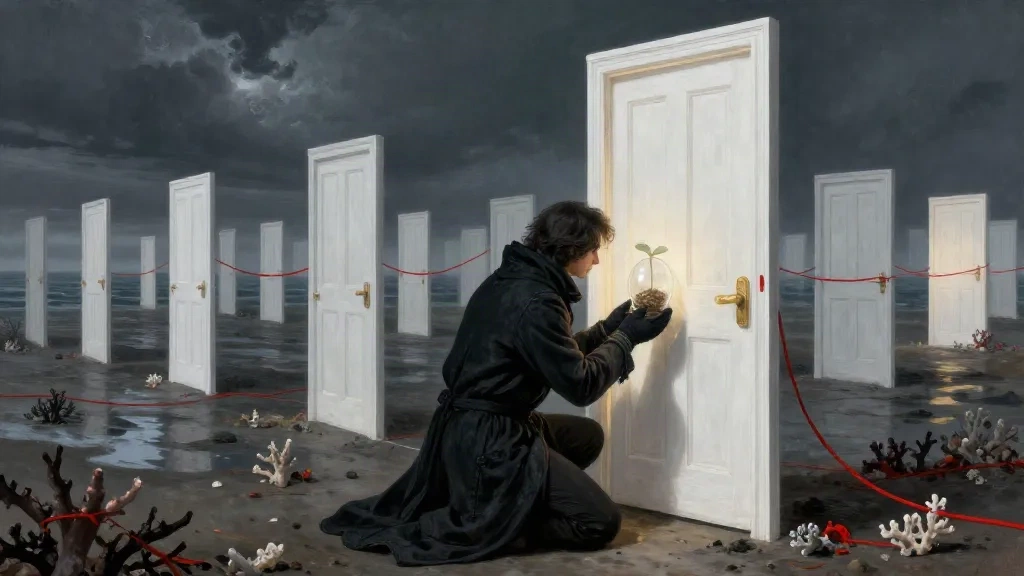
The Museum of Doors occupied the white coral shore between two seasons, its halls full of hinges that whispered when the wind changed. Each doorway opened onto a different courage: the courage to forgive a murderer, to enter a burning house, to speak one true word before a public execution.
Mara Vale was an archivist. Her work was unglamorous. She repaired index cards rubbed soft by impatient fingers, photographed deeds faded almost to skin, and recorded which doorways opened inward. On the brass plate above her desk, a red thread had been tied by someone who believed all records should retain the color of a wound.
One morning, the future catalogue arrived.
It had not been ordered, catalogued, or expected. Its grey paper smelled of rain against hot stone. The pages were filled in letters so fine they resembled cracks. Mara found entry 673 beneath an illustration of a narrow door: The archivist who returned the name of Orris Vale to the land.
Her surname.
No Orris Vale appeared in the museum register. The land’s maps were more discouraging. The eastern parishes ended at marsh, the western estates in salt grass, and the village of Saint Merrow had been struck from every survey after the winter of white ash. No boundary bent toward its absence. No road forgot it.
Mara held a glass seed beneath the catalogue. Inside it, a pale embryo turned once.
Names are not labels. They are doors with the hinges on the far side.
The Assistant in Ink
The seed had belonged to the museum’s founder. He claimed it preserved whatever the soil had lost. Mara’s predecessor, Ludo, had kept it in a wool-lined box and warned her never to plant it indoors.
That evening she found a figure at the deeds desk.
It was shadow shaped like a man, thin at the wrists and dense around its face. The shadow opened a ledger and copied the museum seal with a pen that made no ink. When challenged, it pointed to a transfer document already prepared in Mara’s hand.
“The land consents,” it said.
“The land has no signature.”
“It has forgotten how.”
It dipped the pen again. Across the page, wet letters appeared: Orris Vale, deceased, holdings dispersed.
Mara caught the page before the final mark could dry. The ink snapped around her thumb like frost. A red thread tightened across the desk, stretching from the ledger into the darkness beneath the curator’s chair.
Ludo’s glove lay nearby, one finger of grey wool curled around another. He had vanished that morning, leaving no coat, no boots, and a smear of marsh ooze across his desk.
Mara put the glove on. In the ink reflection, her name was already being removed.
What the Doors Remembered
The shadow signed at midnight.
Mara barred the deed room, but the forged word crossed the door and appeared on every lock. One by one, the museum’s doors began to weaken. Through the courage of a rescue worker came the smell of wet ash. Through the courage of a returning soldier came Saint Merrow in summer: white coral walls, red thread on the door lintels, women calling children home from the flooded lane.
Ludo was there.
He sat beneath the town’s vanished well, holding the glass seed in both hands. His body had become translucent with age, but his wool glove remained vivid.
“Orris was my mother,” he said. “She gave her name to the land so the village would survive the flood.”
Mara understood. Orris had not been forgotten by accident. Her name had been buried, and when she was removed from the land, the land had been removed from history.
“Why sign the transfer?”
“Because the name is still in me.” He held out the seed. “Plant it. Return her. Let the shadow finish the record.”
Mara understood the trap. Restoring Orris would also restore the memorandum, including the shadow’s false signature. Reclamation and forgery would enter the earth together.
She took the seed.
A Name With a Root
Mara opened the final door, marked 673.
Beyond it stood the lost village under a moonless sky. Every house bore the same red thread, drawn from foundation to rooftop. The shadow waited in the square, its document spread across the well.
“One name restores,” it said. “One name erases.”
Mara planted the glass seed in the well. Her gloved hand touched the page, and the false signature ran into her name, forming a dark knot around her wrist. Pain moved up her arm, but she did not pull away.
“Archivists do not choose which truth survives,” she said. “We return both.”
With the wool glove, she wrote beneath the document: Orris Vale, witness. Her land was held in trust, never taken.
The shadow lunged. The red threads tightened across the village, and every door opened at once. Courage poured from them: the courier who carried salt through a siege, the widow who kept a porch lamp burning, the child who walked home beside an stranger. The false ink loosened.
Mara broke its seal with the glass seed.
The document turned to a flock of white birds. The shadow scattered into the walls, leaving the red thread hanging unbroken above the well.
At dawn, Saint Merrow appeared on the survey map—not as a name alone, but as a road, a church, and seven names scratched into the oldest door.
Under Orris Vale, the future catalogue added one final line:
Returned not by the archivist, but by the door she opened.
Mara removed her glove. It had turned white coral, delicate as a shell. In its palm lay a single red thread, warm from a name that no longer needed to be written to remain.





