 Netwrck
Magical Realism.
The Tide’s Return
Mara kept the Blue Kettle on Anchor Street, where the sea pressed against the town’s legs and the gulls argued over fish scraps. Every tide brought back one forgotten object. A child’s red kite. A ship’s brass whistle. A cracked teacup with no matching saucer.
Her recipes summoned the people who had once eaten at her table. Not ghosts, exactly. They arrived hungry, carrying the smell of rain on their coats, and sat until the bowls were empty. Then they vanished before the bell rang.
Mara wanted to prove the family legend: her grandmother had once fed the drowned, and they had opened a gate beneath the lighthouse that kept the sea from swallowing the town. Her grandmother had denied it until her last breath.
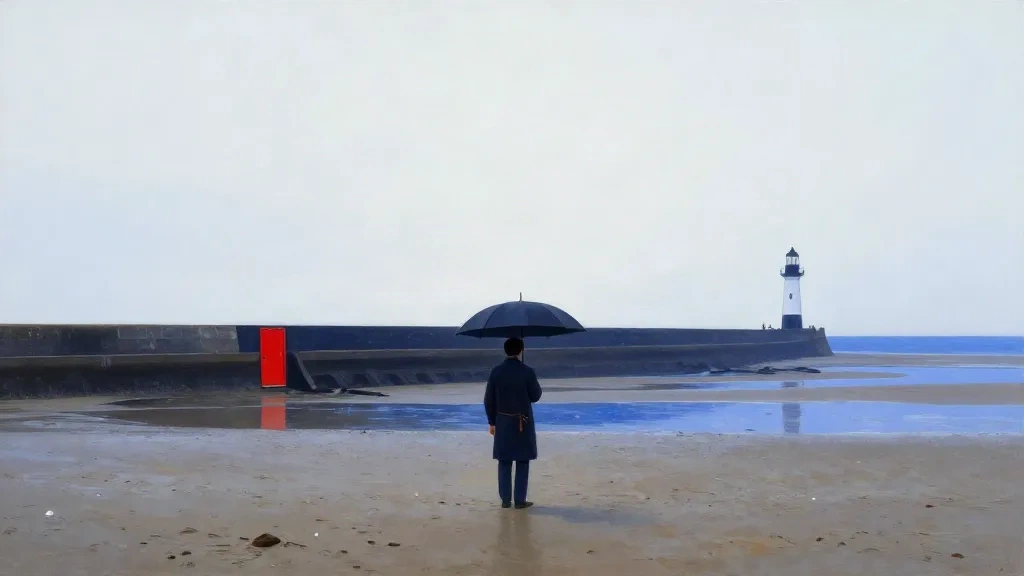
At the lowest tide of the month, the water withdrew beyond the harbor and revealed a dry riverbed cutting through the mud. A black umbrella rested at its center, upright though there was no wind. Mara carried it to the kitchen, and that night the recipe for eel stew produced a young man in a drowned sailor’s coat.
“My father said this town was cursed,” he whispered. “He said your grandmother bargained with the water.”
Mara nearly dropped the ladle. The legend had never named a bargained price. The man vanished when the stew cooled, leaving a wet footprint beside the stove.
The Red Door
On the next tide, a red door appeared in the sea wall, far below the lighthouse. It had no handle, only a brass knocker shaped like a closed mouth. The black umbrella leaned beside it, though no one had carried it there.
Her aunt Sela said the door opened for one person who gave up a true memory. “The sea cannot be cheated,” she said. “It remembers what it takes.”
Mara brought the family ledger, bound in salt-stained cloth. Inside were recipes and margins filled with names. She tried every dish associated with the legend: shellfish pie, smoked fish, honeyed figs, bread baked with rain. Each meal summoned someone who had eaten at her grandmother’s table. Each person spoke a little more clearly about the red door.
One said the town had been empty before the sea arrived.
Another said the lighthouse had been a house.
The oldest, a woman with seaweed in her hair, touched Mara’s wrist. “Your grandmother fed us to open the way,” she said. “Then she fed us again to close it.”
Mara understood then that the legend’s truth was not a miracle. It was a meal repeated.
The Price
At dawn, Mara descended to the dry riverbed with the black umbrella over her head, though no rain fell. The red door waited below the wall. When she knocked, the sea answered inside her skull.
Bring me what your grandmother buried, it said.
Mara pressed the ledger against her chest. Inside it was the only surviving memory of her grandmother’s face: the exact expression her mother had worn when she refused to say the old woman’s name.
The door opened a finger’s width. Cold air touched the memory and drew it toward the gap.
Mara could stop. She could keep the legend, her grandmother’s face, and the proof that her family had survived by hunger and stubbornness.
Or she could surrender the memory and learn what came after the meal.
She let go.
The memory tore free without pain. Mara remembered her grandmother, but not her face. She remembered the kitchen, but not the color of the door. The red door swung inward.
Beyond it waited a dining room under the sea. Empty places had been set around a long table. At the head sat a woman who looked exactly like Mara, except for the silver hair.
“You came late,” the woman said.
“The cost cannot be paid twice,” Mara answered.
“No,” said her grandmother. “That is why it must be paid honestly.”
The Last Course
Inside the room, Mara cooked from memory, though she had forgotten the recipe’s final ingredient. She used eel, figs, black pepper, and rain caught in the black umbrella. The smell of her childhood kitchen rose through the water.
One by one, the drowned diners returned. They did not ask for the gate. They asked for her bread.
When the last bowl was empty, Mara’s grandmother rose. “You proved the legend,” she said.
“I lost my face.”
“No. You lost the face you had been protecting. Now the sea can give you a better memory.”
The sea entered the room as a thin red door. The diners walked through it one by one, carrying plates that shone like mirrors. When it closed, Mara stood alone beneath the lighthouse.
The black umbrella had vanished. In its place lay a dry riverbed silver with rain.
That night, she served a simple stew to three children who had never been to the Blue Kettle. When they left, the oldest turned in the doorway.
“My mother said she dreamed of eating here,” he said.
Mara looked at the empty bowls.
She remembered the taste of every meal she had ever lost, and she began to prepare another.





