 Netwrck
Mystery.
The Translator’s Work
Every bridge in Bellwether carried a promise carved into its underside. Some promised safe passage. Some promised marriage, forgiveness, or a future agreed upon in a warmer century. The river was less forgiving. It kept every broken vow in its silver water, polishing them smooth but never losing them.
Orin Vey translated dreams for sleeping machines at the municipal observatory, where rain ticked against the windows and the furnaces breathed through their chimneys. The machines were used to settle disputes, count harvests, and decide which roads should open after storms. Their dreams were not images exactly. They were pressures: a blue hand pressing against a locked door, a thousand small bells sinking beneath black water.
Orin paid in silver transit tokens and had saved enough to leave Bellwether. His destination was the western coast, where the maps were printed in ink blue and no bridge carried an inscription. He wanted to leave behind a better map than the one received: a map showing not only the roads, but the promises that made them trustworthy.
That morning, the oldest machine in the observatory spoke in his sleep.
It was a bridge calculator, obsolete except for ceremonial work. Its brass casing was scratched by children, and one of its brass teeth had been replaced with a sliver of amber glass. Orin had never translated it before. When he attached the reading electrodes, the machine gave him a dream with an unmarked door at its center.
The Door in the Riverbed
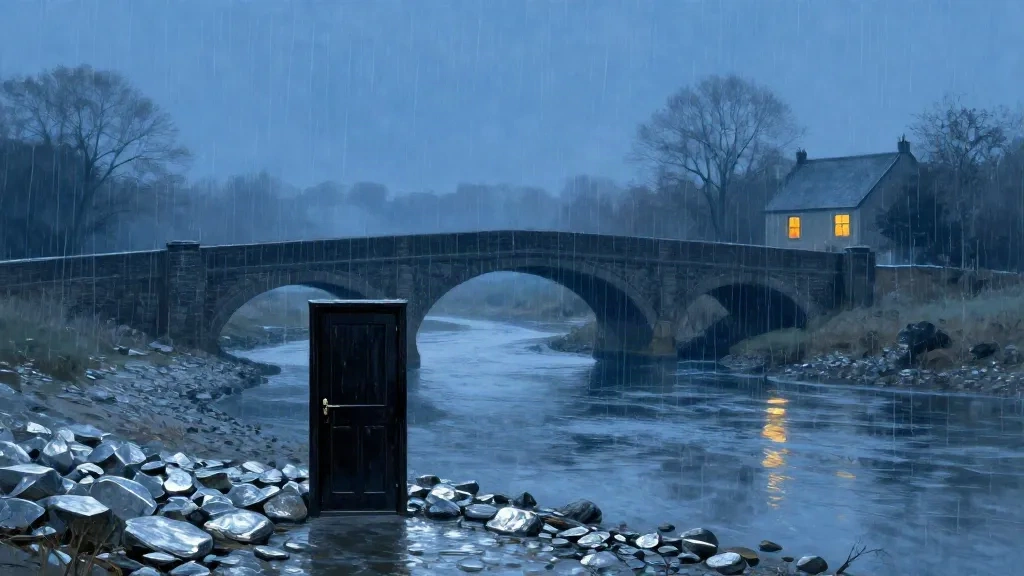
The door had no handle, no hinges visible, and no number. It stood in the dry riverbed beneath the western bridge, upright in the mud as if the earth had closed around it and then forgotten.
Orin went there after dusk. The river had withdrawn beyond its banks, leaving stones, rusted cans, and the pale tracks of old water. The bridge overhead cast a long shadow across the bed. Its promise was hidden beneath the arch, but Orin could feel it in the silence: a vow stretched tight enough to snap.
When he placed his hand against the door, he heard the machine’s dream return.
One bridge. Three memories. One promise. The river refuses all three.
The voice belonged to Mara Senn, the family who had controlled the bridge permit for three generations. They had been arguing over the crossing for months. Uncle Joren said their grandfather promised to keep the river open. Cousin Ilya said he promised to close it during drought. Their mother said the promise had been made to a stranger, not to Bellwether at all.
Orin knew the family because his mother had been one of them. She had left when he was twelve, taking with her the only map he had ever owned.
Three Versions
At the Senn house, three people gave him three answers.
Joren unfolded a survey showing the river at full height. “He promised the town water.”
Ilya held a dried reed from the riverbed. “He promised us dry land.”
His mother pointed to the amber-lit window across the street. “He promised the stranger a way back.”
Each version contained a fact. None contained the whole promise. Orin realized the family had not forgotten the agreement. They had each preserved the piece that condemned them.
He returned to the observatory and translated the rest of the machine’s dream. The pressure behind the unmarked door resolved into a map. Not streets or bridges, but dates, witnesses, and the order in which the river had changed. The amber glass tooth in the machine was a fragment of the original bridge seal. It had been placed there by his grandfather, not to measure water, but to remember the moment the promise was broken.
Orin took the fragment to the riverbed. When he fitted it into the door, the hidden lock opened.
The Better Map
Inside was a narrow chamber filled with dry maps. Each one showed a different Bellwether, but the same warm amber window appeared in every version. The oldest map recorded the stranger’s return. The newest marked the river dry for a single winter. Between them lay the family’s history, including the missing hour when the bridge was closed and the stranger disappeared.
The river had kept the witness. The family had divided the promise because no one would accept that its cost was shared.
Orin drew a new map that morning. He included the bridge, the dry riverbed, the door, and the three conflicting memories. Then he drew a line from the door to the amber window, showing the way home.
He did not decide what the old promise meant. He made the uncertainty visible.
By evening, the town had gathered at the crossing. They read the names aloud, one by one, until the promise became larger than its owner and the river began to sing beneath the bridge.
Orin left the next morning with a better map. It was not reliable because it showed a single truth. It was reliable because it showed where the truth had been broken, and who might still be needed to mend it.





