 Netwrck
Magical Realism.
The Book of Unfinished Addresses
At midnight, the river changed direction.
By morning it flowed north beneath the customs bridge, though the mills south of town had drunk from it for three hundred years. People watched the water pass their windows and agreed not to discuss it. They mended fences, polished boots, and wrote letters to relatives in the other country. Some families hung a red cloth over their door when a relative lived across the river, a warning to those who might follow.
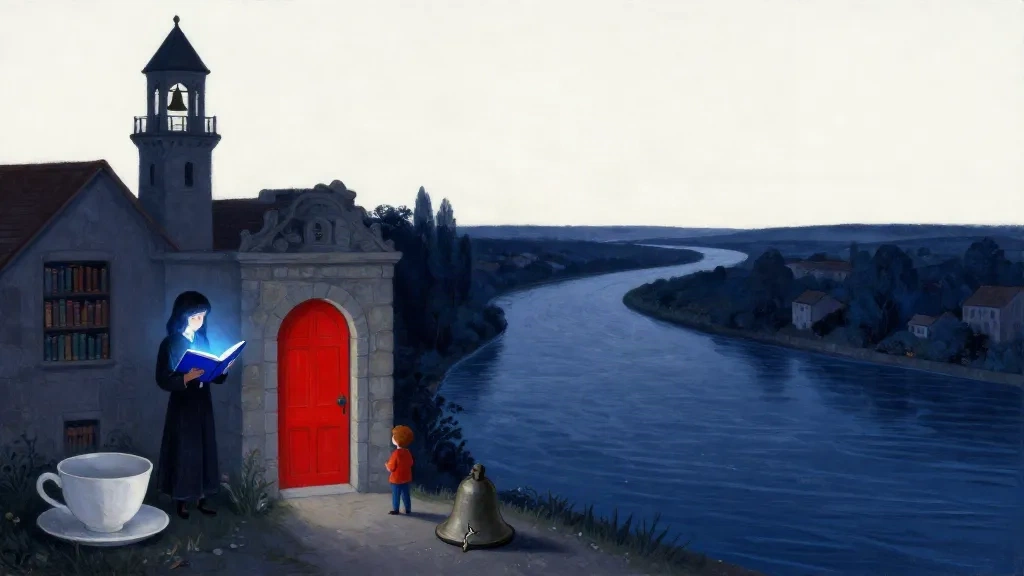
In the old customs house, Mara kept the library. Its shelves held atlases with coastlines that no longer existed, grammars for languages nobody spoke, and one book bound in midnight-blue leather.
The book had no title. Whoever opened it found a different address written on the first page: a house, a cave, a railway carriage, sometimes a hollow in a hedge. Beside the address was a sentence explaining what the place could shelter.
“A home for a storm,” a tanner read once.
“A home for a drowned bell,” a child said.
“A home for anyone who has been told they are impossible,” said an old woman, and the librarian heard the book give a small, dry cough.
Mara lent it freely. She had no family left in the town, and her room above the stacks had a square window facing the river. At night the water reflected a second sky, crowded with unfamiliar constellations.
Her wish was plain: to find a place where impossible residents could remain without being corrected.
The Boy Who Would Not Look Away
On the evening the river turned, a boy named Elian came in carrying an empty teacup.
He was perhaps seven. His shoes were polished, though one had a hole through the sole. He placed the cup on the desk.
“I need to borrow the book,” he said.
“What do you need a home for?”
Elian looked toward the window. “The thing in the square.”
Every evening the children played football in Market Square. Every evening, when the ball rolled beneath the old bell tower, they stepped around the large pale shape crouched behind the monument. It had the proportions of a man but no face, and its fingers rested on the stone as if waiting for a signal.
Adults never mentioned it. They walked around it and spoke loudly about football.
Elian could see it. Worse, he could see the red door that appeared in the bell tower whenever the river reversed. The door was not hidden, exactly. It was overlooked with such precision that people complained when Elian pointed at it.
“The square has no door,” a baker told him.
“The bell has no sound,” his mother said, though everyone heard it ringing whenever the river changed.
Elian opened the library book. The page shown him an address written in water: Bell Tower, fourth stair, behind the crack.
Mara copied the words carefully. “That is not a home,” she said.
“It could be,” Elian answered.
The Cracked Bell
They crossed the square after midnight.
The river ran north, silver under a pearl sky. The invisible residents had emerged: women with branches for hair, men carrying small suns inside their coats, children whose shadows walked ahead of them. They stood at the bridge, waiting for the water to decide which country they belonged to.
Inside the bell tower, the bell was split from lip to crown. Its crack glowed faintly red. Every time the river turned, it rang a note too low to hear. People felt it in their teeth and hurried home.
Elian climbed the fourth stair and pressed his palm against the crack.
The tower wall opened.
Beyond it was a narrow room. A red door stood inside, with the cracked bell hanging before it. The pale man sat beside the bell, cup in hand, waiting.
“You cannot open it alone,” he said.Elian offered him the empty teacup. “Then drink first.”
The man shook his head. “There is no tea.”
“There is room,” Mara said.
She set her own cup beside his. The pale man stared at the pair, then slowly filled both from the river outside. When he raised his cup, the water did not spill. It shone pearl-white, midnight blue, and at its center burned a single red point.
Elian touched the red door. It opened onto the opposite bank, where the invisible residents stood waiting. The bell began to ring, clear and whole.
A Place to Return To
By dawn, the river flowed south again.
The square looked ordinary except for one detail: the red door remained in the bell tower. The pale man sat inside, holding the empty teacup. Elian had carried it back without remembering the walk.
People began visiting. A woman brought a small storm in a glass jar. A railway engineer came with a carriage that existed only on wet days. Others followed, carrying forgotten relatives, lost languages, and names removed from old records.
Mara opened the library to them. She moved the desks from the entrance and hung a paper sign, handwritten in her careful capitals:
All who are difficult to explain are welcome here.
At dusk, the invisible residents crossed the bridge. The town watched them arrive, then turned away. But no one moved the red door, no one covered the river with lies, and no one pretended the square was empty.
Elian rang the cracked bell each evening. The note passed through the walls and under the floorboards, reaching every room where someone had been told they did not belong.
Mara left the empty teacup on the windowsill. By morning it held a thin blue reflection, and she knew the river had carried someone home.





