 Netwrck
Folk Horror.
The Observatory of Borrowed Rooms
The storm arrived before the signal completed its thirty-first year. Sefa Orr watched it cross the observatory’s copper roof as a pale thread, though the weather station insisted there was no wind. Below, the desert had turned frost-white despite the midsummer heat. The stars remained visible, but they were no longer in their familiar houses.
He had refused every evacuation vessel offered after the crews began leaving orbit. Earth, they told him, was a rumour transmitted by damaged relays. Sefa did not need their evidence. He remembered the smell of hot circuitry, his mother’s bread, and the exact blue of the sky above his childhood roof. He had also spent forty years trying to hear Lera’s voice again.
Static With a Fingerprint
Lera had been sixteen when the first star message arrived. Its carrier wave contained a voice buried beneath static. Sefa heard it once in his headset: his sister reciting her brother’s name and asking him to look up. Everyone else called it interference. Governments sealed the recording. Historians reduced it to a footnote beneath a story about meteors.
He came to the desert observatory because its dish had preserved the original carrier wave. For years he listened to the static, seeking a vowel, a breath, the shape of the sentence hidden inside it. On the night of the storm, he heard a door unlock beneath the floor.
Every Door in the House
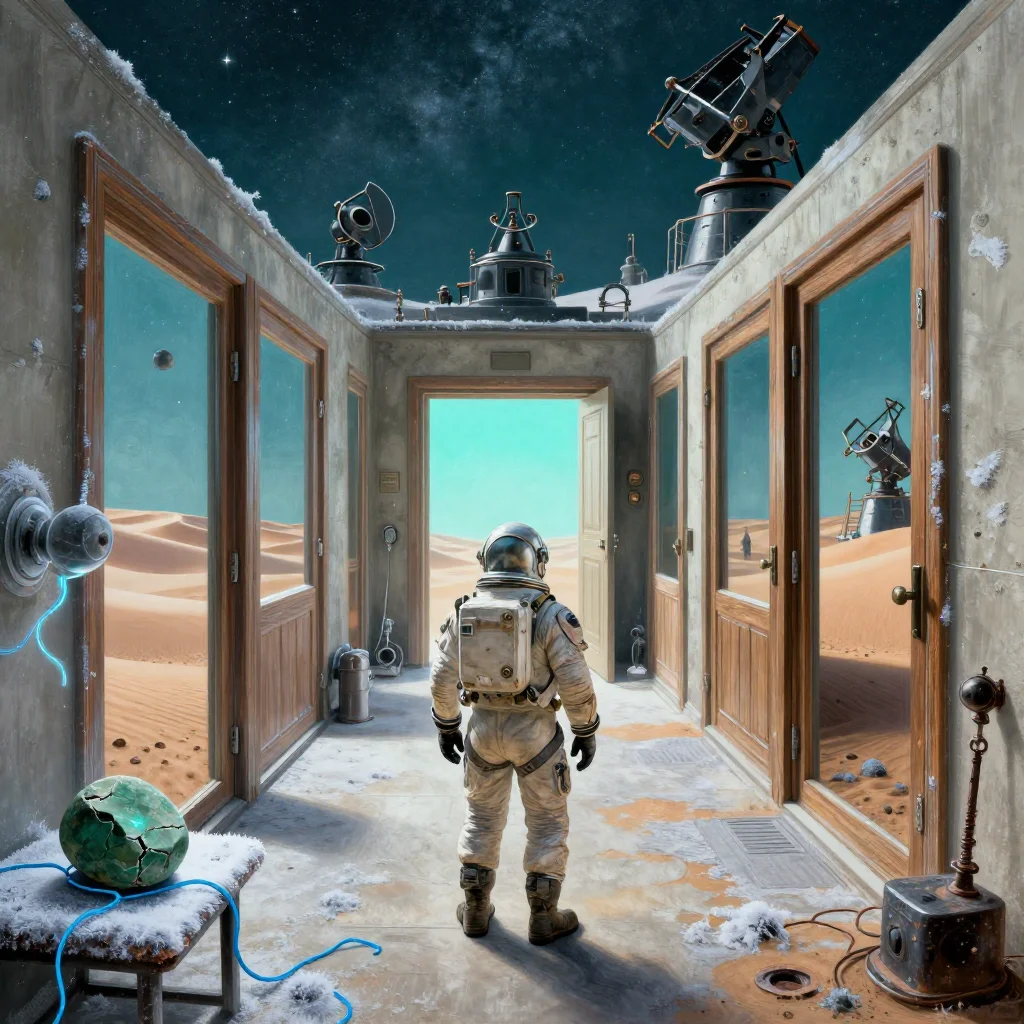
It opened onto a kitchen with a blue-painted door. Frost silvered the windowpanes. An iron kettle stood on the stove, though no fire had lit it. Sefa stepped through. Behind him, the observatory’s eastern wall became a row of doors belonging to houses that no longer existed in the desert. Each opened onto the same kitchen, but the weather differed beyond each threshold.
One led to a summer dust storm. Another to rain falling upward from a black sky. A third exposed the lunar horizon, its craters filled with walking figures. Sefa searched each room for Lera. In the last, he found a green stone resting on the kitchen table. It was warm, smooth, and cut with a notch from their childhood river.
The Blue Thread
A blue thread ran from the stone beneath the floorboards. Sefa followed it into the wall, where the plaster opened like a seam. Behind it waited a narrow corridor lined with doors. Their number increased as the storm strengthened. Voices leaked through the wood: neighbours arguing, infants crying, a woman calling children indoors. Every voice made the corridor seem larger.
Then Lera said his name. The sound came from a door marked only with the green stone. Sefa reached for the handle. The blue thread tightened around his wrist, tugging him toward another threshold. He understood, with the certainty of old grief, that the doors were not traps. They were sorting the people inside them.
The Voice in the House
He opened Lera’s door. Beyond it was the cabin at their mother’s house, preserved with winter light on the window. Lera sat at the table, younger than she had been when she disappeared. She looked at Sefa and recited the same message: “Look up. The ground is the part that moves.”
The corridor shook. One by one, the other voices stopped. When Lera finished, the green stone cracked and a single blue thread ran from the hearth to the open sky. Beyond the walls, the observatory doors began returning to their proper places.
Sefa stayed inside until the storm carried the cabin away. At last he understood why history had used Lera as background noise. It could not bear a voice that spoke from every room at once. Outside, the desert dawn glowed an impossible cyan. The star signal had fallen silent, and beneath the frozen dishes, something was knocking from the other side.





