 Netwrck
Romance.
Doors in the Roots
By the time Mara Venn retired, she had drawn coastlines for vanished harbors, roads for abandoned villages, and the hidden doors of houses that had burned before anyone thought to record them. Her maps lived in the municipal archive under probable locations, because certainty had become an administrative virtue she no longer trusted.
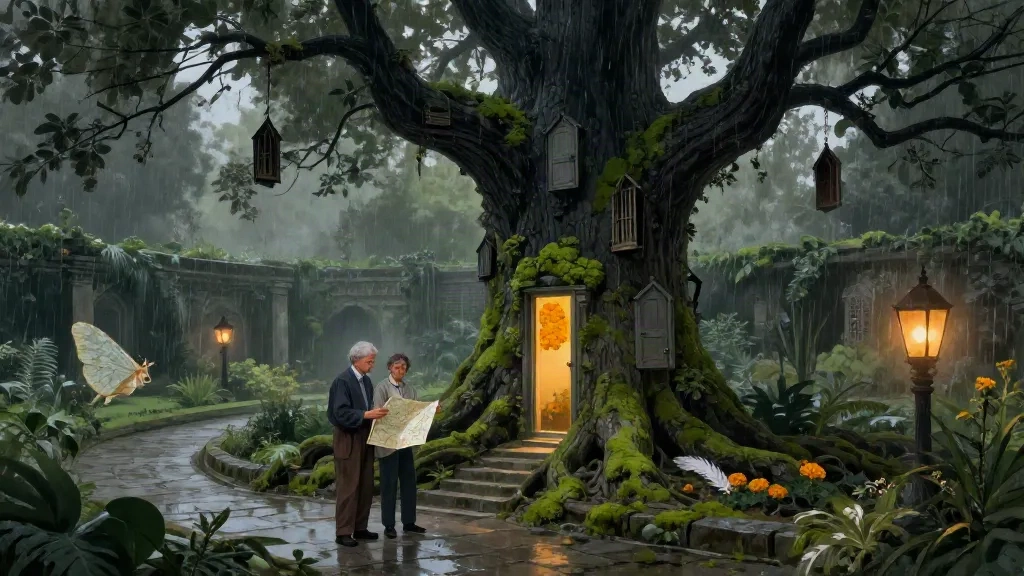
Every autumn she visited Orison Botanical Garden, where a black tree grew doors through its mossy trunk. They appeared overnight: narrow doors with brass handles, orchard doors, sea doors crusted with salt, one made of pale birch and warm as a cheek. The gardeners called them survivals. Mara called them invitations.
She carried two objects in her coat. A moth wing, folded inside a glassine envelope. A white feather, stiff with age. One had belonged to her brother, the other to the village where he vanished. She had spent twenty years trying to draw a map to the places they had lost.
The tree had never accepted her drawings. Her pencils stopped at the edges of vanished places, as if the paper itself had closed.
The Price of Being Right
At the market beneath the garden’s western wall, truth was sold by weight. A brass scale accepted memories, keepsakes, or promises. A woman traded her childhood for the certainty that her son had loved her. A boy laid down a silver button and received the exact day his father had forgotten him.
The market’s expensive things were always true. That was its cruelty.
Mara found a stall where a moth wing rested in a glass case. The seller said it belonged to a man who had changed his name. Mara knew it was her brother’s wing by the split along the left edge. She placed the white feather on the counter. The scale rang like a small bell.
“That was his,” the seller said.
“I know.”
“Then you have paid for a fact you already carried.”
He gave her the wing anyway. Beneath it lay a map drawn in black ink. Mara recognized the broken line of the river, the hill that no longer existed, and a door drawn where no door had ever stood.
At the far end of the market, a young conservator named Ilyan watched her fold the map. He had been repairing the tree’s oldest hinges, hands blackened by sap, eyes careful as survey markers.
“You’re going to make a refuge,” he said.
“How do you know?”
“Because you keep looking at the empty spaces.”
Her plan had only a name and no building. A place where lost things could rest: keys without locks, shoes without roads, letters whose recipients had vanished. She intended to draw its boundaries on the blank quarter of the map.
A Place With No Name
That night, Mara entered the garden. The doors opened as she passed, each revealing a fragment of the old world. In one, her brother was nine years old, throwing stones across a frozen river. In another, the house stood with its kitchen warm and her mother humming.
She could not stay. The garden had no room for a life assembled from grief.
Ilyan waited beneath the tree. He held a lantern, though the doorframes cast their own pale light. “The map changes,” he said. “Every time you look away.”
“Then I’ll learn its rules.”
“Or its price.”
He showed her the first truth: the garden could preserve only what someone willingly released. She drew a small square for a lost key, a curved line for the road leading nowhere, a door with no hinges. As the ink dried, the tree answered. A new door opened in the trunk.
Beyond it stood a white room, empty except for two beds. On one lay the moth wing. On the other, the feather.
Mara understood. The refuge would be built from what she surrendered, not what she recovered.
She looked at Ilyan. “I don’t know whether I can let him go.”
“Neither do I.”
His hand covered hers, sticky with tree sap. “But I know I want to help you find out.”
The Last Door
Before dawn, Mara drew the final door. It was smaller than the others and opened toward the garden instead of away from it. She intended it as an entrance, a threshold where anything lost could be welcomed without being kept.
The market’s bell began to ring. Someone was buying a memory of the first snow, someone else the sound of a name spoken before a funeral. The sellers called prices that no one could afford.
Ilyan took her hand. “If we open it now, the garden may show us where he went.”
“It may also make us forget why we built it.”
“That is the expensive truth.”
Mara looked at the two objects in her palms. She had carried them so long that their edges had worn her fingerprints into them.
Then she placed the wing and feather inside the white room. The door remained. It did not reveal her brother. It did not erase him either. It simply waited.
Ilyan lifted the lantern. Inside the refuge, moss green spread across the floor, wet stone gleamed on the walls, and a flash of marigold burned in the empty garden beyond the threshold. Mara set the map down. It was no longer a record of absences. It was an instruction for arrival.
“No lost thing will be alone,” she said.
Ilyan answered by taking her other hand.
Behind them, the black tree opened one last door. This time, it opened onto a room where nothing was missing.





