 Netwrck
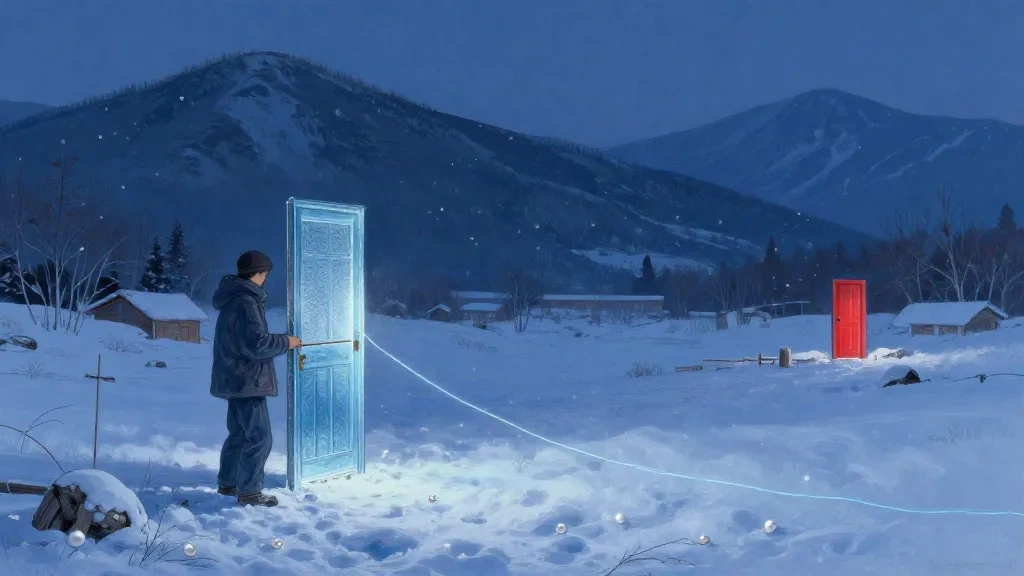
Magical Realism.
Shadows at the Gate
At Veyra, winter began with the shadows.
They came down the mountain before the first skier, sliding beneath the pines and pooling at the doors of the guesthouse. Each carried the outline of a room, its windows bright as beetle shells, its corners softened by distance. The porter learned not to greet them. He simply moved aside and let them enter first.
Mara arrived three days before the guests with a crate of tools and a blue thread tied around her wrist. She was a glassblower, though the resort’s order forms called her a window architect. Her work was stranger than ordinary glassmaking. For each room, she shaped a pane that opened onto another world: a kitchen above a cloud, a garden beneath a winter moon, a railway platform where no train had ever stopped.
That morning, as she unpacked her rods, a shadow lifted itself from the snow.
It wore the shape of a door. No house.
Across its center ran a single blue thread.
Mara touched it. The thread tightened around her wrist and pulled toward the eastern wall, where the snow had not yet reached.
The Room That Was Missing
The wall was not a wall. Under Mara’s palm it felt like cold glass stretched over a narrow darkness.
She drew a bead of blue glass and pressed it against the surface. A line of cold appeared, then widened into an unmarked door. No hinges. No handle. No number.
On the other side was an ordinary bedroom.
Morning light fell across a wooden floor. A kettle steamed on a table. Beside it lay a pair of child’s shoes, toes pointed toward the window. Through the window, she could see the same mountain, but the trees were green and the sky was the pale blue of early spring.
“Please,” said a woman inside.
Mara looked again. The woman was nowhere. The kettle continued to steam.
The blue thread entered the room and vanished beneath the table.
“What do you want?” Mara asked.
“One morning,” the room replied.
Every object in Veyra answered differently. A bell rang before it was struck. A suitcase unpacked itself and then remembered being closed. Guests woke with names that belonged to other people. The resort lived by stories, but lately the stories had begun to agree with one another.
That afternoon, Mara met twelve guests at the lodge. Each spoke in careful sentences. No one admitted fear. No one mentioned the shadows. When a boy asked whether his mother would return, the woman beside him said, “Of course,” though everyone in the room looked toward the unmarked door.
That night, the mountain became quiet.
The thread around Mara’s wrist loosened only when she told a lie.
The Price of Safety
She learned the trail’s rule during the storm.
It began as a path behind the guesthouse, marked with blue footprints. The footprints led toward a bridge, then a frozen stream, then the place where the shadows waited. The trail was dangerous while the air held an honest word. Speak plainly, and the ice cracked. Tell the whole truth, and the path lost its edges.
But when everyone became careful, the trail softened. Lies made it wider. Small lies, especially. A guest said the coffee was strong when it tasted of rain. Another said he had never been afraid. The porter said the shadows were only shadows.
By midnight, the blue footprints crossed the black river without a bridge.
At the far side stood the unmarked door.
This time Mara opened it easily.
The ordinary morning waited inside. The kettle steamed. The child’s shoes stood by the bed. Beyond the window, spring shone over the mountain.
“You can keep it,” said the room.
Mara reached for the thread.
Then she saw the woman again, seated at the table, stitching a blue seam into her sleeve. Her face was blurred, as if several mornings had been laid over one another.
“If you take it,” the woman said, “the others will forget their way home.”
Outside, the trail began to glow. Safer, brighter, and leading nowhere.
The Window She Chose
Mara understood then that the resort was not being invaded. It was being spared. Every truth had frightened the mountain into hiding its own paths. Every admission of doubt had made a person’s shadow leave before they did.
She melted the blue thread into a small, clear bead.
“I will not take the morning,” she said.
The room trembled.
“You came here to keep it.”
“I came to make a window.”
She shaped the bead in the fire of her small furnace, drawing it thin with a blowpipe. The glass took the color of pearl, then midnight blue. At its center, she preserved one red line.
She placed the pane in the unmarked door.
On the other side, the child’s shoes vanished. The kettle went cold. The woman stood before the window, no longer blurred, and looked through the new glass.
“Now,” Mara said, “tell the truth.”
The woman looked at the green mountain. “I am afraid my daughter will never come back.”
The door shuddered.
In Veyra, every window opened at once. Guests saw the paths they had hidden from themselves. A man called his brother by name. A woman admitted she had not forgiven anyone. The porter told the truth about the first shadow, and the shadow bowed.
The blue trail narrowed, no longer safe, no longer kind.
It led uphill.
Mara picked up her rod. The unmarked door remained behind her, its red seam glowing in the pearl-colored glass.
By dawn, she had made twelve windows. The shadows arrived afterward, carrying the shape of rooms that now opened both ways.
And in every pane, the ordinary morning remained visible—fragile, uncaptured, and no longer taken.





