 Netwrck
Fantasy.
The Market Below the First Floor
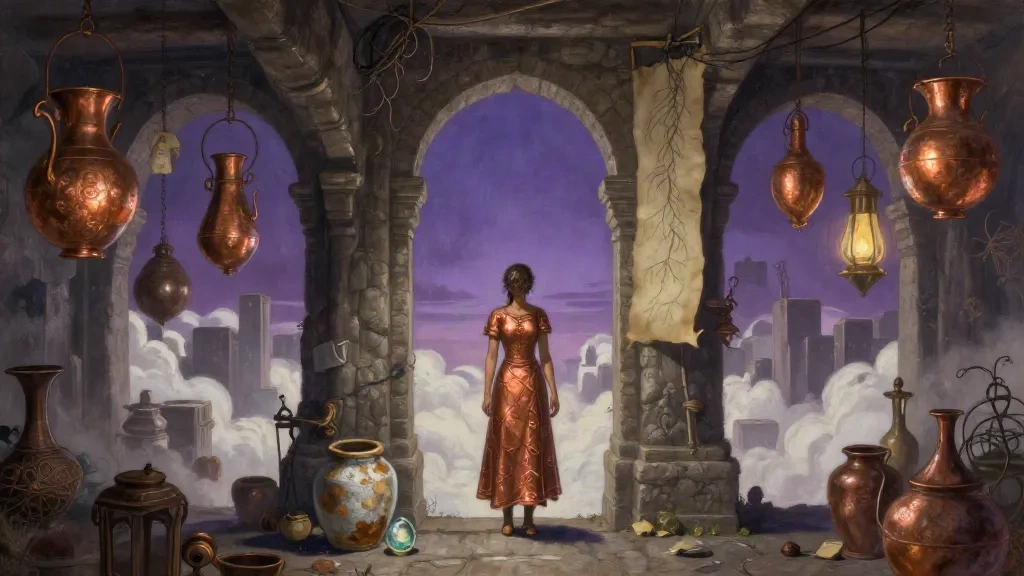
At violet dusk, Ilya set up beneath the hanging floors of Veyr, where no street descended and every shop opened instead into the earth. Her needle hung above a thimble, silver as a storm. Beside it stood a salt jar clouded by damp and a glass seed no larger than a grain of millet.
Her hands could mend the distance between two people. Not their roads, not their tempers, but the invisible span that made one voice arrive faint in another ear. Children came to have quarrels shortened. Widows asked for dreams to cross the years. Merchants paid in secrets too blunt for the daylight market.
That evening, the dead came for her.
They descended through a hatch hidden beneath the tea seller’s counter, wrapped in burial linen and smelling of rain under stone. At their head walked Pell, carrying a knife that had cut the boundary from her village, and Oren, who had signed away the shared water beneath it.
They brought no corpse. They brought a treaty.
A Language in the Margins
Its vellum covered two joined hides, dense with marks no alphabet could name. The letters bent toward one another, joined by strokes like roots. Ilya recognized none of them, until a grave-scented man touched the page and whispered.
Then the sentence burned itself into her mind: We bind our children to our children, our roofs to their roofs, and our wounds to their wounds, until neither village may suffer alone.
It was a generous agreement. It was also seven generations old.
“We need a door,” Pell said. Her voice came from far below the market, as if spoken through deep water. “The treaty is broken. Our people have forgotten the other side. We need you to mend it.”
Ilya looked at her needle. “A mended distance can be crossed without asking.”
“Then it is no use to the living.”
Oren tapped the treaty. “Write this instead: our children may come, our children may leave, but every threshold we cross must open by the will of both sides.”
The dead had no heirs to consent. That was the flaw in the dead.
“Why can’t your own hands do it?”
“Because the old covenant names only us.” Oren’s eyes held no accusation, only exhaustion. “We built a prison and called it kinship.”
Ilya drew the glass seed from her pocket. A child had brought it that afternoon, insisting it had been planted in a dream. Inside, violet dusk turned slowly around a cloud-white center.
The Distance Between Two Floors
Before first frost, the villages met beneath the market: stonecutters from the upper wards, ferrymen from the buried river, children carrying lamps that burned without smoke. Above them, Veyr’s foundations ended in sheer walls. Below, the old market continued into streets dug by generations who no longer remembered the sky.
Ilya stretched a copper thread from the treaty to a blank archway. She joined its ends to the salt jar, then passed the needle through the glass seed. The thread became a doorframe taller than the underground street. Openings appeared in its center: one smelling of rain, one smelling of flour, one smelling of extinguished lamps.
The first villager tried to step through.
The copper frame tightened.
“He consents to enter,” Ilya said, “but no one on the other side consents to receive him.”
They tried again with a child. The child wanted to go; the shadowed village did not. They tried with gifts, land, oaths, even their oldest grief. The door rejected every hand.
By midnight, the market had divided. Each side demanded Ilya alter the other. The salt began dissolving the stone beneath her feet. With every hour, the treaty’s language faded from the page.
Then the dead began to speak all at once.
Dead languages filled the arches: words for apology, refusal, hunger, welcome, the cries of infants delivered beside forbidden wells. None formed a sentence. None agreed.
Ilya seized the glass seed and held it to the treaty. The violet dusk within it darkened. For one breath, every person above and below the market seemed visible through the glass: a hundred hearts, no two shaped alike.
What Both Sides Chose
She understood then. The treaty had mistaken shared suffering for shared consent. The living could not inherit that mistake.
With her needle, Ilya unpicked the old clause. Each severed stroke released a memory into the air: a shared well guarded by both, two children sleeping beneath one roof, a widow carrying bread to a house that had cursed her. The dead watched. Some wept. Some looked away.
Then Ilya asked the living to speak.
“I consent to your door,” said the stonecutter.
“I do not consent to your roof,” said the ferryman.
“I will open a path, not a promise,” Ilya said.
For a long moment, no one moved.
One by one, they named their limits. Welcome here. Shelter there. A well shared, a graveyard closed. The frame cooled around a narrow opening, no wider than two people walking abreast.
Pell touched the unfinished door. “And us?”
“No place is yours unless someone living welcomes it,” Ilya said.
The treaty dissolved. The dead rose in the manner of shadows returning to stone. Before vanishing, Oren placed his thumb in the salt jar and drew a final boundary.
“A door is not a promise,” he said. “It is the place where promise may begin.”
By morning, the market had a new route upward. Ilya left the salt jar at its threshold and planted the glass seed beside it. Children later swore white flowers grew inside the glass, each facing a different way.
No door opened without two voices.
For once, no one mistaken silence for welcome.





