 Netwrck
Speculative Fiction.
What the Market Kept Beneath the Floor
At dusk the bakers unhooked their skirts of stone and the night market came down. Stairs grew out of the undersides of buildings, patient as ivy, and under them the stalls opened, lit by a pale winter light whose color arrived without a sun. There was no warmth in it. The light was the color of the inside of a shell and it made everything look like something preserved.
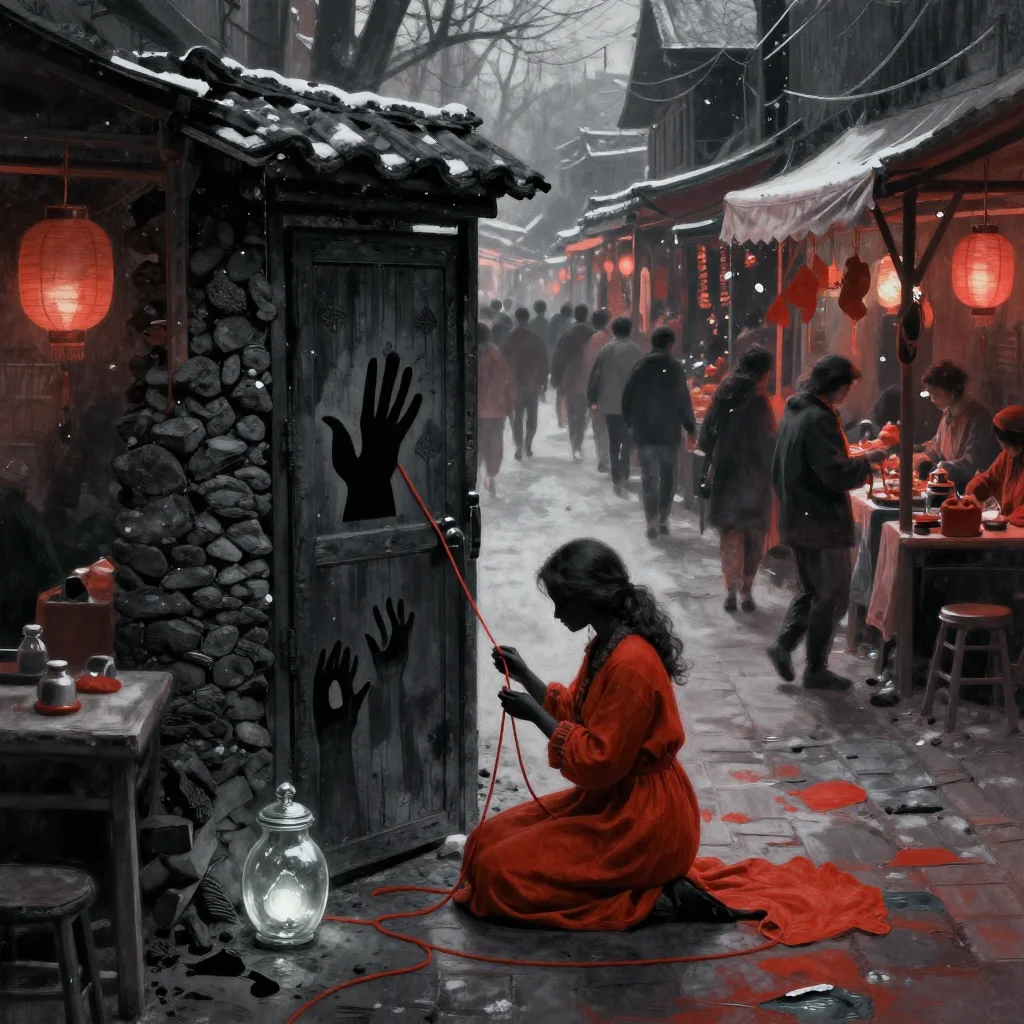
Mara watched from her booth and kept her rust-red thread in three neat coils, because a loose coil is a wasted coil and waste at her table was a sin she had invented for herself. In her left hand she held the flat brass ruler she used on ordinary tears. In her right she turned a glass seed between two fingers, clear as trapped sleet, and it caught the shell-colored light and threw it back thinner.
She could mend the distance between two people. Not their bodies. Not their years. The invisible wrong that made a wife’s greeting land like a question and a husband’s silence land like a verdict, the thing that made a family eat in the same room with the air wrong between them. One pull of her needle, if both parties were willing, could close that distance. She had been nineteen when she learned the pull worked. She had been forty-one when she learned that willingness could be arranged, worn, or borrowed by a third hand.
What she wanted was simpler than a reputation and heavier than the city above her: a door that opened only when both sides consented. A door that asked twice.
Her own door had opened on both. She and her sister Tomas had knocked from opposite lives, heard each other through the wood, and neither had turned the latch. The distance between them was not made of neglect. It was made of paperwork, and she had written it.
The Agreement Written Belowground
The market’s lowest aisle lay beneath a stone arch cut with no tool marks on it. You could put your palm against it and feel the smooth of water that had never run there. There, on a shelf of flat stone, she found a village agreement sealed in sheets of black bark. Its characters were narrow and without color. Beside it stood a salt jar, always full, though the market swept the floor every morning and the sweepers never once tipped it.
The older women of the market watched her from their booths without pretending otherwise. They said the agreement had been made before the city raised its walls, when the village under the hill still had doors in its houses, and when the dead were counted as parties. A door, one of them said, was the last thing a village owned together. If it disagreed, the village disagreed, and villages that disagreed did not get a second bridge. They got a grave with two names in it.
Mara leaned close. The words moved out of sight, sliding sideways like minnows. She went along the shelf, and the text went with her, keeping a polite distance. Then she looked lower, at the floor, and found the same narrow characters on the backs of dead moths pinned beneath the bark. A month’s catch, layered, wings overlapped like shingles. They did not move. They had been dead long enough to stop being surprised.
She read them aloud, and her voice came out wrong in the undercity, flatter, as if the stone drank the echo.
No passage shall be opened by one will alone. A door is a bridge, and no bridge may become a cage.
The language belonged to no living scholar. She knew dead-script and the merchants’ clipped ledgers and she knew nothing else that fit. The women watched as Mara turned a page and whispered to one another, not mockingly, the way you speak near a sleeper.
Below the first floor the city had forbidden every cellar. Brick sealed the old shafts. Streets ended at barred gates with a mason’s stamp on the iron. The offense carried a fine and then a year. Still people came, carrying jars of ashes, gloves cut from wedding clothes, keys that opened houses no longer standing. They asked her to mend what the agreement forbade them to touch, and she had done it, because a fine is a price and she had priced herself out of the market above by her third winter down here.
The Brother She Closed
Years ago a rich man named Sabek had paid her to close the distance between him and his exiled brother Dovan, who had gone north over the wall and stopped writing. She had asked the two questions. She always asked the two questions. Sabek said yes with a settled jaw. Dovan, on the other end of a borrowed thread, said yes too, but slowly, the way a man agrees to a price he expects to be beaten down on. She should have heard the slowness. She had been careful to hear it, and she heard it anyway, because she was tired and it was a good coat of money and she was young enough to still believe that wanting a thing fixed was the same as consent to fix it.
She stitched their names together on a night with rain in it, working by the shell-light, humming. Sabek came home in the spring, lighter, newly devout, and thanked her in front of his wife. Dovan vanished. Not into the north. Out.
A servant’s child had been in the room, drawing on the floor with a stick, and had touched the loose end of the rust-red thread as it trailed off the table. The child was nine and did not understand what a third hand on the thread meant. Mara had seen the touch. She finished the stitch anyway, and then she folded the thread into her sleeve where it would not tempt her, and she told herself that a needle pulled wrong once was an accident and that accidents could be mended by more needlework.
She found Dovan’s coat in the eleventh week, folded beneath the first floor at the base of a sealed shaft, as if someone had set it down on the way out. Inside the pocket: a clay bead with his name scratched into it, kept. Someone had kept his name. The city above had struck it from every register, tax roll, labor roster, and the clerk’s ledger where births were corrected. Someone had decided it was worth the trouble of a bead.
That was the night she stopped taking rich men’s money first. It did not stop her taking money.
What the Market Would Not Mend
A courier came in the second winter after, named Ren, who was not yet twenty and who ran messages down into the undercity for the market women and back up again faster than any watch. He was thin in the wrist and quick in the shoulder and he had a habit of counting stairs out loud. He wanted a door of his own, he said, a passage with only one side, and he said it lightly, the way young men say they want a window when they mean they want a way out of an argument.
He had a wife above, six months pregnant, and a room over a dyer’s. He said the door was for his deliveries. He had a good reason, and it was even true, and she stitched it for him in a single evening because it was the kind of work that takes an hour and pays like a month. A door that opened one way. She asked him the questions out of habit and he answered them with a shrug and a joke about his knees, and she let the joke stand because she was tired and because she had already decided he was the price of the thread she had not mended.
He left on the eleventh day. There was no confrontation. That was the part she had been dreading: no scene, no slammed door, just a latch lifted and a shape going up the stairs too fast. The dyer’s wife came down nine weeks later with the child, which was born fine and small, and stood at Mara’s booth for a long time with it in her arms and did not say anything, and that silence was louder than screaming, and Mara could not mend it, because mending it would have meant using her hands the way the servant’s child had used her hands: as a third hand, on a thing that had already been decided.
So she sat with the silence and it stayed in her booth like a stool no one would move. She learned the shape of what she had done. The old agreement was not superstition and it was not even kind. It existed because somebody, once, in a village with doors in its houses, had watched one will close a passage and understood too late that the closed person had never been asked. The dead of that village had carried the rule down so that the living could not pretend not to know it. That was all the dead had ever done for anyone. They carried things. They did not forgive; they were too busy holding.
Two Knocks, Never One
She began the door on a worktable of plank and packing straw. A piece of charcoal, door-shaped, cut from the sweepings of a bakehouse. She stitched its hinge with rust-red thread. She stitched its lock with a loop of gray thread taken from a dead woman’s shroud, because the market’s dead could read a knot and would know the warning in it: no one enters, no one is entered. Below the charcoal, laid flat and unstitched, was a palm’s width of nothing, which was the part that mattered and the part no one looks at.
The Ash Passage opened below the floor while the market was still trading. No crack, no draft. One step the aisle was there and the next it was a landing, and the landing went down further than the stairs had any right to go, and the light in it was the same shell color, so that nothing down there looked like morning or evening or any hour a living person keeps.
Dovan waited on the landing without a lantern. He was neither alive nor dead, which she had expected, and he was thin, which she had not, and the clay bead was gone from wherever he had kept it, and he did not tell her where.
“You closed me by another hand,” he said.
“I was wrong.”
“Yes,” he said, and there was nothing in it, no appetite. He looked at the charcoal door the way you look at a wall you have already judged. “Ask again.”
Inside the passage the old agreement rustled without wind. Its living words came up across the walls in the narrow script, and beside them, fainter, the dead words, the original covenant. She understood then that the two had been one text and had been split by the living, who could not bear the refusal in it. The living had kept the permission and converted the refusal into a registry: who descended, who was listed below, who might be given passage. They had made a queue out of a covenant and called it civic order. Everything the city had built on the undercity was a queue.
To open Mara’s door, both sides had to consent. Even the dead. The market’s women had watched her stitch, and one of them, an old woman named Sethi who had never once said her own name, came and crouched at the edge of the passage and said, “Then the door is useless. Every useful door is one-sided. That is why it is useful.”
Mara said nothing to that, because the old woman was right, and because a stitch cannot argue.
She sent the glass seed down through the arch. The passage took it. It came back into her palm warm, then trembling, held up a moment before she took it, the way a returned coin is held up. Someone below had touched it. Not summoned it, not called for it, not paid for it. Touched it, and let it go.
Tomas. There was no other name it could be. The sister who had gone north at seventeen with a bag and their mother’s keys still in her pocket, because Mara had not thought of the keys, because she had been busy with the registrar. Tomas. Who had learned, from letters, exactly what her sister had done, and had written, and had not sent.
Mara struck the seed with her heel, the way you kill a thing you are afraid of. A crack went across the glass. The seed held, which was the last good thing that happened that night.
What Answered Was Enough
Two knocks came from the other side. Firm, unhurried, the knock of a person who has knocked many times and knows the sound carries.
She did not answer. The agreement required more than sound. More than blood, more than payment, more than the polished lies people used to make a wound look mutual from both sides. And more than the thing she actually wanted, which was an entrance so narrow that only Tomas could use it, so that her sister could come back without either of them having to say the sentence. Say what. I signed the paper that sent you north. I was seventeen and the registrar asked if Mother had other kin and I said no, and it was a lie, and I said it fast, and then I let you go with the keys in your pocket like a punishment you were meant to feel for me. A door that asked once would spare them both that. That was the whole architecture of her life: build the thing that opens the wrong way so the truth is not required.
So she sat down beside the charcoal door and sewed her own name over her heart, in thread she had spun from the rust-red coil, the last coil, and the needle went in the way it went for a living mend, which is not through but around, leaving the thread unbroken so the name could hold.
She thought about the servant’s child with the stick. She thought about Ren going up the stairs too fast, and the dyer’s wife standing in her booth with the small child, saying nothing. She thought about a coat folded at the foot of a shaft. Then she took the shears and cut the rust-red thread.
The cut was the severance. The market’s dead read it the way the market’s living read a bell; the passage changed temperature. From below came a second knock, slower, and Mara sat very still with both hands flat on the wood, and understood that the second knock was not agreement. It was the sound of a person declining to be answered. Consent did not mean agreement. It meant the right to refuse and still remain unharmed, and the whole of her trade had been built, for thirty years, on the assumption that those were the same thing.
Mara turned the latch on her side. She stepped back. She left the latch on his side untouched, and she stood in the aisle of the lowest market with salt in her apron and the shell-light on her hands while the passage stayed exactly as it was: a bridge, and nobody on it.
What Stayed Where It Was
Dovan did not come up. That was the consequence she had not, in all her arranging, allowed herself to picture. He stood in the passage and looked at the opened side of her door, and he said, “No,” and he meant it the way he had meant his slow yes all those years ago, and she understood that the rule had never been the thing that saved him. He had said no to a one-sided door. Every one-sided door he had ever met had been the same door, wearing different coats.
“I will be here,” he said, “as long as the dead keep their half of the paper. That is the arrangement. You should read it.” And she did, later, on the moth backs, and it was true: no passage was ever to be closed on the dead, and in exchange the dead held the floor. The bargain was not mysterious. It was maintenance, done badly by a city that thought sealing a shaft was the same as finishing a problem, and it was still being kept, by moths, without complaint.
Tomas never touched the seed again. Mara left it in the arch, in the white light, and the market’s women took turns changing the salt in the jar without being asked, and the thing she had wanted for twenty-four years did not come and did not go. It sat above her at the lowest aisle like a breath held.
Ren’s wife named the child Sethi, after nobody, because nobody had told her the name of the old woman. Mara went up once, in daylight, to the room over the dyer’s, and stood in the doorway with a basket and did not mend. She said what she had done, in the plainest words she had, and the woman listened with the child on her hip and her eyes on the floor, and at the end she said, “I know. He told me before he went. He said it was already done.” And then she asked Mara to sit down and eat, which was not forgiveness, and was not the opposite of it either, and was the only door in the house that was open that day.
Word came up through the market, the way all word did, that the seamstress at the bottom of the stairs had sewn a door that asked twice, and had taken nothing for it. It was a story the women told better than it happened, and she did not correct them, and she did not tell them about the courier either. The market thinned. The women with money went north, or northwards, or stopped. What remained was the work that had no money in it: the arguments, the silences, the standing-in-doorways, the strangers who had come down with ashes and gloves and keys and no coin at all, having heard that there was a seamstress who would mend a distance if and only if both ends of it agreed.
She asked twice. Twice is heavy. Most people, finding the second question, choose the first answer and go away angry, and anger is at least a shape you can work with. The ones who answered twice went up the stairs changed and light, carrying their jars and gloves and keys, and none of them came back down, because there was nothing left below them that they had been needing.
At dawn the stalls rose through the street. Mara carried the salt jar back to her booth and set it beside the ruler, and she did not stitch for an hour, which was the most she had ever rested, and the market sweeper came past and said good morning as if to a colleague, and Mara said good morning back, and did not ask the sweeper to explain what she had seen at four in the morning, and did not need to, because a whole market of women had been carrying the same paper for two hundred years and none of them had ever once asked it to be carried lighter.
Her new door was a measure no larger than a palm. Across it, where the wood was thinnest, she stitched two open hands, each facing away.





