 Netwrck
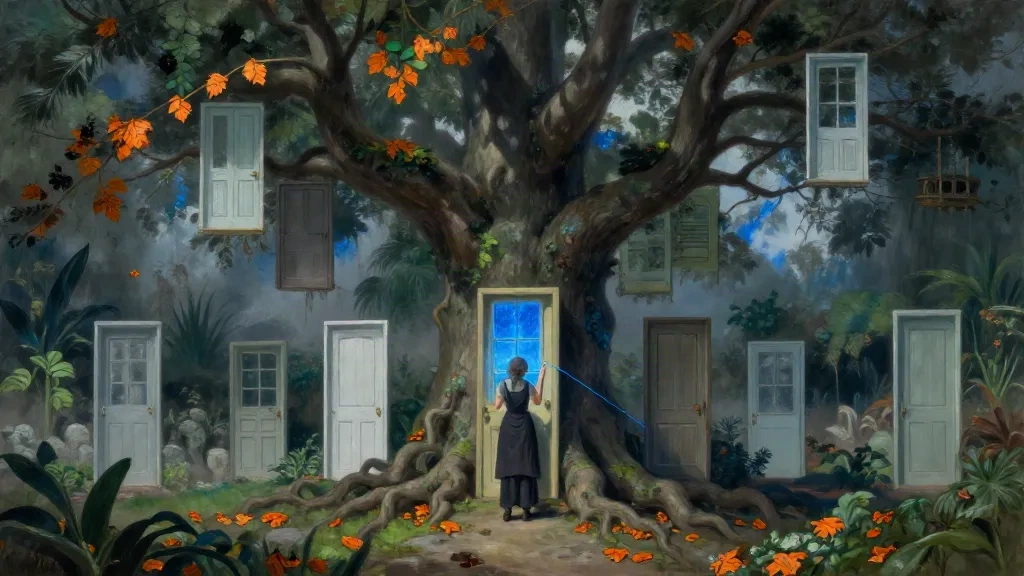
Surrealism.
The Glassblower's Window
Mara kept her ordinary morning in a pane of blue glass.
At dawn she drank bitter tea beside the south wall, watched steam erase the orchard path, and listened to her neighbor's broom strike the same three stones in the same three pauses. Then the tree at the garden's center opened a door.
Beyond it waited a room with no floor, only a square of blue storm-light. Inside, someone was arranging a breakfast table for two.
“You are late,” said the room.
Mara lifted the pane. “I haven't missed anything.”
She had been coming to the botanical garden since the tree first grew its first door, forty-three years ago. She shaped windows for the rooms behind them: narrow glass for closets that opened onto winter, thick glass for kitchens where every spoken promise became furniture, rippled glass for rooms where time had become weather. Her hands knew the cold of the molten glass. They knew the exact pressure required to keep a distant world from pressing through.
That morning, the room had prepared a place for her brother.
He had been gone eleven years. The room said he was waiting. Mara believed it, which was how she found herself shaping a window for a place she had never asked to enter.
The Trail of Lesser Truths
A blue thread ran from the tree's lowest branch to Mara's bench. She tied one end around the pane and followed the other through the orchard.
The trail grew safer as she told the truth.
“I am afraid,” she said.
A root lifted from the soil and revealed a stairway.
“I miss my brother,” she said.
A wall of flowering thorn opened, showing a path clear enough for anyone to follow.
But when she spoke to the gardener, he asked why she had come.
“To deliver a window.”
The gardener nodded. “To deliver a window.”
Nothing else opened.
When Mara lied, the danger thinned. If she claimed the garden belonged to her, the trees forgot their roots. If she said the morning was uneventful, the insects became silver and still. If she declared the room had never been empty, the door before her unfolded silently, without hinges or handle.
By noon, she had reached a clearing where six unmarked doors stood in a circle. The blue thread lay slack at her feet.
The one without a handle was hers.
She recognized the chipped lower edge. Her brother's workshop had possessed the same flaw.
What the Morning Required
Inside the unmarked door was her kitchen.
It smelled of scorched milk and wet flour. At the table sat her younger brother, alive, holding a cup in both hands. The window above the sink had no glass. Blue storm-light poured through the empty frame.
“You can stay,” he said. “Nothing has to be taken.”
Mara looked at the cup. A crack ran through its handle.
She had made that cup when she was seventeen. He had kept it after the accident. The real cup was in a box on her attic floor, wrapped in newspaper, broken in the same place.
Outside the kitchen, the garden began to erase its paths. Every truth she had spoken had made the trail more certain, but certainty was not safety. The orchard doors were closing one by one, and with them went the rooms that borrowed from her life: the rooms where winter lived, where promises became chairs, where her brother's voice could be heard without the original event.
Mara understood then what the tree wanted. Not lies. Selection.
She placed the blue pane in the empty window frame.
Her brother frowned. “You promised you would stay.”
“I promised to keep the window,” Mara said.
She turned the pane so its blue faced outward.
The Shape of a Kept Morning
The kitchen dissolved into storm-light, then rebuilt itself around the real window, the real table, the real silence.
Mara woke with a cut on her thumb and a blue thread tied to the latch.
Outside, the garden was different. The trees still carried doors, but fewer of them opened. The roots had drawn a circle around the bench, leaving the path beyond untouched. The trail was not safe, exactly. It was known.
Her neighbor's broom struck three stones. Steam lifted from her tea. She listened until the final pause, then tied the blue thread to the bench and returned to the kiln.
At the top of the path, an unmarked door appeared in the orchard wall.
Mara left it shut.
Some mornings survive because nothing asks to be saved.
Some mornings survive because we learn the difference between a door and a way home.





