 Netwrck
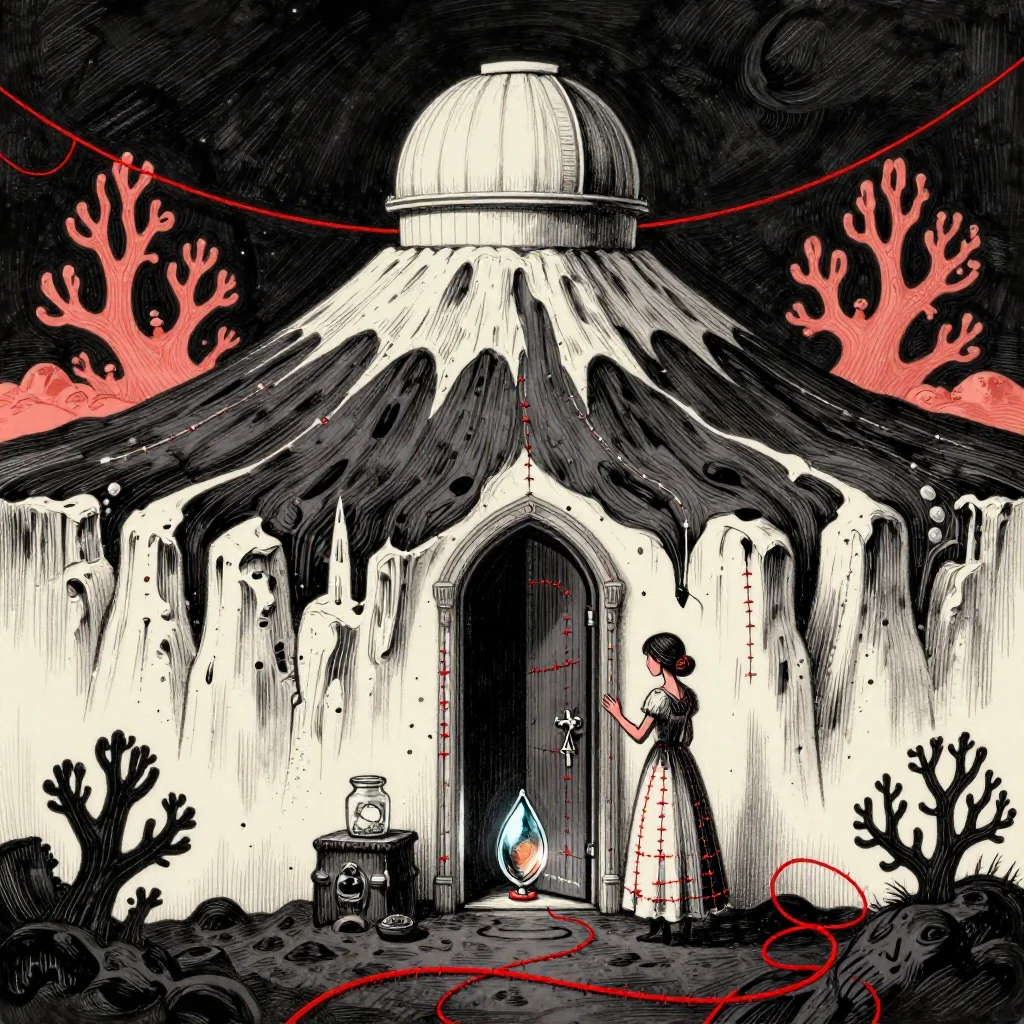
Gothic Fantasy.
The Observatory Below the Snow
Elian kept her salt jar beneath the eastern window, where the white coral cliffs caught the last light and turned the falling snow pink. The jar had belonged to her mother, who had mended sleeves in the village at the volcano’s foot. Elian had inherited the jar, the silver needles, and the gift that made her hands restless when people stood too far apart.
She could mend distance. A cut sleeve brought her the memory of an embrace. A torn glove recalled the warmth of a hand once held. If she stitched the hidden seam correctly, the lost touch returned—not as a ghost, but as a possibility held in cloth.
That spring, the observatory walls began to split.
Not from earthquakes. The cracks appeared along the old mortar, each no wider than a hair, each breathing cold air. Beyond them Elian heard voices in a language she did not know. The mountain had been called sleeping, but something beneath it had begun to turn in its sleep.
On her worktable waited the glass seed. It was clear as frozen breath and warm as a living animal. The villagers had sent it with the spring thaw, wrapped in a page torn from the municipal ledger. The note said only: Make a door that opens when both sides consent.
Below, the village had sealed its gates.
The Agreement of the Dead
The village agreement was carved into a black slab beneath the square. Every living official had forgotten its words, but the dead had not. At night, their names appeared in white coral chalk along the roads, and at dawn the marks vanished.
Elian descended to the square with her red thread trailing from one wrist. The slab sat beneath a shrine of volcanic glass. When she drew the thread across its letters, the writing rearranged itself.
The language belonged to the dead. It did not speak in sound. It spoke in obligations: who had carried water, who had buried a child, who had promised land and never returned it. The agreement bound the village to the mountain. In return, the mountain had promised the village a safe winter.
But the final clause was unfinished.
Elian pressed her palm to the stone. Cold entered her bones. She saw the village in two forms at once: the living homes below and the pale procession of the dead climbing toward the observatory. Both forms ended at the same threshold. Both had once been asked to cross.
They had refused separately.
Someone had cut out the words permitting passage.
That night, the dead gathered in her workroom. They did not bend. They did not speak. They sat upon the shelves among jars of buttons, salt, ash, and clouded glass. One of them wore her mother’s face.
“You cannot make them agree,” the dead woman said.
“I can make the question fair,” Elian replied.
She drew the red thread through the glass seed. The seed split without breaking, releasing a thin light that smelled of rain on hot stone. She sewed the seed into a strip of black cloth and began the door.
A Threshold Without Coercion
The first attempt opened inward.
On the other side, the village square appeared beneath a sunless sky. Every living person stood facing away from it. Elian heard a voice behind her say, They will enter if we command them.
She pulled the thread free.
The second attempt opened downward.
A staircase descended into the volcano’s throat, where the dead waited beneath the lava. They reached for her with fingers made of ash. The salt jar cracked, and a white line of crystals spilled across the floor.
Elian understood the flaw. A door made from one person’s will became a command. A door made from the mountain’s will became a trap. Consent could not be hidden inside obedience.
She divided the red thread into two strands. One she sewed into the glass seed. One she tied around her own wrist. The dead woman watched, her face unreadable.
“You will be on one side,” she said.
“Then the other side must choose me.”
At dawn, Elian carried the seed to the village gate. She hung the salt jar beside it. The jar’s crystals shone like white coral under the clouded sun. She sewed the door onto the air between gate and mountain: a narrow oval, its border stitched in red, its center holding the transparent seed.
On her side stood the living village.
On the other stood the dead.
Elian placed her hand over the left seam.
“I consent to meet them,” she said.
The thread tightened. The dead did not move.
Then, from beyond the glass, came three knocks.
The Answer
Elian stepped back.
The knocks came again. Not from the dead. From the village, where a child had pressed her palm to the other side of the door. One by one, the living stepped forward.
No one pulled the thread. No one spoke for another. Each placed a hand where they could see the opposite side. The woman who had cut the final clause knelt among the pale procession and confessed that the village had feared the dead would take its homes.
The dead had feared being forgotten.
Elian stitched the two answers together, white salt and red thread crossing every surface. The door opened a finger’s width. Cold entered, then warmth. The dead did not pass through. They looked at the village, and the village looked back.
At dusk, the agreement was rewritten in both languages. The living copied it onto paper. The dead carved it into the volcanic glass. Between them, the glass seed held a door that could not be opened by grief, hunger, or command.
It opened whenever two people—or two dead—chose the meeting.
Years later, travelers found the observatory above the snow, with its white coral cliffs, its salt jar, and a red thread stretched from the eastern window to the sky. They never saw the door. They never heard the dead.
But sometimes, at the hour before sunrise, a red seam appeared in the mountain’s darkness, and two hands pressed from opposite sides.
The mountain did not open.
They did.





