 Netwrck
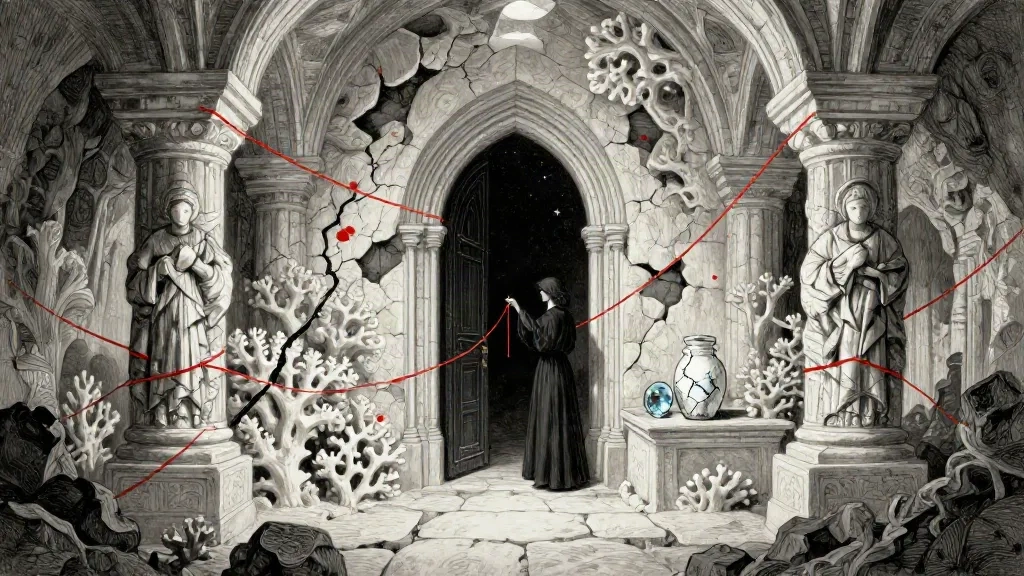
Gothic Fantasy.
The White Cliff of the Comet
Below Sister Orris’s window, the monastery wound downward through white coral cut by ink-dark veins. Its corridors followed the comet’s old orbit, narrowing toward a nucleus that had not cooled in six hundred years. Red thread crossed every surface: around pillars, through door hinges, beneath the mouths of saints carved into the rock. The prior called it a discipline. Orris called it a stitch holding the world together.
She was the monastery’s seamstress and its only mendmaker of distances. A torn sleeve she could close. A cracked friendship she could stitch edge to edge. Her needle drew white thread from the air and drew two distant people gently nearer, enough for one to speak and the other to hear.
What she could not mend was the door at the comet’s heart.
It stood in a chapel without windows, a narrow slab of black stone bound in red cord. Beyond it, villagers once kept their dead in white coral niches: the town beneath the monastery, abandoned when the comet carried the monastery through the roof of its church. Their agreement still governed that threshold. It forbade burial on one side without burial on the other. It sealed the door against anyone who had not consented to that equality.
The Agreement of Chalk and Salt
Orris received the village agreement in a salt jar sealed with cracked wax. No priest had been able to read it. The living saw black letters swimming beneath the parchment, then fade. The dead read it perfectly, but the dead had never crossed the threshold to explain it.
She laid a glass seed on the table. Inside the seed, a white coral splinter turned like a tiny compass needle. The prior gave it to her years ago. He said it had fallen from the comet when the village covenant was broken. He did not say by whom.
That night, Orris stitched a listening seam from the jar to the chapel door. She used red thread for the living and black thread for the dead. When she pulled, the agreement spoke in a dry chorus.
We, the living, consent to remember. We, the dead, consent to be remembered. No hand may open the door unless both witnesses place their names upon it.
Orris smiled without warmth. A door could not require names. A distance could not ask permission. The agreement was not protecting a boundary. It was hiding one.
The Seam That Pulled Back
She found the first false stitch beneath the door’s red binding. Her needle pierced it, and every burial niche in the comet below rang like a struck glass.
From beyond the black stone came a child’s voice.
“Sister, my mother is buried on the other side. She said I was forbidden to follow her.”
Orris drew the thread. The dead child’s voice grew nearer, then snapped.
Each stitch mended a separation by consuming another. To close the door, she would have to sever consent itself. The dead had made their agreement with fear. The living had sealed it by refusing to answer.
She found the living mayor at dawn, asleep beneath the monastery’s bell tower with his hands full of red thread. He had been born in the village below, though every official record placed his birth after the comet’s passage. In his coat pocket lay the missing half of the glass seed.
“You wrote the agreement,” Orris said.
“We did,” he whispered. “After the town moved here. We wrote the dead beneath us and our ancestors beneath them, then made the door so no family could claim either.”
“Consent was never offered.”
“Consent would have ended it.”
A Door That Listened
At sunset, Orris opened the salt jar and poured its grains across the chapel floor. Each grain caught the comet’s inner light: white coral, ink black, one thread of red.
She placed the two halves of the glass seed against the door. The mayor spoke the name of his grandmother. Below, the dead child spoke her mother’s. Others followed until the chapel filled with names, each voice asking not to be forgotten but to be allowed to choose.
Orris stitched a red seam from threshold to threshold, then erased the original clause with a needle black as night. The door did not open. It grew a seam.
And for the first time, it waited.
In the morning, the monastery bells sounded without wind. Orris hung the empty salt jar beside the chapel entrance. The glass seed remained on the sill, no longer a compass but a small clear window through which both sides could see the other.
Behind the black door, someone knocked twice. From beyond the village niches, someone knocked back.
Orris picked up her needle.
“Consent requires a seam,” she said. “A door is only a decision nobody has made yet.”





