 Netwrck
Science Fiction.
The Measure of Distance
On the third floor of the Museum of Doors, Nera kept a salt jar beneath her worktable. It was squat and blue, its rim worn smooth by the sleeves of her coat. She filled it with salt from the kitchen, though the museum contained no kitchens and no sea. Each morning she shook a pinch onto the floor, where it settled into the thin lines between the tiles.
Those lines were distances. Between two people who had stopped speaking. Between a child and the shore where her mother vanished. Between a village and the century it had tried to bury.
Nera was a seamstress of separations. She could mend a torn sleeve, a split hem, the small裂 opening left when two lives pulled in different directions. Her thread was spun from the fibers of worn clothes. Her needle drew the loose edges together without erasing the shape of the wound.
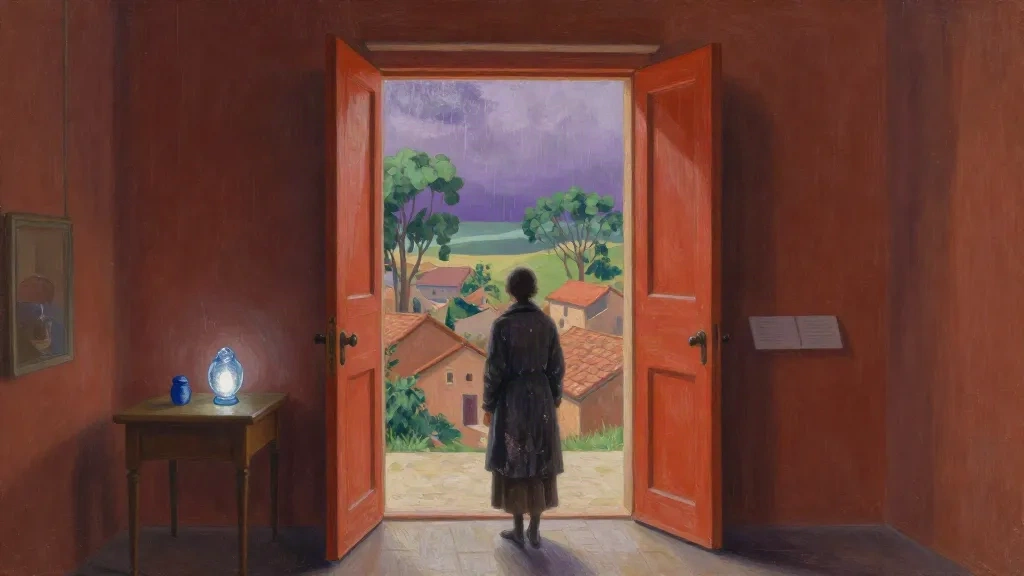
The museum’s newest door stood at the end of the corridor, painted the deep red of old brick. Its frame carried a silver thread, and across its center someone had written a sentence in a language Nera could not read.
The curator called it a treaty. The village below called it a warning.
The Agreement Below
The village had built the door from stones taken from three graves. In return, the dead had promised to watch over the harvest. For eighty years, the arrangement had held: no storms crossed the eastern fields, no child was taken before the barley ripened, and no door in the village opened unless both hands touched the latch.
Then the river changed course, and the dead stopped answering.
Nera descended to the village at dusk. Terracotta roofs shone beneath a sky bruised purple and green, like fruit crushed under a thumb. Eucalyptus trees leaned over the lane, releasing their bitter perfume. At the village well stood a woman holding the blue salt jar’s twin, though Nera had brought the original from the museum.
“The dead are asking for a new door,” the woman said. “One that opens from either side.”
Nera took out the glass seed from her coat. It was no larger than a lentil and held a spiral of clear light. The village children had planted seeds for generations, but none had ever germinated. This one had been given to Nera by a dead seamstress whose name appeared on no register.
“Can they consent?” Nera asked.
The woman looked toward the well. “The living can consent. The dead can refuse. The agreement is written in the language of refusal.”
What the Dead Could Say
Nera laid the glass seed on the treaty door. She threaded her needle with silver, then dipped the thread in the salt jar. One stitch made the village appear: crooked houses, bright windows, the black line of the river.
Another stitch brought the dead: standing in the wheat, their faces hidden by veils of rain. Nera could not hear their words, but she felt them in the needle. They wanted a way out without abandoning the living. They wanted no child to cross alone. They wanted the door to remember that protection required two voices.
She understood then why the agreement was written only for them. The living had mistaken refusal for abandonment because they had never permitted the dead to speak in the same sentence.
Nera began to mend the distance between the two sides. She stitched the treaty into the door’s grain, knot by knot. The glass seed opened beneath her palm. A tiny root appeared, piercing the stone, and the buried dead drew breath.
Both Hands
At midnight, the villagers gathered. Each placed one hand on the inside of the door. Nera stood on the museum side, holding the silver thread.
The dead gathered on the other.
She would not make the door for them. They would make it together.
So she tied the final knot and left both ends loose.
Nothing happened. Then an old woman asked whether the river was allowed to return. A boy asked whether his sister could cross without being taken. The dead answered by pressing cold palms against the other face of the wood. The silver thread drew taut.
Consent became tension. Tension became a seam.
At dawn, the door opened three inches. The living smelled rain. The dead smelled bread.
No one passed through. No one needed to. The opening remained exactly wide enough for a promise to pass in both directions.
Later, Nera returned to the museum. She placed the salt jar on a shelf beside the glass seed, now rooted in a shallow bowl. Its first leaf was eucalyptus green.
The door was not a solution. It was a repair: visible, imperfect, and strong enough to hold.





