 Netwrck
Fairy-Tale Fiction.
The Black Lacquer Thread
In Bellweather, the city obeyed a stranger law: every citizen had a shadow, and every shadow had a citizen.
At noon, the shadows moved beneath their owners, slipping over cobbles with long, dark coats. At dusk, the citizens followed their shadows home. The watchmen swept the moonlit streets for mismatches—a head without a body, a body without a head—and locked them in the House of Proper Shadows.
Mara Venn was a seamstress. She mended torn hems, split collars, and the ripped linings of winter coats, but her true work was stranger. With a needle of black lacquer and thread spun from gold dust, she could mend the distance between two people who had once loved each other.
She kept her tools in a room above the dye market. On a high shelf stood a salt jar, sealed with wax, and beside it rested a glass seed no larger than a tear.
For years, Mara had sewn only small separations: a daughter too far from her mother's window, a baker from his brother's stall, two lovers divided by a street that had flooded. The threads went taut in her hands, showing the shape of the wound. She never asked who had been right. Distance was not a lie. It was a tear in the world's fabric.
Then, on the coldest night of the year, the mayor came to her.
Build a door, Mara said. A door that opens only when both sides consent. We can no longer govern the border between our citizens and their shadows.
The border had begun to open by itself.
The Agreement of the Dead
At the edge of Bellweather stood an old village, though everyone in the city called it a mistake. Its houses had no windows. Its streets were covered in black lacquer, polished until the moon lay trapped beneath every boot.
Mara found the village gate open and three villagers waiting inside. They wore funeral clothes, though none of them were dead.
“We are what remains,” their eldest said, “when the living refuse to remember us.”
He presented a document written on thin black skin. The letters curled like insects. Whenever Mara looked directly at them, they disappeared.
“The agreement,” he said, “can only be read by the dead.”
Mara took the glass seed from her coat and held it over the page. Inside the seed, a pale shape turned.
She dipped a needle in the salt jar. The salt climbed the metal and froze along its length. When she touched the page, the dead language opened beneath her hand. It was not a language of grammar. It was a language of endings.
The agreement said the city and the dead village had once shared one door. Every citizen was to pass willingly to the other side. Every shadow was to follow. The living were to remain.
But the last sentence had been scraped away.
Without that sentence, the dead village was sealed forever, and the shadows were losing their citizens. Soon the city would consist entirely of shadows, each one wandering alone through a world with no body to obey.
What Both Sides Kept
Mara returned to her room and began to build.
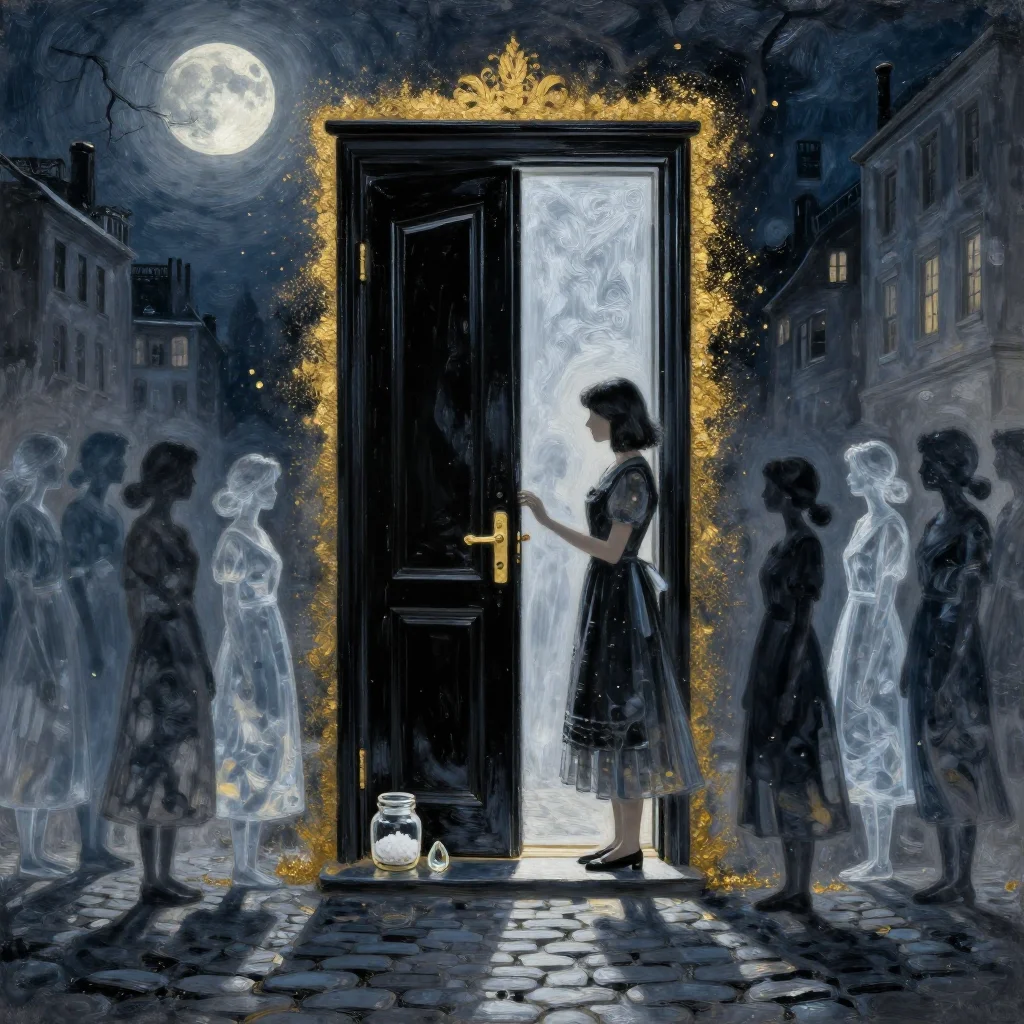
She used a black lacquer frame, gold dust along its edges, and a hinge made from a sliver of cold moonlight. The glass seed became the doorknob. The salt jar supplied the lock.
When she asked the mayor to test the door, it remained still. When the shadow of his wife touched it, the door rattled but did not open.
“The agreement requires the dead,” he said.
“It requires consent,” Mara replied. “That is why only the dead can read it. The living will say yes to the obvious answer.”
She carried the door to the village. The dead stood around it, their faces hidden beneath veils. On the city side, the citizens gathered, each one afraid to look at the shadows beneath their feet.
Mara stitched the final seam using thread from the glass seed. The seed cracked. Inside it was not a pale shape, but a narrow room filled with moonlight.
She placed the salt jar beside the threshold.
“Consent is not possession,” she said. “Open from your side.”
The village touched the black lacquer. The city touched the gold dust.
The door opened inward.
A Distance Closed
Nothing rushed through. No shadow seized a body. No citizen vanished into mourning.
One by one, the people of Bellweather stepped across, followed by the shadows they had feared abandoning. The dead received them without claiming them. When each returned, they found the other side waiting—not as an owner, not as a jailer, but as a neighbor.
The village gate disappeared. Its houses folded into the city, and windows appeared where there had been none.
At dawn, Mara sewed the last black thread into the mayor's coat. The thread snapped, dissolved into gold dust, and vanished.
Her door remained open. It opened when someone came willingly and waited when someone did not.
Years later, children asked why the threshold had no doors. Mara told them that distance was not a wall. It was an agreement between two people who had forgotten how to speak.
Then she set the empty salt jar on the sill and watched the moonlight pass through it without needing to be caught.





