 Netwrck
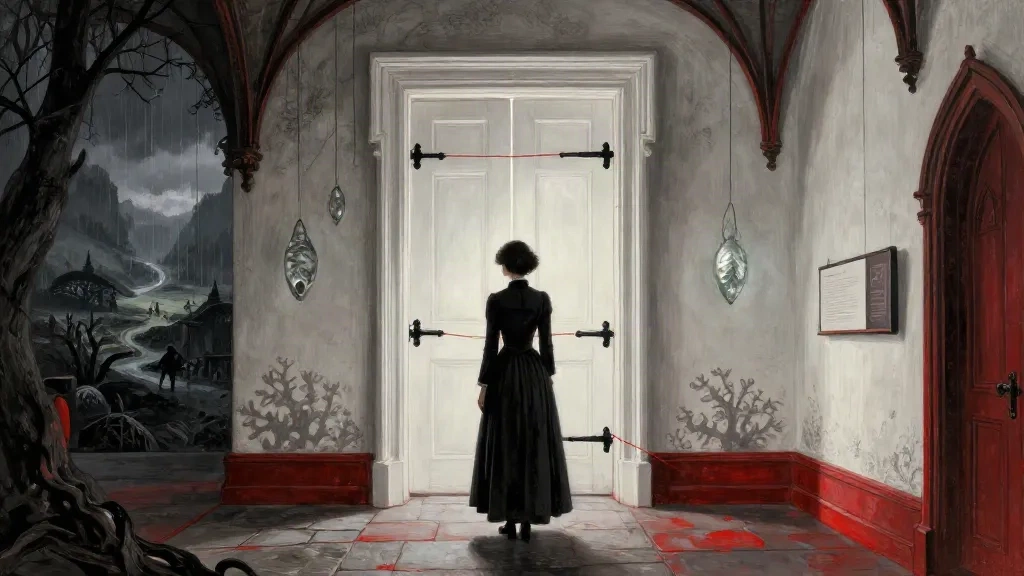
Gothic Fantasy.
The Museum of Openings
In the city of Vell, beneath a hill of black brick, there was a museum of doors. Each door stood in its own white room, labeled with the courage it demanded: courage to forgive, courage to enter, courage to remain.
Maren kept the smallest room, where the doors were repaired. She was a seamstress with a patient needle and an unnatural gift: she could mend the distance between two people. A torn sleeve, a crooked photograph, a glove left behind at a funeral—she could close the gap until the wearer remembered the warmth of the other.
Her own workshop was cramped and damp. A red thread crossed every surface, winding around the window latch, the sewing table, the handles of her scissors. On the highest shelf sat a salt jar with a silver lid and a glass seed clouded like a winter moon.
The Village Below
One morning, the museum curator brought her a map. A village called Orison had sealed its last door and refused to open it for refugees crossing the valley. Yet each night, the villagers left bowls of water outside their locked gates.
“Make a door,” the curator said. “One that opens only when both sides consent.”
Maren looked at the map. “Consent is not a seam I can stitch.”
“Then make the seam honor it.”
That night, the glass seed split open in her palm. Inside was a narrow black flame. A whisper entered the room in a language she did not know, though she understood its meaning: the dead are meeting below.
The Agreement in Bone
The village agreement was found beneath the well. It had been written in black ink on strips of bone, sealed in salt. The curator recognized the old ritual script, but only the dead could read it. The dead came when Maren cut her thumb over the red thread and touched the bone.
They filled the room without disturbing the dust. Men and women in funeral clothes stood behind her, their faces blurred by the candle flame.
“What does it say?” she asked.
“It says the village surrendered its firstborn memory to the valley,” the dead whispered. “In return, the valley promised refuge. But the promise was divided. The village kept half. The valley kept half. Neither can prove the other’s consent.”
Maren ground salt into the ink until the pale script shone. “Then consent has been broken.”
“Yes.”
“And the door?”
“The door remembers what was stolen.”
At dawn, she carried the salt jar, the glass seed, and her needle to Orison. The villagers gathered behind their gate. On the far side of the valley, refugees watched through the rain, carrying bundles and children and the expressions of people who had learned to distrust doors.
The Last Opening
Maren hung the glass seed between two black hinges. She drew a red thread from her own heart to the seed, then gave one end to an old woman inside Orison.
“Do not pull,” Maren said. “Speak only what you can freely give.”
The old woman closed her eyes. “I forgive the valley for making us afraid.”
The thread went taut but the door did not open.
Across the rain, a boy held out the other end. “I am not afraid of your hunger,” he said. “I am afraid of being refused.”
The salt jar cracked. Black flame poured from the glass seed and raced through the red thread, across the gate, over the walls. The bone agreement blazed white. For one breath, every dead voice in the valley spoke at once.
Then the door opened inward, without force, without hunger, and both sides crossed only when they chose.
Maren stayed at the threshold. The thread in the room had finally stopped pulling. In the salt jar, the remaining grains formed a small white corridor. She understood then that courage was not the absence of fear, nor the strength to open every barrier. It was the discipline to leave the final choice untouched.
The museum later hung a plain white door in the smallest room. It had no courage written above it. Visitors were asked to knock only if both they and the world beyond the door were ready.
Maren never mended that door. She left its seam loose, red thread trembling in the dark.





