 Netwrck
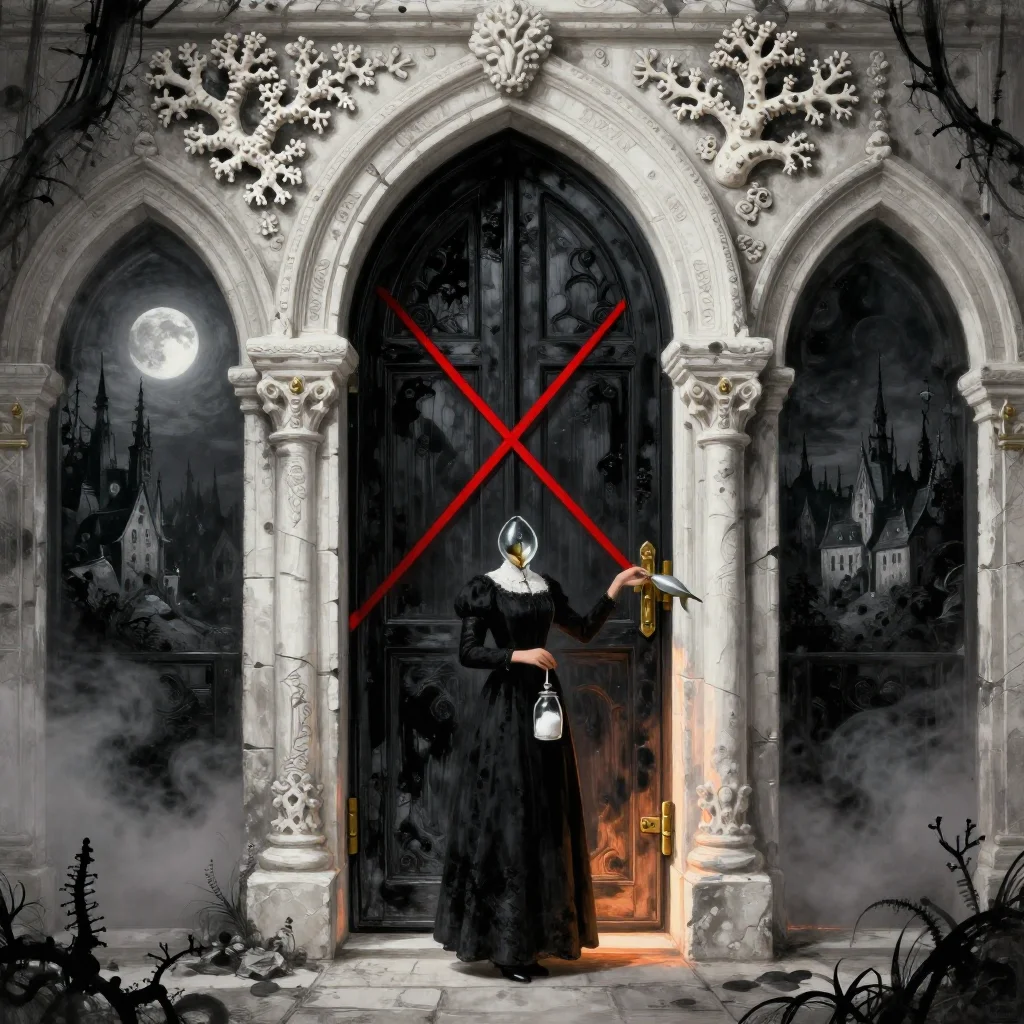
Gothic Fantasy.
The Salt Jar
In the Museum of Doors, the wind was a seamstress who had lost her scissors. It entered through the cracks, passing beneath shelves of obsolete hinges and between the spines of forbidden catalogues. It wore a coat of white coral, and wherever it passed, the brass doorframes wept a thin red thread.
That was how Mara found the door.
It stood beneath a low ceiling, painted the colour of old ink. The surrounding exhibits were loud: a green door opening onto a battlefield, a blue one onto the roof of a burning house, a narrow ivory door that exhaled perfume from a childhood bedroom. The door Mara found gave off no light and no sound. A small placard hung from its handle: CONSENT, RECIPROCAL.
Mara touched the wood. In the blankness beyond it she felt two hands pulling in opposite directions. She understood the old craft then: she could mend the distance between two people by stitching the darkness where their fear had torn apart. She could close a wound, conceal a betrayal, make two strangers walk away holding the same invisible thread.
She had never made an opening.
Her mother had left her a salt jar and a glass seed. The salt was for keeping grief from turning into weather. The seed was for doors that had forgotten how to grow. Mara carried both in her apron pockets, though the seed weighed more than a stone.
The Agreement Beneath the Floor
The village below the museum had not opened its doors in eighty years. Its people lived behind shuttered windows, passing bowls of salt and water through narrow slots. At night, a red thread appeared across every wall, from cradle to grave, and vanished before morning.
They brought Mara their agreement.
It was sewn into the lining of a child's coat: white coral cloth marked with black stitches and one long red line running through the signatures. The village had forgotten its words. The old priest said the pact had been written in the language of the dead, spoken only after both living witnesses had surrendered their names.
“A door cannot remember what its makers refuse to say,” Mara said.
“Then make it remember,” said the priest.
She unrolled the agreement across the floor of the museum. The ink rose from the fabric. Letters writhed like lice beneath the lamp, each one forming only when she held her breath. The dead could read them, but the living could not. The village had agreed to share the water beneath their houses. The dead had agreed to share the roads.
Neither side had agreed to open the other.
Outside, the ground trembled. A red thread tightened around the museum's pillars. Mara put her ear to the silent door and heard villagers knocking from both sides at once.
The Seed of Two Willings Shadows
She built the frame from doors that had failed. The green battlefield door supplied courage to strike. The ivory bedroom door supplied courage to leave. The burning-roof door supplied courage to stay. She burned their old hinges into black ink and mixed the ash with salt, for a threshold must contain both refusal and return.
At the centre she planted the glass seed.
It cracked open. Inside it was a room smaller than a cupped hand, with two people standing on opposite sides. One held a knife. The other held out an empty hand. Neither could cross.
Mara began to stitch the distance.
Her needle passed through the door, not the room. Red thread gathered around each shadow and drew them together. The knife lowered. The empty hand closed. Yet the door remained shut, because consent was not the same as mercy.
“Both sides must choose,” she whispered.
She cut the thread.
The room inside the seed went dark. The museum shook, and the village's agreement split along its final line. One name shone in white coral. Another shone in ink. Between them, a third mark appeared: a red thread tied in a knot neither had made.
Someone had sealed the pact after both villages were dead.
The Hinge
Mara went down into the village with the salt jar in one hand and the glass seed in the other. The dead children opened their windows. They were small and translucent, wearing names written on their sleeves. At the well, the oldest dead woman pointed beneath the water.
There the original agreement waited, curled around a stone. Its language was visible only when Mara dipped her fingers into the salt jar. The dead were not its authors. They were its witnesses, forced to translate the living's refusal into a promise they had never made.
Mara did not destroy the agreement. She mended the tear that separated consent from obedience, and the red thread turned white coral at its centre. Then she planted the glass seed in the well.
It opened.
This time, two shadows stood on either side, neither holding anything. The living villagers came to the threshold. The dead gathered behind them, waiting without hunger. Mara placed one hand on the left frame and offered the other to the dark.
“Only opens when both sides consent,” she said.
The shadow consented. So did the village. So did the dead, who had wanted passage, not possession.
The door opened inward.
Beyond it was neither the village nor the afterlife, but a narrow white room filled with morning. The living crossed. The dead followed. Mara last stitched the threshold shut, leaving one seam open so no agreement could become a trap again.
By dawn, the museum had one more door. It was painted ink, crossed by a red thread, and bore no placard.
Mara knew what it was for.
Some doors opened when courage was demanded. The rarest opened only when someone finally chose to let another person in.





