 Netwrck
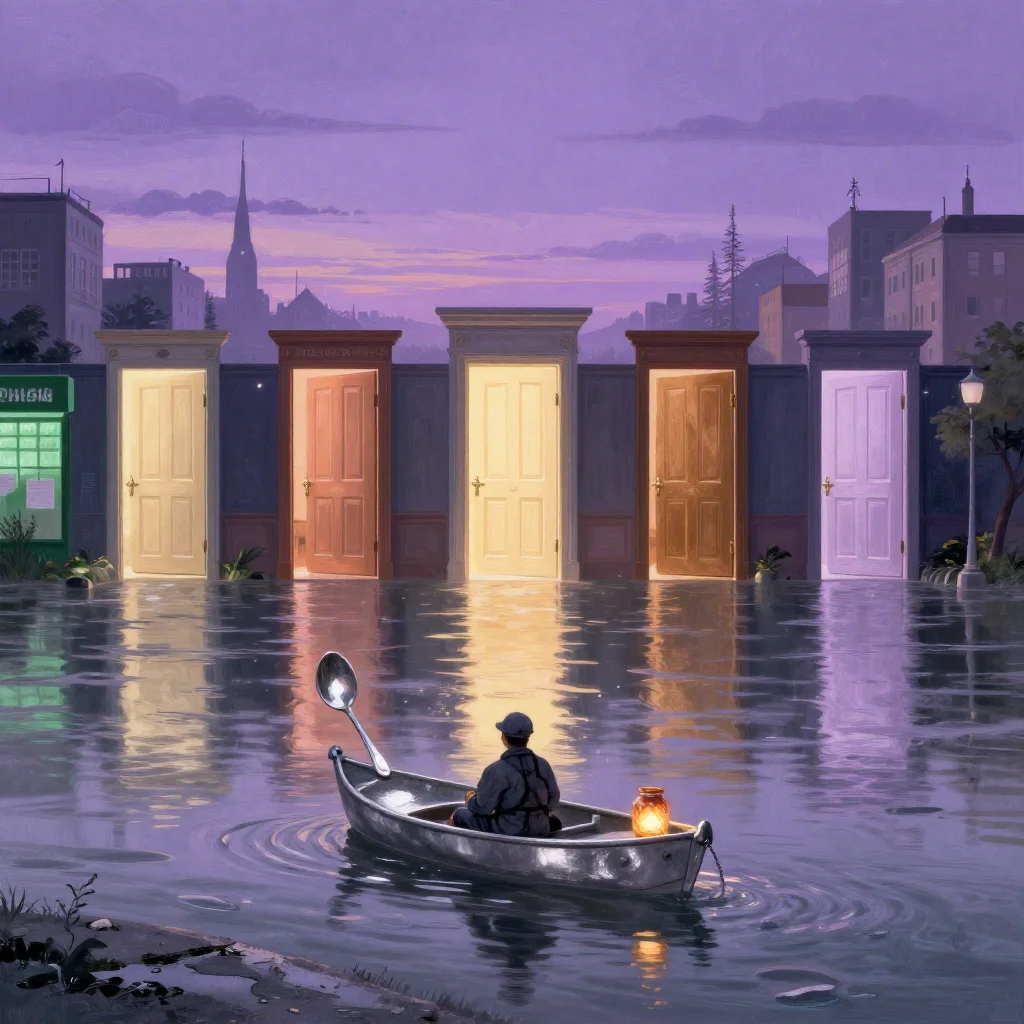
The Door That Faced the Rain
The Bureau of Hydraulic Sentiment owned three boats and one surveyor, and for eleven years the surveyor was Mara Venn. She poled a flat-bottomed silver boat down the Reach with a lavender flag tied at the bow, because her grandmother had owned a lavender flag, and because a flag was the only thing about the job that was allowed to be decorative.
The work was simple to explain and impossible to do. Water carried feeling the way it carried silt: in suspension, in layers, in sudden flocculation after rain. Mara did not read faces. She read surfaces. She could skim a tremble of resentment off the current with the bowl of a spoon and lay it out on a card, and she could name the spot where grief sat trying to become useful to someone.
The spoon was dented on one side. It had belonged to her son, Ren, who was nine when the Bell Street weir took him in the spring of his ninth winter, and who had eaten off it nightly with a stubborn squareness that made the handle shine. The salt jar came from the kitchen on Vane Street, where Ren had counted out grains to prove that a pinch of salt was more than a pinch of nothing. She had kept the jar. She had not kept the house.
Each morning she performed the small private arithmetic: a pinch into the water, the tiny collapse of each crystal, a name for what the river was carrying under the bridge she was measuring. Nobody knew. Nobody was meant to. Sentiment was not a hydrological quantity, and the Bureau had a filing system built on the assumption that if you could not meter a thing, you could not be responsible for it.
Then came the notice. Ordinance 44-B, the Veer Diversion, eleven kilometers of concrete throat to be finished at first light. On the morning of the survey that would end her license, the river gave her a bridge she had crossed as a child.
The Boy With the Wet Envelopes
It rose out of the water in a white line, delicate as a crack in glass, and it was the Bell Street bridge. She knew it before she knew anything else. She knew the missing railing on the north side, the one the city had never repaired because repairing it would have required admitting the seam. She knew the blue pharmacy sign that had stood at the corner for forty years and reflected itself downward into the wet planks, so that children walked through a second blue street under their feet.
On the bridge stood a small boy with his hands full of wet envelopes.
Mara's hands went slack on the oar. The boat drifted. She counted the envelopes before she could stop herself, the way you count a fever, because counting is what the body does instead of hoping. Eleven. Their corners had gone soft. His sleeves were soaked to the elbow and he did not seem to mind, and his face was turned three-quarters away, and she was fifty-one years old and she was not going to let herself finish turning it the last quarter.
“You are not permitted to address the subject,” said the water.
That was how the river spoke. Not in words. In the flat, clerkly way the surface closed over a disturbance, the tone of a form being stamped and returned.
She raised the spoon.
That was the professional gesture, the one that meant reading, stand clear, this will take a moment, and she had used it eleven thousand times, and it had never once failed to give her something she had not asked for. The boy was gone. The envelopes were gone. In the bowl of the spoon the river was turning pages: every bridge ever built on the Reach, and under each span the long sediment of what it had been built to carry. She saw the fear in the ironworkers' mortar, the arguments in the stone of a viaduct finished in a bad year, an apology poured into a pier in 1911 and never mentioned again, and everywhere the stubborn, cheap, unremarkable hope that gets a span across a gap because a gap is a thing that can be argued with.
The structures had been demolished. The records had not. That was the discovery. For a hundred and forty years the river had been keeping the public record of every public thing the city had ever agreed to remember, and nobody had asked it to, and it had never once been thanked.
The River's Public Record
By noon it stopped keeping.
It started returning. A woman named Nadja Okonjo opened her apartment door on Ferro Street and found the smell of rain on a childhood staircase that had been demolished in her ninth year, and she stood in the hallway and wept with an exactness her sister could confirm. An express train went into the Marrow Tunnel and came out beside a market that exists only in a song, and forty passengers got off carrying produce that was not there when they boarded. On the steps of the Halloran Museum of Civic Instruments, three doors appeared overnight. One opened onto courage measured by weight. One opened onto courage measured by silence. The third opened onto a broad, patient courage, the kind that could wait for a bridge to finish becoming itself.
Mara brought the records ashore. She laid the fragments on the marble of the museum's central hall — the hall where the city had displayed its survey of itself since 1893 — and used the salt to mark each origin, the spoon to lift fear away from tenderness so the two would not curdle together. Visitors came. They recognized pieces of their own lives in the water's reflections, and then, in the way of crowds, they began bringing pieces that were not reflected at all.
The museum director, Ilse Ferrant, stood in her good shoes and watched a stranger weep into a doorway.
“This should belong to the city,” Mara said.
“A river is not a public archive.”
“It has been keeping one.”
“It has been keeping debris.” Ferrant's voice was level and entirely reasonable, which was how she had kept the Halloran alive through four directors and one fire. “You are proposing to formalize a leak. There is no chain of custody, no provenance, no consent. Half of what is on my floor is somebody's worst hour, offered to me without their permission, and I am expected to give it a catalogue number.”
Mara had no answer, and the not having one was the part that would later turn out to be the whole shape of her life.
The Bureau arrived at four. Deputy Hydrologist Cassian Rohe came up the museum steps with two men and a folded ordinance, and he had been her colleague for eleven years, and he had once carried her son's coffin.
“Venn. You are recording feelings.”
“I am recording water.”
“You are recording feelings, and the clearance you hold is a hydrological clearance, and in fourteen hours this river is going into a pipe.” He lowered his voice, because Rohe had never once in eleven years used a public voice when a private one would do more work. “Clear the floor. I can make this a sanitation order and it will be legal and it will be quiet, and you will keep your pension.”
“They'll concrete it over.”
“They'll concrete it over.” He looked at the doors, which is a thing a man is not supposed to do. “Mara. Whatever the boy was, he is not a record. He is a thing you would like.”
“He had eleven envelopes.”
“Then write that down in a diary,” Rohe said, and hated himself for the shape of the sentence, and went back down the steps to wait for dawn.
What the River Owes
Emre Vass found his mother's voice at ten past six.
He had come in because his sister told him the museum had a room where a thing you had lost was giving itself away free. He was a solid man, a freight broker, forty-one years old, and he got about nine words into the reflection before he put both hands over his mouth. His mother had died in March. What the water gave him was her, twenty-two years old, signing the sale of the house on Gantry Row, the house with the low ceiling and the coal chute that blocked, the house in which she had left her nine-year-old son inside for the duration of a flood and a set of papers she had been promised would be worth more than the boy. She had signed it, and she had come back, and she had spent the rest of her life saying it was a decision made in an emergency.
Emre Vass crossed the hall in four strides and had Mara by the throat before Piet Lindqvist, the Halloran's one remaining archivist, got there. Piet pried him loose. Nobody shouted. There was nowhere in that hall for a shout to go.
“You put her out,” Emre said. Not shouting. Wrecked. “You put my mother's voice out on a floor.”
“Yes.”
“She took me out of a house.”
“Yes.”
“And now everybody can hear it.”
Mara did not look away from him, because she had been a surveyor for eleven years and looking away was the only cheating there was. “What did she say about it? In the reflection. Word for word.”
“She said she was twenty-two.”
“Then that is what is true,” Mara said, “and it was true before today. I did not put it in the water. I only stopped holding it down.”
He sat down on the marble, in the middle of a floor covered in other people's worst hours, and Piet brought him a cup of water, and the water was only water, and he drank it anyway. That was, Mara thought, the entire moral question, and it had no resolution, and she was going to have to decide anyway.
She decided at ten o'clock, and it was not a heroic decision. She went to the lectern and read the record into the museum's public address system, and the system was old and it squealed, and the reach for a microphone was the reach of an arm that was shaking.
“The Reach is a public watercourse,” she said. “It carries the public's feeling, in the same water, into the same pipes, past the same intakes. Under the Veer Diversion, eleven kilometers of that water will be sealed. Everything it is carrying goes with it, unrecorded, unattributable, and unreturned. The record of it is on this floor. I am proposing that the City accept it as an archive, with the survey data as provenance, and that the archive be held here, in public, in perpetuity, and that it be given away in public, to anyone who asks, because it is not ours to keep.”
“You are proposing to flood my building,” Ferrant said.
“I am proposing to tell you that it is already wet.”
A Map Made Together
At midnight the river rose over the museum steps and did not flood a single room. It made channels between the doors. It ran under the marble in bright braided seams, carrying the city toward the Halloran and the Halloran toward the city, and outside, on the wet asphalt of Ferro Street, the pharmacy sign threw green light across the road in a shivering bar. Under lavender lamps that the city had, for reasons nobody could later explain, already owned in quantity, strangers stepped out of one another's courage.
The woman who feared asking for help went through the door of patience, and came back still afraid, and asked anyway. The man who had never been afraid in his life went through the door of surrender and came out quiet. A child crossed a span made out of a grandmother's first apology and arrived without falling, because apologies, unlike bridges, are load-bearing immediately.
Nadja Okonjo found the staircase again, and this time it went up. It went up through her own ceiling and into a hallway she had not had since she was nine, and at the top of it stood a woman in a coat she had kept for sixty years, and Nadja did not speak to her, and neither did she, and Nadja stood there for eleven minutes, which Piet timed, because he timed everything, and afterward she told him it was the longest she had ever been in a room where nobody was asking her for anything.
Other people were not so lucky. A witness in the second row bled from both nostrils and could not say why. A fourteen-year-old would not stop crying for nine hours and later described the crying as reading. Three tiles lifted in the eastern gallery, and a door that had been a door in 1908 walked eleven meters across the floor and came to rest against a wall, and the two archivists on duty watched it go and neither of them wrote it down, because some things do not go in the register.
Mara went up onto the roof, where the wind came off the water and the whole Reach lay out below her like a document nobody had proofread. She tied the spoon to the flagpole, and the lavender flag snapped above it, and the salt went in a grain for each public step, a grain for each door, a grain for each person who came up the museum steps after dark and did not have a question so much as a weight.
The map took shape the way maps of that city always eventually do: by being walked. People began crossing the spans the river put up, and the spans brightened under exactly the weight they could bear — not the weight they had, but the weight they needed to cross. The map was honest. That was its cruelty and its gift. Nobody could cross anything by being told they were strong enough. They had to find out, at the crossing, in front of people, which was the one thing the city had spent a century arranging to avoid.
The Last Crossing
At sunrise the river lifted the Bell Street bridge clear of the water and set it above the Halloran, a white arc hanging in the wet air, bright with everything it had been asked to carry, the missing railing still missing, the blue pharmacy sign still doubled underneath it in the wet planks.
Mara had about ninety seconds. The contractors were two hundred meters downriver with a chute and a permit and a schedule, and Rohe was on the steps with his hat in his hands, and Ferrant was standing in the doorway of her own museum with her coat over her arm, and none of them told her what to do, which she would remember as the greatest courtesy of her life.
She loosened the rope.
The spoon went into the current and the current caught it, and for a moment the whole Reach held its breath the way a held page holds its breath. Then the river gave it back as a thousand spoons. They came up out of the water on the undersides of every bridge in the city, silver, dented, wet, catching the first light, and they went into hands — a child on Ferro Street, an old man at a bus stop, Rohe, Ferrant, a woman on a fire escape on Vane Street who had not lived there in twenty years and who held one for a long time before she turned and went up the stairs.
Then the Bell Street bridge came down as light. It did not fall. It unbroke: the span went green from the pharmacy end to the museum end, a single line of green light laid across the wet city at knee height, and it stayed there, and it has been there since, and the city walks across it every day on its way to work, and nobody has ever found out whether crossing it makes you braver or simply gives you somewhere to put your weight.
By eight o'clock the ordinance was signed and the Veer Diversion was finished on schedule. That is the part that ought to end the story and does not. The concrete went in. The water went where the water goes now, all of it, in a pipe, under the city, at speed, out to the estuary, and the city kept its river in a box like a kept bird.
What the River Kept Afterwards
The archive holds. It is on the third floor, where the pendulum cases used to be, in a room with the windows open, because the water in the basin on the east side will not stop trying to get out and the archivists have stopped trying to make it.
The ritual is codified now, and nobody in particular is in charge of it. You bring a question, or you bring only a weight, and you take a spoon, and you stand at the edge, and the river tells you what it is carrying at that spot, measured, named, and released. Rohe resigned his post in the autumn and then turned up on a Tuesday with a clipboard and a new title, because the Bureau discovered that it could not meter a thing it had stopped denying, and he had thirty years of forms to learn. Ferrant runs it. Piet times the crossings and publishes the minutes, and the minutes are dull, and they are the most important document in the city.
People use it for the small things. A man came in October to find out whether his brother had forgiven him, and the water said that was not a thing the river had, and the man sat down on the third floor and was forty minutes late to his own dinner and did not mention it to anybody, ever, and came back in the spring to ask whether his brother had forgiven him, and the water again did not have it, and the man said all right, and left.
There is a cost, and it is real, and the city argues about it in council. The archive has no consent. Old wounds are now public property, and Emre Vass has spoken at three hearings against the whole enterprise, and his mother's voice is still in the water, and he still brings a lawyer, and no one has ever suggested he stop, because the suggestion would be the same as the silting of the Reach.
The salt jar refills itself, which nobody can explain. Children do it mostly. There is a rule about not asking the river for anything you already have, which children enforce on adults with a savagery their parents find alarming and correct.
And Mara Venn goes out in the flat silver boat on the mornings, past the culvert mouth, where the water still comes up smelling faintly of rain on a stone staircase nobody has standing. She keeps no private crossings. The boy with the eleven envelopes is not in the water and is not gone; he is simply no longer hers alone, which is what she wanted, and which she has found, on the whole, less like being forgiven than like being allowed to set a thing down in a room with other people in it.
Fear did not disappear. It never does; it is only quieter in a room with other light in it.





