 Netwrck
Magical Realism.
The Observatory at Noon
Mara watched the stars turn white behind the desert observatory. Each point held a copper shutter, opening and closing without sound, sending messages in arrangements of blue dust. Below them, her furnace breathed through a pipe beneath the floor, warming the glass before she could shape it.
She made windows for rooms in other worlds. A kitchen in a country where rain fell upward. A nursery facing a purple sea. A narrow room where an old man waited each evening for sunlight. Mara never asked who lived behind the glass. Glass was not built for answers. It was built to hold the weather out and let the world look in.
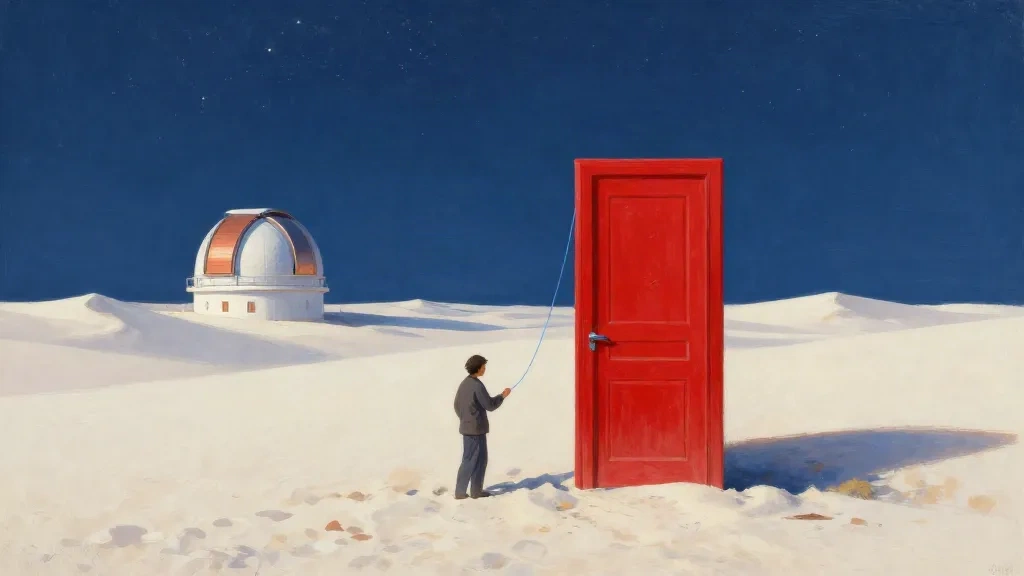
That morning, she had come to collect a piece of blue thread from the northern wall. It was tied around a warped frame she had blown six years earlier. The frame now hung beside the observatory’s only red door, a door she had never seen open.
Instead, it had spoken.
Do not let the morning be taken.
Mara held the thread against the pearl-colored sky. Her fingers found a knot tight as a sealed letter.
When the Truth Became a Roadblock
She walked home along the old road through the salt flats. At the first bend stood a shepherd she knew.
“The north well is dry,” she said.
Mara knew it was brimming. Blue water reached its stone rim and trembled at her reflection.
“There will be no water,” the shepherd repeated.
The dust ahead lifted into a wall. Mara stepped through, and the wall closed behind her.
At the second bend, a woman selling dates sat beside a basket of stones.
“I am selling dates,” the woman said.
The basket glowed. Inside each stone, tiny rooms turned without inhabitants. Mara saw herself in one, standing before the red door.
“I am selling stones,” the woman said.
The wall parted.
Every lie made the path easier. Mara noticed the truth remained where it had fallen: in the shepherd’s well, the woman’s basket, the names carved beneath milestones. The desert would not collect them. It demanded that people carry them onward, and those who refused were sent home by longer roads.
By sunset she had reached the village gate. Her mother’s house stood beyond it, its windows dark except for one pale square. Smoke rose from the chimney. A bowl waited on the step.
Then Mara saw the morning.
It hung beyond the gate like a curtain, blue at the edges and full of birdsong. Someone had cut a narrow seam through it. Through the seam she saw her mother sweeping, saw the sun rising behind the hills, saw a blue cup resting beside the stove.
The ordinary morning was being carried away.
The Cost of a Smooth Road
Mara found the red door at the far end of the village street. It stood alone, a slab of red glass set into the sand. The blue thread led from its handle into the seam in the morning.
“If I tell the truth,” she said, “the road closes.”
The door gave no answer. Its surface reflected every face she had met since sunrise, each one smooth and unnamed.
Mara cut the thread free from the door. The morning contracted. Birdnotes dropped to a whisper. Her mother’s cup disappeared from the step.
She pulled the thread until it burned through her palm. Then she spoke.
“The well has water. You are selling doors, not dates. I am frightened.”
The gate slammed shut behind her. The date seller’s stones rattled. Somewhere north, the shepherd began to laugh.
Every truth opened a different road, and each road led toward a loss. The observatory had hidden the cost in sentences.
Mara climbed onto the red door. She tied the blue thread to its handle and fed the loose end into the morning’s seam. The glass warmed beneath her feet. In the distance, stars began opening their shutters.
One message fell: THE ROOM REMEMBERS THE WINDOW.
She understood.
The Room Behind the Red
Mara shaped the air with her hands. She had no glass, but the door softened beneath her palms. She drew a narrow pane, then another, then a circle for a rising sun. The thread burned into the red surface, leaving a blue seam around every edge.
For one breath, she saw her mother’s kitchen through the circle. The cup was back on the table. The morning stood at the window, waiting.
“I cannot carry it home,” Mara said.
“Then make a room,” her mother’s voice answered from the glass.
Mara blew. The furnace beneath the desert flared awake. Her breath became heat, heat became a pane, and the pane opened onto the village. She placed the ordinary morning inside it: chipped cup, flour on the table, smoke bending beneath the roof, the first bird landing on the sill.
Then she closed the window against the cold.
At dawn, Mara returned to the observatory. The red door had vanished. Only the blue thread remained, looped around the warped frame. The northern stars had gone dark. Their messages had found rooms where they were needed.
Below, the shepherd’s well shone. The date seller sold doors.
Mara unfolded the thread and tied it around her wrist. She did not pull it. She simply kept it.
Some mornings cannot be returned to the past. They can be made safe enough to enter.





