 Netwrck
Fairy-Tale Fiction.
The Salt Jar
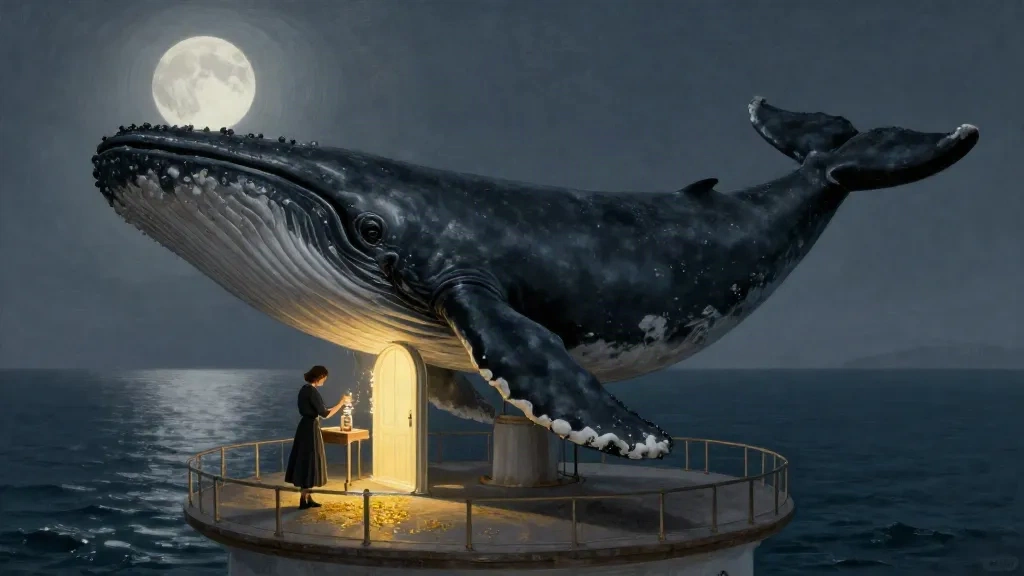
Maren’s needles lived in a black-lacquer case upon the lighthouse’s highest gallery. From it, the moon showed no silver road, only a cold disc above the sea and the slow black bulk of the whale carrying them all. The great machine breathed through brass nostrils. Its ribs opened and closed beneath the floor, and each breath raised a faint tide of gold dust through the lighthouse rooms.
Maren was a seamstress of distances. She could stitch a torn road between two towns, mend the lost span between a father and daughter, or close the invisible breach that opened whenever a person walked away in anger. Her work required no spellbook, only two pieces of cloth taken from the clothing of those who wished to meet again.
Her own mother had walked away when Maren was seven. The unfinished seam remained beneath the little finger of her right hand, thin as a gray thread.
For that scar, she wanted a different work. She wanted to make a door that opened only when both sides consented. No hidden longing could summon it. No blood, oath, or familiar face could force its latch.
Her materials waited on the worktable: a salt jar, sealed with wax, and a glass seed containing a single black grain. Below them, villagers were gathering in the whale’s old boat-shaped hall.
The Agreement of the Vanished
The village had signed an agreement with the neighboring shore three generations earlier. Since then, fishermen had found silver seals washed up on their decks, children dreamed of houses where no doors opened outward, and the sea returned empty cradles bearing the village mark.
Now the dead had come to collect.
They entered through the whale’s belly gate without disturbing the water. Their clothes were stiff with salt, and their faces shone like windows in abandoned houses. One carried a rolled parchment written in narrow black letters.
“The living broke our consent,” the eldest dead woman said. “Open the door, and we will return what was taken.”
Maren examined the agreement. The writing moved whenever she looked directly at it. When she glanced at it in the brass reflection, the letters remained still, but she could not read them.
The village elder explained that the agreement had been written in the language of the dead. “They can read it because the living cannot,” he said. “We do not remember what we gave.”
Maren knew the glass seed. Dead languages could be stored inside small, clear things. In daylight, the seed would show its meaning. In moonlight, the meaning would hide.
So she asked for the salt jar.
What the Dead Remembered
She filled the lighthouse gallery with moonlight, then mixed the seed’s black grain into the salt. The salt began to glow. Lines appeared across the whale’s black lacquer ribs, spreading beneath the floor until the whole machine resembled a vast illuminated manuscript.
Maren followed the words. They were not a contract but a question.
“Shall the living inherit the sea, and the dead inherit the shore, whenever the moon is neither full nor empty?”
Everyone who had inherited the agreement had answered yes. The dead had accepted their half. The living had never been asked.
Maren cut a strip from her black mourning dress. She embroidered two hems, one for the village and one for the dead. The glass seed cracked. Cold moonlight spilled out like water, carrying the dead language upward.
She stitched the village cloth to the whale’s inner door and the dead cloth to the far shore.
“Now consent,” she said.
The dead offered their half of the salt. The living were silent.
Then the old lighthouse keeper raised his hand. A widow followed. A child followed, then another, until every living person who depended on the sea had touched the door. The whale stirred beneath them, its sleeping eyes glowing beneath the floor.
Both Sides
The door opened.
Beyond it was neither the shore nor the underworld, but a narrow room filled with moonlight. The stolen cradles rested there, empty but intact. The dead walked in without claiming anything. The living walked in only when they chose, carrying no weapons and no obligations.
At the far wall waited the silver seals, still bound with the old agreement.
Maren placed the salt jar between the seals. The widow added her tears. The lighthouse keeper added a handful of ordinary sand. The dead added nothing, because they had already consented to the exchange.
When the jar filled, the parchment softened. Its black letters loosened from the paper and sank into the salt. The glass seed sealed itself again, empty now.
Maren cut the thread between the two hems.
The door remained open because both sides had chosen it.
By morning, the whale slept deeper than ever, its black ribs shining with gold dust. On the shore, the first returning child stepped through an ordinary doorway. She did not remember the drowned years. She remembered the weight of her mother’s hand.
Maren’s scar remained beneath her finger. It was still a seam, but no longer an unfinished one. She had learned the only condition no one could forge:
love could reach across the distance. Consent had to answer from the other side.





