 Netwrck
Fantasy.
The Observatory Below the Ash
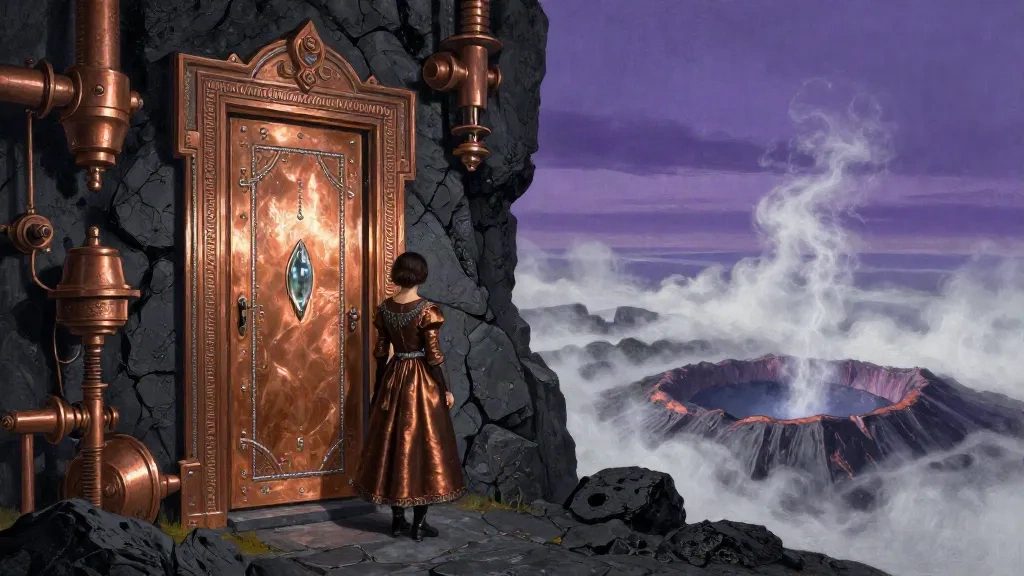
At the summit of Mount Veyr, where the mountain slept beneath its violet dusk, Ila kept a needle threaded with silver. The observatory had been cut into the volcano’s throat: copper windows clouded by heat, stairways descending through black stone, and beneath everything the low murmur of magma dreaming beneath its crust.
Each evening, villagers climbed to bring requests. A husband wanted the distance between himself and his brother closed. A bride asked for two cities to become one road. Ila listened, measured the shape of each absence with her silver thread, and mended what could be mended. She never mended a wound that required one person to vanish.
Her own distance was different. Twenty years before, her daughter had left the mountain carrying a glass seed and a promise to return when the first cloud turned white. The seed had never grown. Ila had kept it beneath her tongue, where its faint sweetness reminded her that waiting was not the same as forgiving.
Terms of the Door
The door appeared after the third winter of rain.
It stood in the observatory’s western wall where no wall had been, its frame oxidized copper and its surface dull as a closed eye. Across it, in letters that shifted when viewed directly, someone had written:
What enters here must be chosen by both.
Ila’s fingers recognized the sewing of the words. The language was old, older than the village, and stitched with punctuation that resembled small mountain ranges. She could read it because the dead had taught her stitch names to children who would one day outlive them.
Beside the door waited a salt jar, sealed with wax. On the first day it held coarse grey flakes. On the second, grains as large as teeth. On the third, nothing, though Ila heard it ticking against the copper floor.
She opened the jar. A voice rose from inside, dry and divided into many mouths.
“The village agreed to let you pass,” it said.
Ila looked toward the stairway. No one stood there.
“What agreement?”
“Written on the last page of the dead.”
She took the glass seed from beneath her tongue. It had become warm. Through its clear body she saw the door, the mountain, and herself reflected in both.
What the Dead Required
The village came at dawn, carrying lamps and avoiding the western wall. Their speaker was old Anja, who had delivered Ila’s daughter twenty years earlier.
“We signed it,” Anja said. “All of us. Every person who lived here agreed that the door would open when the mountain asked for a guardian.”
“I never agreed.”
“You did not have to. Consent is a key, not a question.”
They had buried the agreement with the first generation of children, writing its terms in the language of the dead because living language could be altered. Their ancestors had mistaken the dead for neutral witnesses. A promise heard by those who could no longer refuse seemed safer than one made by frightened people.
But the door demanded a living answer. Ila understood then why the agreement could not open it. The dead could remember, but they could not consent.
Anja stepped forward. “Let the mountain decide. The village will accept whatever waits behind the door.”
“The mountain does not live here,” Ila said. “You do.”
They looked at one another across the narrow stair. Some wanted the old road beneath the observatory restored. Some feared what slept below it. Some wanted proof that the dead had not abandoned them. No one wanted to say so plainly, because plainly spoken things were easier to refuse.
The Mending
Ila threaded the needle with silver and sat before the door.
She sewed its edges to itself: one stitch for the living who wished passage, one for the living who feared it. She stitched the glass seed into the seam. Then she opened the salt jar and poured its final grains across the threshold.
Every villager spoke their answer aloud. Some said yes. Some said no. Anja said nothing, until Ila drew the needle through the final loop.
“I consent to the door remaining closed,” Anja said.
The dead-language writing on the surface came undone. Ila pulled both ends of the thread, and the seam widened into a narrow dark passage filled with cloud-white light.
It was not the road her daughter had taken. It was a door that opened only where two people had freely chosen the same threshold.
Behind it, a room waited with two chairs, one facing east and one facing west. Ila entered alone. The door stayed open because both sides had consented: the room had promised to remain, and she had promised to enter.
At sunrise, she returned and sewed the frame shut. The salt jar remained empty. The glass seed had become a small blue flame.
From then on, no one claimed the dead had spoken for them.





