 Netwrck
Science Fiction.
The Last Reel
The abandoned cinema stood behind the terracotta houses of Bellwether, its roof furred with eucalyptus and its ticket window boarded over. Inside, the seats waited beneath a dust that tasted of rain on warm stone. Mara had inherited the building with her grandmother’s sewing box, a salt jar, and a glass seed no larger than a thumb.
Every night, the cinema showed a future that had almost happened. On a screen above the broken concession stand, people celebrated the opening of a bridge. A child survived the flood. A stranger confessed a murder before committing it. The films ended in bright, silent applause, and then the walls returned to dust.
Mara wanted to build something the futures could not revise: a door that opened only when both sides consented.
Language Below the Screen
Her needles were needles, not spells. Thread passed through two pieces of cloth and made them bear one another. In the projection room, she found strips of film spliced together with words stamped in silver.
“Let the living speak for the dead,” the first strip read.
“Let the dead speak for the living,” the second replied.
The village had sealed its agreement beneath the cinema, where the foundation stones dipped into black water. Mara had never been allowed there. Her grandmother had only warned that Bellwether’s oldest promise was written in a language no living person could read.
At midnight, the screen lit without a projector. A woman in municipal grey stood before the village council, holding a document thick as wet rope.
“The agreement is valid,” the woman said. “Every generation must consent to the same boundary.”
Then she looked directly at Mara.
“Your village has already consented. You alone have not.”
The Dead Grammar
Mara descended into the flooded foundation carrying the glass seed. The water rose to her knees, then her waist. On the wall, marks appeared in the mortar: spirals, blunt crosses, small circles filled with salt. She pressed the seed against them.
The dead did not speak aloud. They translated through objects. A loose brick became a left hand. A bead of rust became refusal. Three drops of water held beneath the ceiling spelled the word NOW.
Mara stitched the village agreement into her coat hem, using thread pulled from the projector. The cloth began to tighten around her ribs. Each stitch made another voice audible beneath the floor.
“We will not be returned,” said the drowned.
“We will not be abandoned,” said the living.
“We will not be mistaken for one another,” said someone else.
The dead grammar required witnesses. Mara understood then that the consent she needed was not permission granted by the past. It was an agreement between everyone who could still suffer the consequences.
A Door That Waited
At dawn, the council gathered around the ruined screen. Some wanted the door to open toward the valley, where their children had been evicted. Some wanted it to open toward the old cemetery. Mara unspooled the agreement across the floor.
“The door is not for crossing,” she said. “It is for meeting.”
They read the marks as best they could. When one man demanded the dead be made to answer, Mara struck the glass seed against the salt jar. The sound was small, but every mark in the foundation trembled.
One by one, the living touched the thread. One by one, the dead answered through the walls, floor, and film. The consent was neither unanimous nor flawless. It was honest.
At last, a narrow door appeared in the screen.
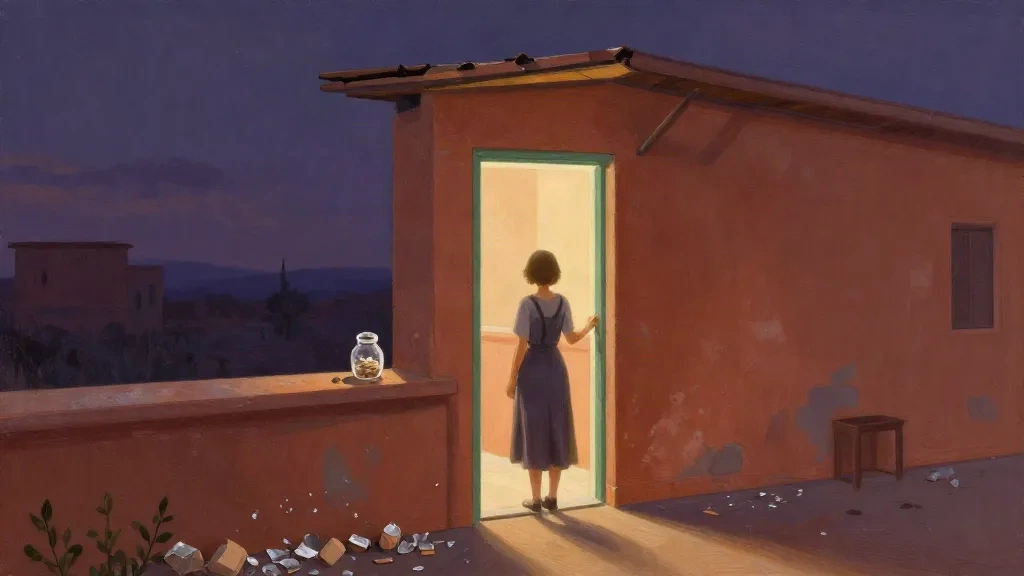
Mara did not open it. She sewed its two edges together, leaving a seam of eucalyptus green between them. Beyond it, possible futures flickered: bridges, burials, reunions, departures. All of them waiting.
For the first time, she understood that a future is not a destination. It is a door whose hinges move only when two people agree to keep it open.
Her grandmother’s salt jar stood on the empty concession counter, bright as a small moon.





