 Netwrck
Hopeful Science Fiction.
The Note Under the Snow
Nia first heard the note in the garden’s eastern greenhouse, where rain tapped the glass roof like impatient fingers. She was tuning her violin when a gardener told her the pear tree had died. The sentence was true. A clear silver sound rose from the floorboards, between two notes she had never found on any chart.
She traced it with her bow. The sound appeared whenever someone spoke honestly: about a broken irrigation pump, a stolen crate of orchids, a daughter in another city. Each truth added a different shade to the garden’s hidden music. Lies produced only wind.
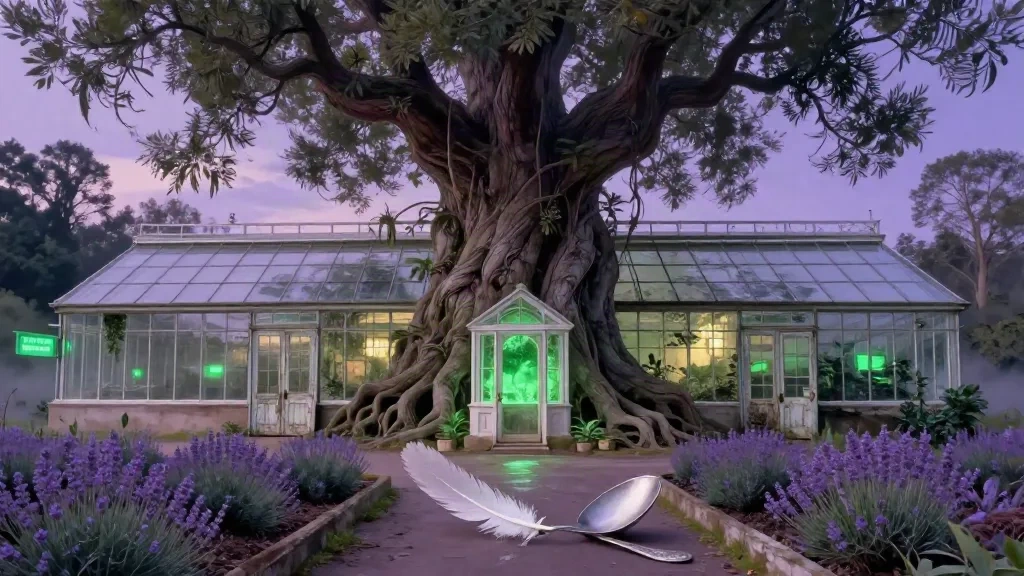
The garden stood around an enormous tree whose bark had the grain of polished doors. In spring, buds opened into brass handles. People entered through them carrying stories, seeds, apologies, and news. The tree accepted what they brought. Nia’s room was beneath its roots, where she slept on a narrow bed and kept her oldest violin in a cedar case.
Her father had built the greenhouse before she was born. He used white ash, greenhouse glass, and a spoon borrowed from the kitchen. He said a building could be a promise with nails.
Nia had no such certainty. When the winter came, it did not melt with the spring. Frost spread from the tree’s upper branches and sealed the ground in a white sheet. Doors that had opened onto distant gardens blew shut. The silver note vanished.
What Winter Taught Her
For twelve years, the storm remained. People rationed firewood, seed, and warm water. They told fewer truths, and the garden grew quiet. Nia played by candlelight, but nothing answered her.
Then a child named Iven brought her a white feather from the roof of the sealed aviary. It was the first living thing she had seen in months. He told her the feather had fallen when the last sparrow tried to leave.
“I miss my brother,” he said.
The note returned: low, warm, and unfinished. Nia held the feather beside her cheek. It smelled of dust and snow.
She began visiting the old service tunnels beneath the greenhouse. There she found her father’s unfinished work: a broad chamber lined with copper pipes, salvaged doorframes, and coils of wire. He had planned a conservatory where people could grow food without the sky. In the corner rested his silver spoon, bent at the handle, and a list of measurements written in a patient hand.
Nia finished the chamber with Iven and the others. They carried soil in baskets. They coaxed mushrooms from the damp walls and built beds beneath salvaged lamps. The white feather became a marker for every promise they kept. The spoon measured fertilizer, seed, and rainwater.
Winter remained outside. Their work became the first green inside.
The Room That Remembered Heat
Years passed, though the calendar did not. Iven’s children learned to play the garden’s truths on three-string instruments. Nia’s hearing grew weaker, but she taught them to listen for the note beneath ordinary speech. The new conservatory filled with basil, onions, and trees planted close together for warmth.
When Nia could no longer climb the ladders, they carried her to the central room. She watched the white feather pinned above the workbench and the silver spoon shining beside the seed ledger. Neither object was powerful. That was why she trusted them.
One morning, a young builder brushed dust from a root and found a door hidden in the bark. It was smaller than the others. When opened, it showed a summer field under a lavender sky. A warm breeze entered carrying wet asphalt, the green glow of a pharmacy sign, and the scent of cut grass.
No one had seen summer in a generation. Nia reached for the doorframe, but the note she heard was her own: a sound rising from the room she had built.
What Outlived the Storyteller
They did not leave. The generation born beneath winter had learned to make warmth from honest labor, so they planted another orchard and taught the children how to repair the door-tree. Nia’s story entered the garden not as a warning, but as a plan.
At dusk, she placed the silver spoon in Iven’s hand and the white feather in his palm. Above them, the hidden doors opened one by one. People emerged carrying seeds from places the storm had sealed away. They bowed to the builders, then knelt beside the beds and began working.
The winter finally broke that night. It did not arrive all at once. Snow withdrew from the gutters, the lamps, the roots, and finally the shoulders of the old woman in the central room. Nia heard one last note, faint but clear, and smiled because it sounded like a beginning.





