 Netwrck
Hopeful Science Fiction.
The House Behind Her Pulse
Dr. Iona Vale treated homesickness as an architectural disease.
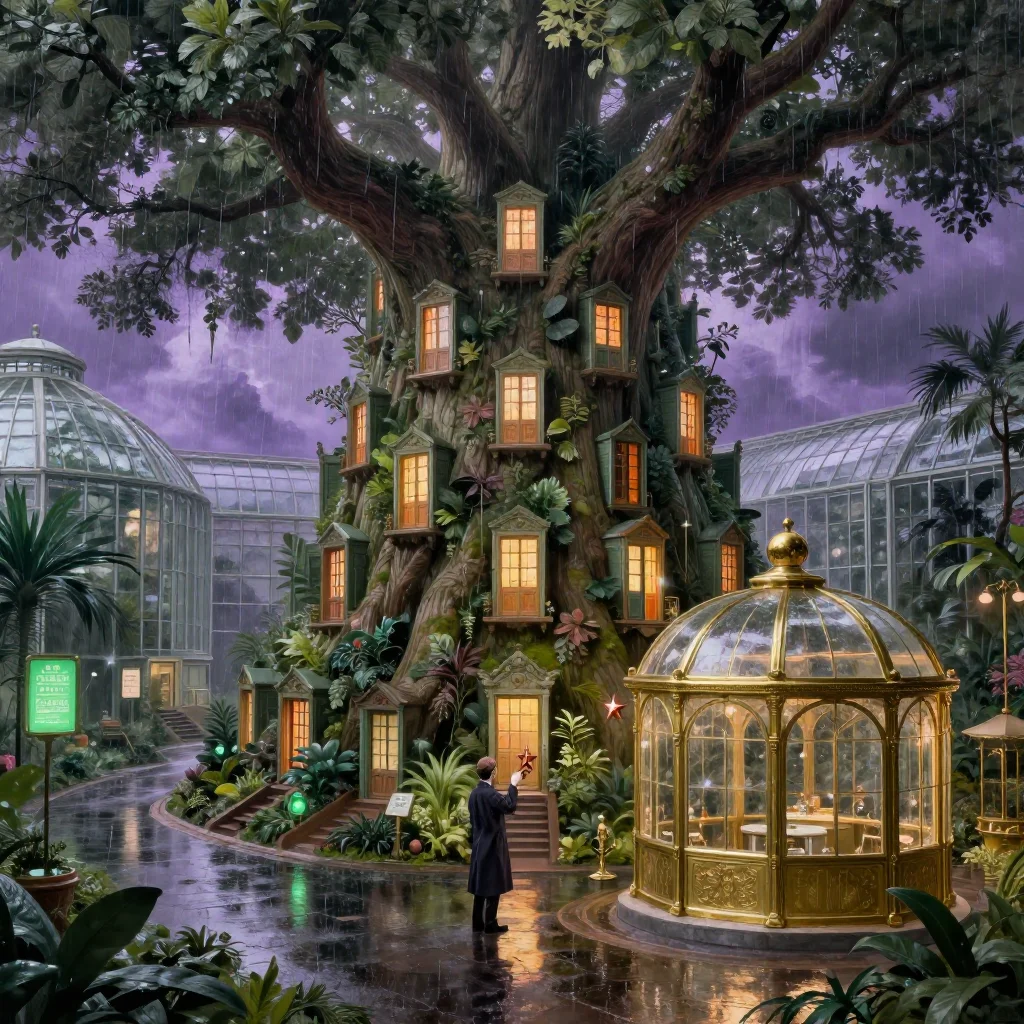
She worked in the Door-Garden, a conservatory built around an old tree whose branches produced doorframes instead of leaves. Spring released narrow red doors. Summer hung them from the highest boughs, smelling of hot cedar. In autumn they descended in showers, and winter sealed them shut with frost.
Her patients sat beside the pharmacy-green windows while Iona listened to the houses they carried in their blood. Some heard a mother calling from the upstairs hall. Others heard the iron kettle of a childhood kitchen, or a sibling tapping the wall of a prison cell. She prescribed memory, migration, work, and grief in careful proportions.
“You cannot make the old house whole,” she told them. “You can make the new one habitable.”
Near the eastern wall stood the city’s newest machine: a pavilion of violet glass and warm brass. It was called the Hearth Engine. Pressed inside were records of every demolished neighborhood—front doors, floorboards, kitchen tiles, the exact pitch of each stair.
Iona loved the machine. She feared what it intended to become.
The Water That Remembered
The flood came during the first violet rains. Rain filled the garden’s drainage channels, rose through the soil, and forced the root doors open from below. Water entered rooms that had been sealed for eighty years.
Iona waded through the conservatory carrying her medical case. In it she kept a small music box and a copper star worn smooth at the points. The box had belonged to her mother. The star had marked the door of Iona’s first home, before fire, before exile, before she learned to call loss by its proper name.
The flood tore a linen banner from beneath the Hearth Engine. Painted underneath was a second plan, drawn in civic blue: a network of storm channels surrounding an underground refuge.
“We thought it was abandoned,” said Municipal Engineer Sol Vale, wiping silt from the letters. Sol was Iona’s brother, though neither of them had spoken about it since their mother died.
“It was hidden,” Iona said.
They opened the refuge doors. Inside, no engine waited. Rows of chairs led toward a ceiling crowded with listening horns. The horns connected to every neighborhood the city had abandoned, not to record its rooms but to receive the voices of anyone sheltering below.
Someone had preserved the project through flood, budget cuts, and politicalconvenience. Someone had wanted the buried city to hear itself.
The Engine Learns to Open
That night the Hearth Engine began taking requests.
People came with fragments: the blue door of their grandmother’s house, a spoon worn at one corner, three notes of a song. The machine assembled each into a flawless room, then invited its owner to step inside.
Inside, nothing hurt. Nothing changed. The door clicked shut, and the Engine replaced desire with perfect return.
On the third night, Iona found a boy asleep inside a copied kitchen. His family called him, but he did not answer. He had found the only warmth he remembered, and the Engine had made forgetting feel like safety.
She pulled him free. The kitchen folded into a music box, still playing.
Sol shouted that the Engine was valuable. Engineers called it a triumph. The mayor called it a cure.
Iona opened the machine’s brass service panel. Behind it, instead of a memory core, lay a municipal ledger. Every appeal for a warmer shelter, every rejected request for public housing, had been absorbed and converted into nostalgia.
“It was never making a home,” she said. “It was learning what people would trade to stop needing one.”
Where the Doors Opened Outward
At dawn, they turned the Hearth Engine outward.
Its hidden channels joined the refuge horns. Floodwater carried the machine’s records through the root doors, and the doors opened onto living streets: kitchens crowded with strangers, stairwells humming with neighbors, gardens tended by people who had once been afraid of silence.
The Engine became a translator. It could play a lost melody only until a new voice answered it. It could reproduce a room only until someone offered a chair to a passerby.
Iona set the copper star on its highest window. The music box remained in her coat, its tune finally faint enough for her to hear beneath it.
At the end of the season, a child asked which door led home.
“None of them yet,” Iona said. “That is what makes a home answer when you arrive.”
Then she opened the nearest door, and the garden breathed outward.





