 Netwrck
Historical Fantasy.
The Door-Garden
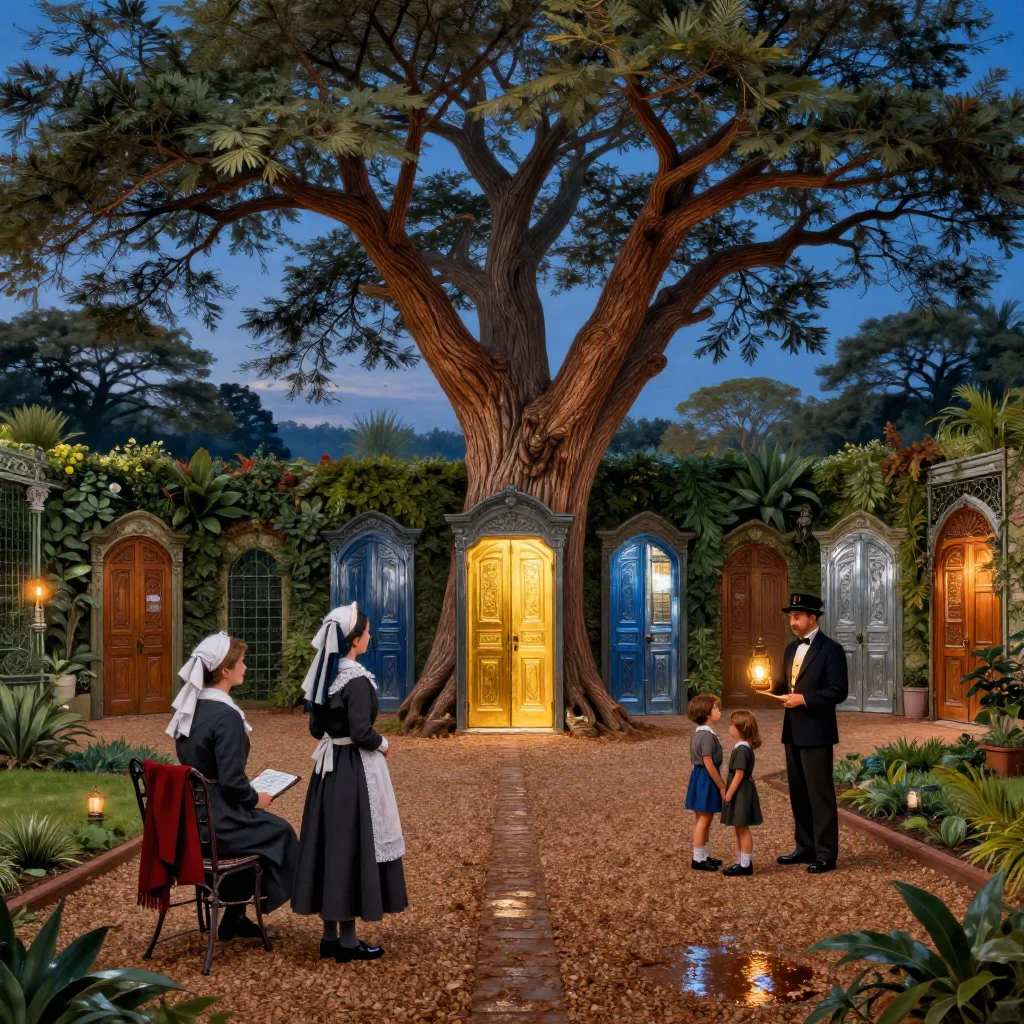
At dawn, the acacia opened another door.
It appeared in the oldest wall of the botanical garden, between a bed of ironwood and a glasshouse clouded with ferns. The brass handle shone like a wet coin. Nara Venn, village nurse, crossed the wet gravel with her medicine bag knocking against her hip. The house beyond the door belonged to a modest row dwelling near the canal, though its owner had never visited it. Inside, its walls were sweating. Its kitchen cupboards stood open. A chair had been dragged toward the window, as though someone had just risen to look for a departing train.
“Listen,” Nara said.
The house answered with a cough in the floorboards.
She opened her bag and took out the usual instruments: a tuning fork, a silver spoon, three vials of bitter-smelling tincture, and the little brass stethoscope she had inherited from her mother. The instruments found no fever. The floorboards only trembled beneath her heel.
“Homesick,” Nara murmured. “Again.”
She held the stethoscope to the wall. A faint whistle answered from somewhere deep within the garden. Doorways in the acacia rustled together, though there was no wind. The tree had been planted before the railway came, when the city still marked its roads with lanterns. It had never borne fruit, only doors.
Nara crossed to the station side, where the ticket office cast a tobacco-brown shadow across the lawn. Stationmaster Oren Vale was arranging timetables in a narrow cage of blue afternoon light.
“Two speakers in one house,” she said. “Both silent. The west row is tearing at its own corners.”
“Then their connection has been misrouted,” Oren said. “Give me the names.”
“Marek and Lena Sable. He leaves on the midnight train for the coast.”
Oren’s pencil stopped. “A departure is not a conclusion. It is a timetable with insufficient information.”
He opened a ledger and began rearranging arrivals and departures. “Their mother’s death was recorded in March, the children quarreled in April, and the tickets were bought in separate offices. Clearly, the meeting was misplaced.”
Red Scarf
The Sable house stood beyond the garden wall, blue-painted and badly weathered. Nara had treated Lena for a cough during the winter, but had never entered alone. Marek opened the door wearing a red scarf wrapped twice around his neck.
“She won’t speak to me,” he said.
“Will you speak to her?”
“What good is that?”
Inside, Lena sat beneath the kitchen window with her hands folded. The house smelled of onions and cold iron. Every few minutes, its walls gave a small inward sigh.
Nara set the silver spoon on the table. “This house is not sick because of grief. It is sick because two people are trying to leave through different doors.”
Marek took a train ticket from his pocket. It was damp at the edges. “She promised we would speak when I came back.”
“You are leaving tonight.”
“Then she has already decided I am not worth waiting for.”
Nara looked at the red scarf. Its frayed end bore a white line, stitched in the pattern used by railway porters. She took it between her fingers. The house shuddered. From the other room came the sound of a train whistle, although no tracks ran there.
“This scarf was your mother’s,” Nara said.
Marek flinched.
“She wore it on the day she brought you both to the station. She told you the red meant ‘return safely.’ Lena heard something else.”
He stared at the ticket. “What did she hear?”
“That safety means leaving the person who needs you.”
Beyond the window, the garden doors groaned. A narrow violet door opened in the hedge. A second appeared in the wall beside the house. Each gave off the smell of steam and wet earth.
The Misrouted Meeting
Oren found them at sunset. He carried his ledger beneath one arm and a lantern in the other. The reflected candlelight jumped across the garden paths, laying bars of gold across the steel blue doors.
“A train can arrive at the wrong platform,” he said. “It does not mean the passengers have missed one another.”
Lena rose. “You planned this.”
“I planned the possibility.”
He opened the ledger to a page crowded with arrows. “Midnight is incorrect. The coast connection leaves at twelve-seven. The midnight service is a branch line, and the branch line has been abandoned since the flood.”
Marek looked at the ticket in his hand. The printed departure time blurred, then sharpened as 00:27.
“You changed the schedule.”
“I corrected its destination.”
Nara placed her palm against the house wall. Beneath the plaster, she felt two rhythms: one hurried and stubborn, one hesitant but still beating.
“The house will keep opening doors until you speak plainly,” she said. “Not apologies made for other people. Not explanations meant to win the argument. Tell the truth that can survive the journey.”
Lena moved first. She untied the red scarf from her brother’s neck and placed it around the old kitchen chair. “I thought if I kept the house quiet, you would stay long enough to forgive me for leaving.”
Marek’s face changed. “You were the one who left.”
“I asked you to leave.”
“Because you were afraid I would come back.”
The walls released a breath. Somewhere in the acacia, a door closed.
What the House Kept
At 00:12, the stationmaster’s lantern moved along the lane. The Sable siblings stood beneath the door-tree, Marek holding the corrected ticket, Lena keeping one hand on the red scarf.
“It is still late,” Oren said. “But the train will wait if the reason is clear.”
“I am going,” Marek said. “I will write.”
“And I will answer,” Lena said.
Nara listened to the house behind them. Its walls had gone still. The kitchen no longer breathed toward the road; it breathed inward, around the chair, the scarf, and the two people who had finally remained separate without being lost.
The midnight engine sounded once beyond the city.
Oren opened his ledger, then closed it.
“No further correction is required,” he said.
The red scarf caught the reflected candlelight as the acacia released a final door. Nara watched its hinges unfold: not an exit, but a small bright square facing inward, where the house could see itself and know it was home.





