 Netwrck
Weird Fiction.
The Hinge Shop
Mara Venn kept her forge beneath the abandoned cinema, in the room where the projectionist had once stored reels. The roof leaked. The bellows worked. Every morning she gathered iron filings from the carpet and hammered them into hinges for doors that had no walls around them.
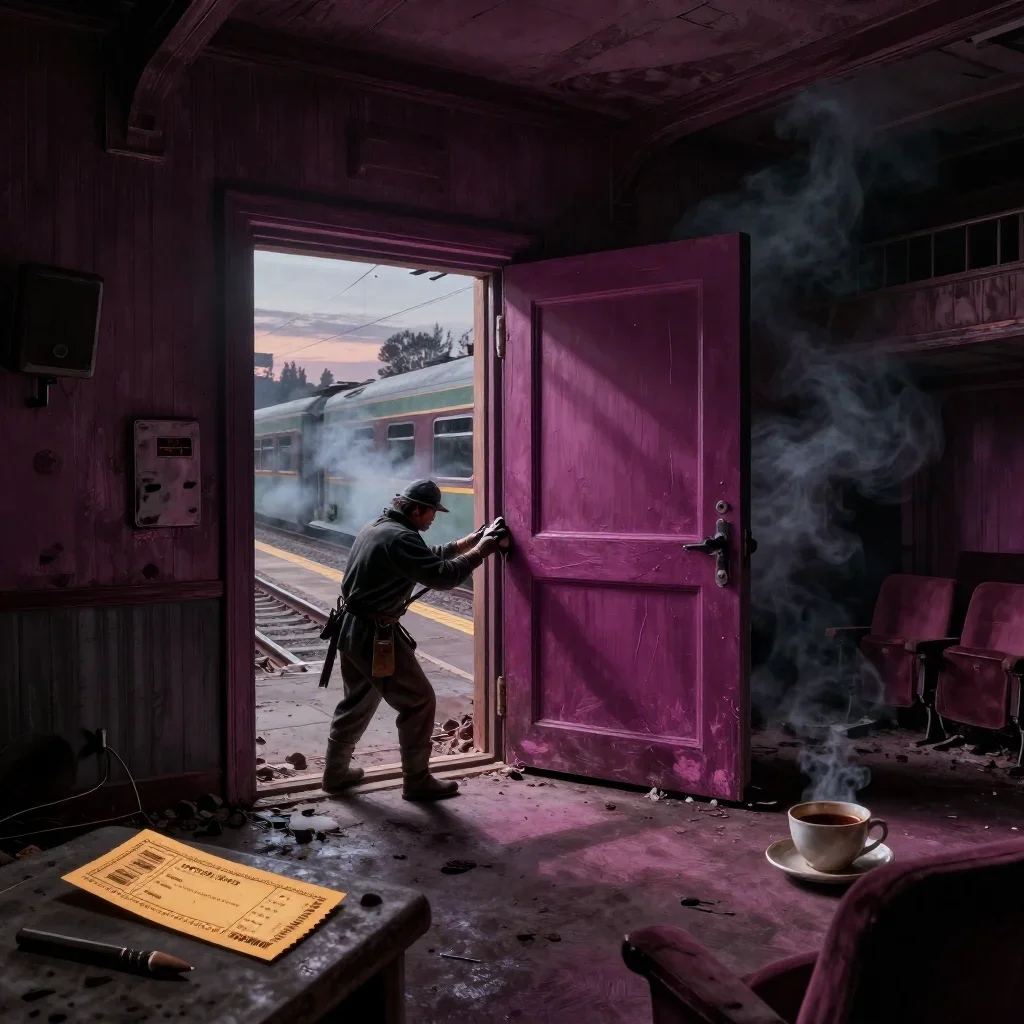
The doors stood in the projection booth, seven or eight at a time, each one enormous and hinged to nothing. Their frames were scarred black around the edges. The brass knobs had been polished by thousands of hands that now existed only in the cinema's faded programmes.
Mara's hands were burned brown. She could tell a door by its weight before she saw it. The heavy ones opened onto cities where the rivers had risen and never returned. The narrow ones opened onto wars that ended before dawn. One, painted the deep plum of a bruise, opened onto a market where everyone had forgotten how to use money.
A train ticket lay on her bench. It was pale saffron, stiff with age, and printed with a departure time of 4:17. Mara had found it beneath the third row of seats. Every day the number changed. Sometimes it advanced by a minute. Sometimes it moved backwards.
Beside the forge sat an empty teacup. It belonged to the cinema's former owner, who had vanished before the last film ended. The cup had no handle and no saucer, only a dark ring inside where tea had once been.
The Future That Owes Nothing
On the night the lights returned, the cinema screened a film titled LOCAL FUTURE, SELECTED AND CERTIFIED. Mara watched from the back row. The image showed her own forge, her own hands, and a sign above the door: PROPERTY OF THE MUNICIPAL CONTINUITY OFFICE.
A woman in a plum coat appeared on screen. She wore a badge shaped like a closed eye.
Every future deserves an ending, she said. Every ending deserves a witness.
The audience applauded. There were perhaps thirty people, all of them waiting for the same revelation. The cinema's owner had returned in the projection booth, thin as a strip of film, smiling at Mara through the glass.
You can repair the hinges, he said, but you cannot choose the room.
He named the power that governed the screenings: the Continuity Office. It supplied films from futures that had nearly happened, then sealed them behind licensing agreements. In exchange, it kept the town supplied with certainty. The office's agents collected alternate histories from closets, drawers, and old bedrooms. They filed away the ones that were inconvenient. Their profit came from the difference between what might have been and what had been allowed to become real.
Mara took the train ticket from her pocket. 4:12.
The empty teacup trembled on the bench.
She had repaired hinges for thirty years, but she had never opened a door. The work had always been enough: oil the mechanism, straighten the pin, persuade the metal to remember its purpose. The desire had begun as a small irritation. A future with an uncertain ending could not be inspected for wear. It might collapse, but it might also become a place worth living.
The Price of a Choice
The Continuity Office sent three inspectors. They carried no weapons. They carried clipboards.
The first asked Mara to sign a statement confirming that the cinema had never displayed a film without approval. The second placed a saffron seal on the projection booth. The third sat in the empty teacup's chair and offered her a ticket to Platform Nine.
The ticket was valid for any future already certified. The inspector tapped its date. Mara saw her own street, drowned in a white flood, and a child standing waist-deep in water, holding a black umbrella.
Keep the hinge shop, the inspector said, and you keep the town. Choose a door tonight, and the Office must open its file.
Mara understood the trap. The cinema could only show futures it possessed. If she opened an uncertified door, the Office would have to acknowledge that the future existed. Then every sealed possibility would become eligible for release.
She struck the nearest hinge with her hammer.
The blow sounded small in the empty auditorium.
The second blow made the screen shiver. The third split the saffron light into strips. The inspectors rushed her, clipboards fluttering like pale wings.
Mara opened the plum door.
Beyond it was a railway platform in smoke-grey air. A train waited without engine or carriages. On the platform stood thousands of people, each holding an empty teacup. They turned toward her with expressions of polite terror.
The train ticket in her hand grew warm. Its time changed to 4:18.
Then the platform began to fill with sound: hammering, bells, arguments, rain on metal, a child asking when the future would arrive. The people lifted their cups, and a dark tea appeared in every one.
What the Door Refused
The inspectors pulled the clipboards against their chests. The plum-coated woman appeared above the platform, enlarged by the smoke, her closed-eye badge shining.
You have no authority to determine an ending,
Mara put the train ticket into the empty teacup.
The paper dissolved into rust. The cup filled with saffron tea.
She turned to the waiting train. Its doors were shut, but there was no locking mechanism. Mara crossed the platform and placed her hammer against the nearest door.
One strike. The hinges answered.
She did not break them open. She repaired them.
Each strike seated the pin, smoothed the iron, removed the rust. The people watched as a future stopped trying to arrive and began, cautiously, to stand.
The plum door slammed shut. The inspectors vanished. The train sounded its horn once, then again.
By morning, the cinema had changed. The projection booth smelled of wet stone. Seven new doors stood where no doors had been, and every hinge was clean.
Mara's ticket lay on the bench, marked for a departure that had not yet been invented. Beside it rested the empty teacup.
She left the tea untouched. An unearned ending, she had decided, should be allowed to remain unfinished long enough for the people inside it to choose what came next.





