 Netwrck
Science Fiction.
The Living Shade
At dusk in Bellwether, the citizens left their shadows at home.
Not literally. Their shadows crossed the terracotta streets without them, slipping beneath awnings, climbing walls, gathering in the eucalyptus gardens to exchange gossip. A child’s shadow waved at a merchant’s shadow. A widow’s shadow carried a basket no living hand could lift. When night fell, the people returned and stepped into their darker doubles, becoming whole for a few hours.
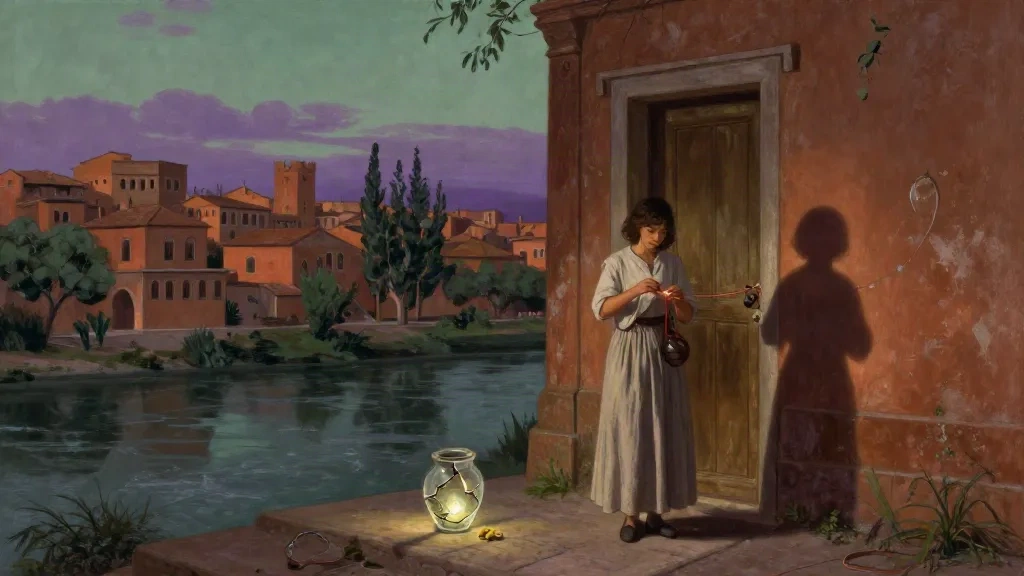
Mara Venn was a seamstress. Her shop stood where three shadows met, beneath a roof the color of old clay. She mended torn hems, split seams, and rents made by the wind. She also mended distances.
Not physical space. The space between two people after an argument, after a betrayal, after a silence so long it had become architecture. She took a stitch of red thread and pulled the hurt edges together. Her customers pretended not to notice when they left holding hands they had entered without.
Mara’s own distance was wide open.
Her brother Tomas had vanished seven years earlier, leaving behind a salt jar with a cracked lid and a glass seed containing a single drop of water. He had promised to return when the city voted on the old boundary agreement. The agreement governed which shadows belonged to which neighborhoods. It also governed who could cross the river after sunset.
When the vote failed, Tomas did not come back.
Words Under the Floor
On the morning the dead treaty began to glow, Mara found a strip of black paper beneath her worktable.
The letters were silver, each one cut from a language she did not know. As she watched, the words rearranged themselves into a map. The river became a black vein. Her shop became a blank square. At its edge stood two doors, one opening inward and one opening outward.
A note in her brother’s handwriting lay beneath the paper: Bring the salt. Bring the seed. Do not bring anyone who cannot read what is written.
At the city archive, the oldest keeper studied the paper and went pale.
“That is the language of the dead,” he said. “Not their speech. Their agreements. The promises they made after their shadows walked away.”
“Can you read it?”
“No.”
“Can the dead?”
He touched the silver letters without looking at them. “They can read anything written after they are gone.”
Mara took the salt jar and the glass seed. At the river, the sky hung low and bruised, purple at the horizon, green-blue overhead. Terracotta roofs glowed beneath it. Eucalyptus leaves turned their pale undersides toward the water.
The black paper showed a third door in the mud.
The First Stitch
The buried door had no handle on either side.
When Mara touched it, the silver writing climbed her arms. She felt every inhabitant of Bellwether as a pressure: the baker and his shadow sharing a kitchen, the mayor’s shadow voting while the mayor slept, Tomas’s shadow standing alone on the far bank.
He was there. The distance had not taken him. It had separated his consent from his body.
Mara drove the glass seed into the keyhole. The drop of water trembled but did not fall.
“Tomas,” she said. “I need you to consent.”
The door remained shut.
She understood then that consent was not a word. It was a shared act. She could mend the distance between herself and her brother, but she could not drag him across it. The treaty demanded that both sides choose the crossing freely.
She cut the salt jar open and poured a white line around the door.
“I choose to open,” she said. “I choose to know what happened. I choose to forgive only if you ask me to forgive.”
The salt hissed. On the far side, something struck the door from within.
Tomas’s voice came through the wood, thin but clear.
“I choose to speak.”
The silver letters blazed. The glass seed split open, and its water became a bead suspended between both handles.
The Distance Closed
The door opened six inches.
Enough to see Tomas’s shadow standing on the other side, younger than the man he had become. He did not enter. He held up the matching half of the salt jar.
“I refused the treaty,” he said. “They made my shadow sign it after I died. The dead can read the agreement, but they cannot break it.”
Mara threaded the red needle. She could not mend this distance with cloth. Instead, she stitched the two shadows together where the door separated them.
The shadows folded. Tomas’s face became visible, then his body.
At midnight, the living citizens returned to claim their shadows. They found the treaty burning in the river, its silver words sinking beneath the water. No neighborhood had voted. No boundary had changed. Yet every citizen stood where they belonged, and for the first time in seven years, the city’s shadows did not move independently.
Mara hung the empty salt jar in her window. Beside it, the glass seed held no water, only a clear room where two people had once chosen to meet.
She left the door open all night.
Consent is the smallest bridge: it holds only when neither side is made to cross alone.





