 Netwrck
Science Fiction.
Under the First Floor
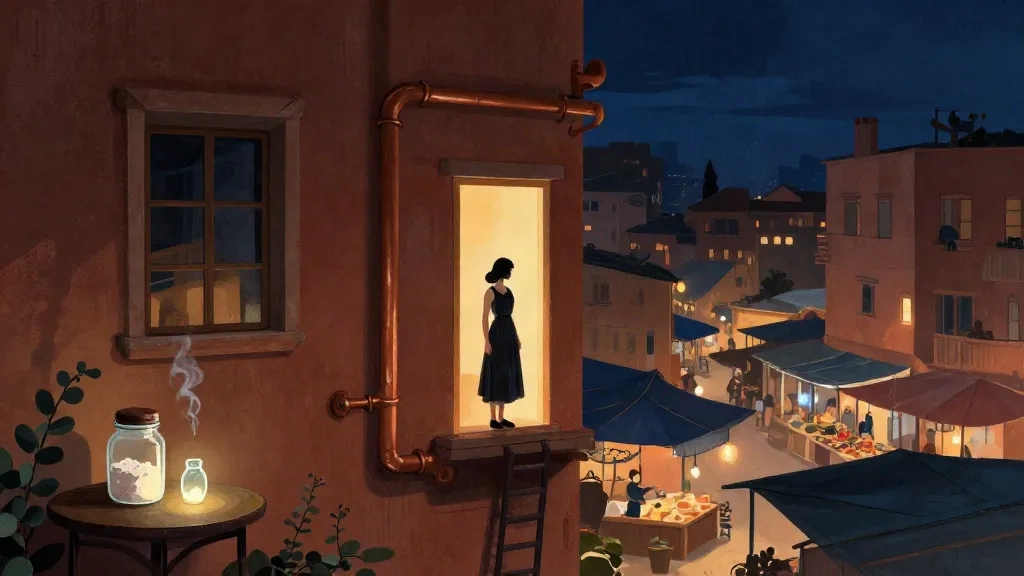
Night opened beneath the city without descending any stair. The market arrived as a warm mineral breath through grates, carrying steam, cardamom, and the smell of wet clay. Above it, towers ended at their first floors, their windows glowing over a chasm of air. No road ran beneath them. The people who traded below did so by ladders, freight lifts, and the patient routes of crows.
At the market's center, Irena stitched.
Her needles passed through two scraps of cloth without joining them. The cloth moved instead, hauling a widow's table closer to her son's chair, making a stalled cart's wheel surrender its rut, pulling a shouting vendor's hands apart before either could strike. A seamstress of distances, the customers said. A mend woman. Irena had inherited the name with the brass thimble.
Her own room lay above the market, three stairs from the highest landing. On its sill stood a salt jar with a blue rim and a glass seed, no larger than a coriander seed.
Every evening, Irena turned the seed beneath the lantern and tried to make a door.
She wanted one that would open only when two people consented. Not a door that let a child escape, or a lover return, or a stranger steal what was hidden in another room. Consent had to be spoken from both sides and heard by the door itself. She had the frame, the hinges, the brass handle. She lacked only the thing that made a threshold honest.
The Agreement in the Wall
When the market's oldest well began whispering, the vendors brought me below it.
They called the place the Reservoir, though no water lived there. Terracotta pipes crossed the brick, and behind them the wall bore a plaque rubbed nearly blank. A dead language had been cut into the stone. Irena could not read it. No living could. The letters changed when daylight touched them, becoming stains, then blankness.
At night, the agreement became visible.
Its first line offered a door to every tenant beneath the city. Its second promised that neither side would enter without the other. Its final line was a list of the dead who had witnessed the signing.
“A door,” said the well-keeper, “for the village that was here before the towers.”
The village had surrendered its ground to the first floor. In return, it had been granted a passage no one could use because no one alive could read the terms. Every tenant, the dead had decided, was invited. Every tenant was also forbidden.
Irena took the glass seed from her pocket and held it to the plaque. Inside it, light gathered like a small blue weather.
“If I can read the consent,” she said, “I can make the hinges obey it.”
The well-keeper gave her the salt jar. The dead had left one beside the plaque, filled with salt so old it had hardened into a white stone. He said it would keep the agreement from changing while she worked.
Two Voices, One Threshold
Irena copied the language onto her sewing cloth. Each letter loosened as she stitched it, but the meanings arrived only at the instant before completion. “May” meant near. “Shall” meant once. “Enter” meant to bring something across.
The dead had not been speaking of rooms.
They had been speaking about the city itself: the life above and the market below, separated by architecture but joined by everything purchased, carried, and owed. A tenant could walk upstairs and leave the city's debts untouched below. A visitor could descend and carry away another neighborhood's memories. The agreement sealed that fracture. The door would permit passage only when both sides named what they were willing to share.
At midnight, the Reservoir filled with market noise. Irena hung the cloth door across the passage between the stalls and the stairwell. Its left edge bore the living market's mud. Its right edge carried dust from the sealed upper city.
The first answer came from below: “I consent to let the night market borrow the city's warmth.”
The second came from above, faint as a nail striking a roof. “I consent to let the city hear the market's debts.”
The door did not open. A black line appeared between the two edges, and the dead language began to burn.
Irena understood then that consent could not be extracted from a crowd. It had to be mutual in the smallest possible scale. She cut the door from its frame and stitched it into two panels, one for the well-keeper and one for the woman who lived in the first-floor room above them.
“What do you consent to share?” Irena asked.
The well-keeper said, “My shadow.” The woman said, “My name.”
When they repeated the words to each other, the two panels met. The black line became a narrow, bright seam. No door was more honest.
The First Crossing
The door did not reveal a street.
It revealed a room suspended between the Reservoir and the city's highest windows. A table stood there, set with two bowls. On the table, the salt jar had turned transparent. The glass seed had split open.
Someone in the dead language had left a final instruction. Not a command, but an offer: the door would work only for those who accepted the burden of the crossing. One memory would pass downward. One promise would pass upward. Neither could be returned.
The well-keeper put his shadow in the left panel. It slid across the threshold and lay at the woman's feet, dark and trembling. She placed her name in the right panel. Letters rose through the room and vanished into the first-floor ceiling.
Then the door opened.
Warm air moved between the two halves of the city. For the first time since the towers were built, something crossed without taking anything by force. Below, vendors stopped bargaining. Above, windows darkened as people leaned toward the stairwell, hearing the market's first shared song.
Irena set the glass seed in the new seam. It remained whole.
The salt jar sat between both thresholds, white as a promise, useless as a lock.
By dawn, the agreement had vanished from the wall. In its place, a small door hung in the brick, wide enough for one person at a time.
It opened whenever two voices met it.





