 Netwrck
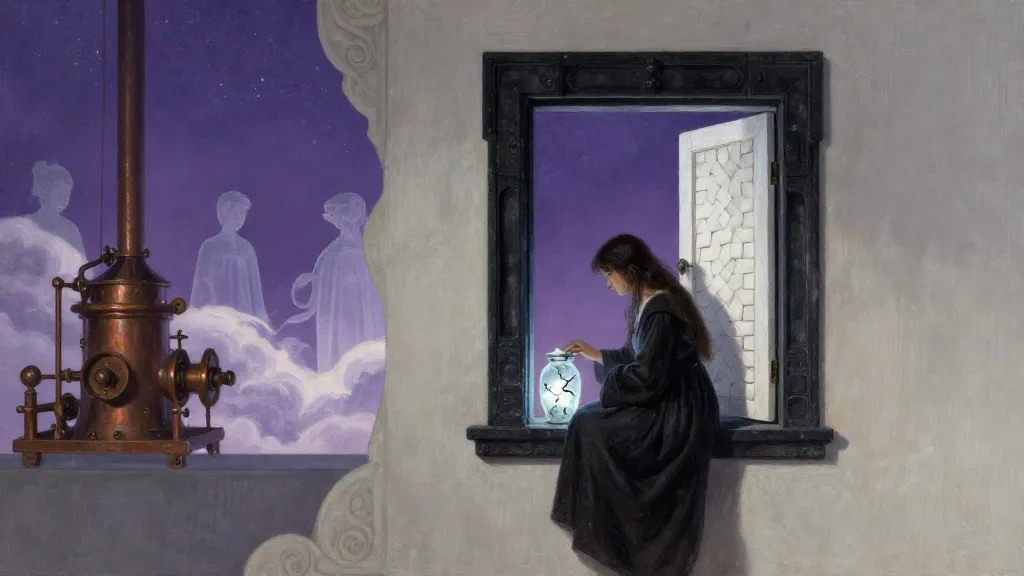
Fantasy.
The Monastery in the Comet
At violet dusk, Sister Orra stitched a seam across the sky.
She worked in the monastery’s eastern chamber, where the comet’s pale inner wall curved like the inside of a shell. Below her feet, the buried chapel trembled with distant bells. Above, through a slit of cloud-white ice, unfamiliar stars appeared and vanished as the monastery turned.
Orra’s needle was made from a splinter of meteor iron. Her thread came from the flax grown in the monastery gardens. With them she could mend a distance: the space between a hand and a face, a grief and its name, a departing traveler and the person waiting at home.
She had been born with the gift. At seven, she had repaired the silence between two children behind the village well. At nineteen, she had sewn her mother’s last words onto the hem of her father’s coat. The dead had remained quiet, but the coat had carried a warmth for three winters.
Her present work sat before her on a frame of oxidized copper. It was a door.
The door had no house behind it. Its hinges were two black stones, its panels woven from cloud-white reeds, and its threshold a thin seam of violet light. Orra wanted it to open only when both sides consented.
“A door is a promise between places,” the abbess had said. “You have been making promises that disobey us.”
Orra drove the needle through the first corner. The thread tightened. A brass key fell from the air and struck the floor.
The Agreement of the Dead
The summons came before the next dusk.
A messenger from the valley below arrived with a salt jar sealed in black wax. The jar was warm. When Orra loosened the wax, a grain of glass emerged, perfectly shaped like a seed.
The village had struck an agreement with the dead during the last meteor storm. The dead could borrow bodies, water, and roads. In return, the living would provide names.
Now the valley had gone silent.
At the village square, twelve people stood facing one another without speaking. Their shadows pointed toward the monastery. On the wall behind them, a document hung from copper nails. Its letters were slender, silver, and motionless.
Orra recognized the language at once. She had seen it on gravestones in the monastery’s oldest cemetery.
Only the dead could read it.
The village elder explained that the agreement bound every descendant to the same choice. A door had opened beneath the square, leading to the place where the ancestors waited. The living were meant to pass through it and bring back the rain.
“The dead wrote the terms,” he said. “They do not require reading. Only obedience.”
Orra examined the paper. One phrase was hidden beneath the seal: When both sides consent, the passage closes.
She understood then that the agreement had been written to prevent a return. The dead intended to keep their visitors.
Back in the monastery, she placed the salt jar beside the glass seed. The salt climbed the jar’s inner wall and formed a small constellation. The seed split open. Inside it lay a shard of clear stone, no larger than a needle.
The abbess entered carrying a lantern. “Do not mend that door.”
“The living are trapped.”
“The dead are afraid.”
Orra held up the shard. “Consent is the missing clause.”
Two Names in One Seam
They descended at cloud-white dawn.
Orra carried the salt jar. The abbess carried the glass seed. The road curved through a field of violet frost, and beneath it, something vast moved with the slow rhythm of a sleeping animal.
At the square, the living waited beside the invisible door. The dead stood behind it, translucent and numerous, their faces like moons seen through water.
One of them stepped forward. He was the village founder, wearing a robe stained with copper.
“We gave you the rain,” he said.
“You gave us a wound,” the elder replied.
Orra knelt at the threshold.
To mend the distance, she had to name both sides without forcing them into agreement. The founder’s people had consented to the passage. The living had consented only to a rain that never came. The dead had mistaken survival for permission.
Orra threaded the needle with the clear shard and stitched the hidden phrase onto the agreement. The silver letters writhed. The dead cried out in a language that shook the ice from the trees.
“Do you consent to open the way?” she asked.
The living answered together, “Only to return.”
“Do you consent to let them return?”
The dead hesitated. Then the founder said, “Yes.”
Orra pulled the thread.
The Distance Closed
The door opened one handspan.
Rain rushed through it, striking the square in cold, bright ropes. The dead did not enter. Instead, they raised their hands and released the names they had borrowed.
The founder spoke one. A mother spoke another. A child called across the crowd, and a man turned toward the voice before the rain had ceased.
The agreement began to burn at its edges, the silver script turning to violet ash. The salt jar cracked. The glass seed shone once, then became ordinary stone.
At last, only the opening remained.
Orra could close it and return to her sewing. Or she could mend the distance permanently, making a threshold that neither living nor dead could cross without mutual agreement.
The abbess watched her. “A door is not safe because it is impossible.”
“No,” Orra said. “It is safe because both sides are seen.”
She stitched the final seam across the threshold.
The door vanished, leaving a pale line in the stone. The villagers gathered around it. No one knelt. No one demanded passage. The line stayed closed because both sides had chosen it so.
That evening, Orra returned to the eastern chamber. The comet carried them through violet dusk toward a darker part of the sky. She placed the ordinary glass seed on the sill beside the empty salt jar.
Some distances should remain open. Others required consent. Between those truths, she began her next seam.





