 Netwrck
Speculative Fiction.
The Needle at the Comet’s End
At the end of the monastery’s eastern nave, where the stone walls opened onto a sky without depth, Sister Anja kept her needles in a case lined with salt. She was a seamstress, though the sisters preferred to say she mended what had come apart. People arrived with torn sleeves, split collars, inherited rifts, and once a man who wanted the crease between his childhood and his present taken out of him.
Anja could mend only distance. A torn cloak might close in a day. A ruined relationship took as long as its oldest silence. She worked with a thread drawn from the edge of one thing and the edge of another, then passed the needle through the space between without pulling it tight.
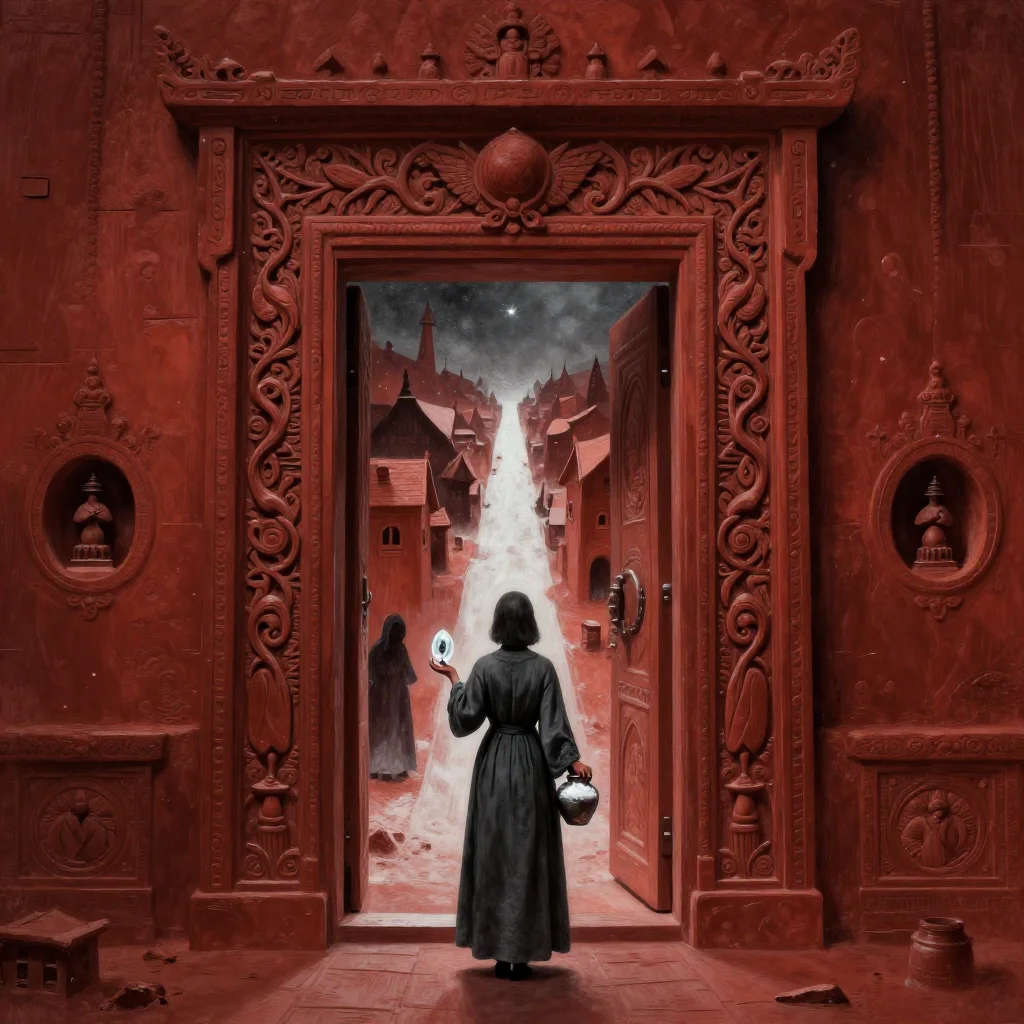
Her desired door had been waiting in the western wall for years. It had no latch, no key, and no hinges that moved. She wanted it to open only when both sides consented.
On the comet’s lower terraces, the village had signed an agreement three generations earlier. The document was kept beneath the monastery in a stone chest, and every dispute arising from it ended there. Anja had been asked to mend the village’s disagreements, but the agreement itself remained unreadable. The letters resembled iron filings pressed into black glass. Sister Veyr claimed the language was known only by the dead.
Anja carried the document upstairs with the salt jar in one hand and a glass seed in the other. The seed had appeared in her pocket after the first snow, clear as a drop of frozen water. Whenever she held it near the agreement, the lines brightened rust red.
What the Dead Required
“They are not giving us the words,” Sister Veyr said. “They are asking whether we remember the promise underneath them.”
Anja laid the page on the floor. The monastery trembled as a fragment of the comet turned beyond the stars. Below, lamps blinked in the village. A bell rang once, then stopped.
She asked the dead to translate. No answer came. Instead, the agreement grew warmer. A name surfaced in the margin: Elian Voss, the boy who had carried salt to the monastery during the winter fever. He had died before the agreement was signed, though every village register placed his signature beneath the final clause.
Anja remembered Elian’s hands. Small, red from cold, always careful with the salt jar. He had told her the dead could not be given a voice. They could only be given a place in a sentence.
She stitched a line across the page. The thread vanished into the paper, then returned carrying a new clause: No passage shall be opened by one will alone.
The village came up the comet path before dawn. They brought torches, ledgers, and the old woman who had signed first. The old woman stood before Anja’s finished door and wept.
Two Hands on the Threshold
“The dead do not read our agreement,” she said. “They read the moment we agreed to let them carry it. We forgot that part.”
Anja understood. The dead had not hidden the language. The living had hidden the meaning. Every generation had preserved the document as proof of peace while denying the consent of those who could no longer testify.
She placed the salt jar in the old woman’s hands. The glass seed rested in her own palm. Together they touched the door. Nothing happened.
The village strained behind them. Someone demanded they pull. Someone else called the dead liars. The old woman closed her fingers around the jar. Anja closed hers around the seed.
The door opened inward, not onto the monastery or the village, but onto a narrow space between them. On one side stood the living, pale winter light striking their faces. On the other stood the dead, rust-red shadows threaded through charcoal stone. Both sides could see the other. Neither could cross.
Anja stitched the consent into the threshold. One stitch for the living. One for the dead. She tied neither knot.
When the old woman nodded, the village did too. The agreement opened along its invisible seam. Names, debts, and refusals separated into their proper columns. The dead received what had been withheld. The living received what they could finally choose.
The Door Remained
By dawn, the comet monastery had a door in its western wall that opened only when both sides agreed. Sometimes it opened a hand’s width. Sometimes it remained sealed for months. No mechanism explained it, and Anja did not pretend otherwise.
She kept the salt jar on her shelf and the glass seed in the seam of her coat. When frightened visitors asked what the door protected, she told them it protected the right to remain apart.
At vesper, she sat beneath the pale winter light and worked a patch over a small tear in her sleeve. The distance between the village and the dead was still there. It would always be there.
But the door no longer forced it wider.





